


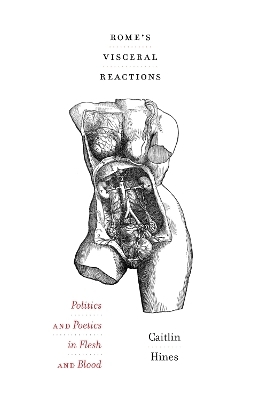
Rome's Visceral Reactions
Politics and Poetics in Flesh and Blood
Seiten
2026
The University of Michigan Press (Verlag)
978-0-472-13366-6 (ISBN)
The University of Michigan Press (Verlag)
978-0-472-13366-6 (ISBN)
- Lieferbar (Termin unbekannt)
- Versandkostenfrei
- Auch auf Rechnung
- Artikel merken
How the word viscera is intrinsic to public discourses around civil war, fertility, and succession in Roman history
In ancient Rome, the Latin word viscera denoted the inner parts of the body, where physical sensations related to fear and anger could be felt and whose injury meant certain death. Viscera were also entangled with religious, political, and reproductive imagery: the word could refer to cuts of sacrificial meat, the inner workings of a governing body, a mother’s fertile womb, and the offspring she has carried. It appears in scientific descriptions of human anatomy, in elaborations of violent deaths, accusations of political conspiracy, and the laments of parents who must watch their children die. The sudden expansions of viscera into vivid metaphors for the body politic, the violated womb, and the desecrated sacrifice materialized in parallel with watershed moments in Roman history, reflecting urgent contemporary anxieties about politics, reproduction, and succession. Rome’s Visceral Reactions traces and interprets the semantic history of viscera, whose progressive acquisition of new meanings offers a compelling case for the dynamic interaction between body metaphor, semantic change, and political crisis at Rome.
Caitlin Hines follows the history of viscera from its earliest attestations through the end of the Julio-Claudian period and considers the works of Lucretius, Cicero, Vergil, Livy, Ovid, Seneca, and Lucan. Applying theories of embodied cognition and semantic change, Hines demonstrates how Roman authors influenced the development of their language through the invention, reception, and affirmation of innovative meanings and how pressing political and cultural crises could shape, and be shaped in return, by the sophisticated linguistic games of the Roman literary elite.
In ancient Rome, the Latin word viscera denoted the inner parts of the body, where physical sensations related to fear and anger could be felt and whose injury meant certain death. Viscera were also entangled with religious, political, and reproductive imagery: the word could refer to cuts of sacrificial meat, the inner workings of a governing body, a mother’s fertile womb, and the offspring she has carried. It appears in scientific descriptions of human anatomy, in elaborations of violent deaths, accusations of political conspiracy, and the laments of parents who must watch their children die. The sudden expansions of viscera into vivid metaphors for the body politic, the violated womb, and the desecrated sacrifice materialized in parallel with watershed moments in Roman history, reflecting urgent contemporary anxieties about politics, reproduction, and succession. Rome’s Visceral Reactions traces and interprets the semantic history of viscera, whose progressive acquisition of new meanings offers a compelling case for the dynamic interaction between body metaphor, semantic change, and political crisis at Rome.
Caitlin Hines follows the history of viscera from its earliest attestations through the end of the Julio-Claudian period and considers the works of Lucretius, Cicero, Vergil, Livy, Ovid, Seneca, and Lucan. Applying theories of embodied cognition and semantic change, Hines demonstrates how Roman authors influenced the development of their language through the invention, reception, and affirmation of innovative meanings and how pressing political and cultural crises could shape, and be shaped in return, by the sophisticated linguistic games of the Roman literary elite.
Caitlin Hines is Assistant Professor of Classics at the University of Cincinnati.
Abbreviations
Acknowledgments
Introduction: Body Metaphor, Semantic Change, and Visceral Reactions
Part 1: Politics
1 Anatomy, Sensation, and Sacrifice
2 Civil Strife and the Body Politic in Cicero, Vergil, and Livy
Part 2: Reproduction
3 Womb Words and Kinship Metaphors
4 Abortion and Domestic Violence in Ovid
5 Civil War and Dynastic Struggle in Ovid
Part 3: Succession
6 Overdetermined Violence and Polluted Sacrifice in Seneca
7 Self-Destructive Devotion and Aberrant Divination in Lucan
Conclusion: Changing Words, Changing Worlds
Bibliography
Indexes
| Erscheinungsdatum | 03.01.2026 |
|---|---|
| Verlagsort | Ann Arbor |
| Sprache | englisch |
| Maße | 152 x 229 mm |
| Themenwelt | Literatur ► Klassiker / Moderne Klassiker |
| Geschichte ► Allgemeine Geschichte ► Vor- und Frühgeschichte | |
| Geisteswissenschaften ► Geschichte ► Regional- / Ländergeschichte | |
| Geisteswissenschaften ► Sprach- / Literaturwissenschaft ► Anglistik / Amerikanistik | |
| Geisteswissenschaften ► Sprach- / Literaturwissenschaft ► Literaturwissenschaft | |
| Sozialwissenschaften ► Ethnologie | |
| Sozialwissenschaften ► Soziologie | |
| ISBN-10 | 0-472-13366-7 / 0472133667 |
| ISBN-13 | 978-0-472-13366-6 / 9780472133666 |
| Zustand | Neuware |
| Informationen gemäß Produktsicherheitsverordnung (GPSR) | |
| Haben Sie eine Frage zum Produkt? |
Mehr entdecken
aus dem Bereich



aus dem Bereich
Konzepte – Methoden – Theorien
Buch | Softcover (2024)
UTB (Verlag)
CHF 55,85
auf den Spuren der frühen Zivilisationen
Buch | Hardcover (2023)
C.H.Beck (Verlag)
CHF 27,95


