


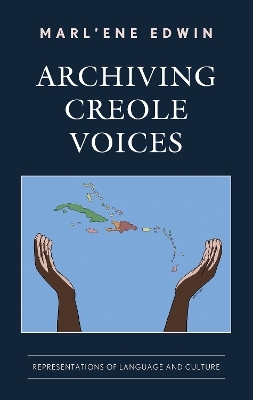
Archiving Creole Voices
Representations of Language and Culture
Seiten
2024
Lexington Books (Verlag)
978-1-6669-5896-6 (ISBN)
Lexington Books (Verlag)
978-1-6669-5896-6 (ISBN)
This book examines the history and construction of the Creole voice in twentieth and twenty-first century Caribbean literature and the archivisation of Caribbean Creoles within the literary text.
Archiving Creole Voices: Representations of Language and Culturebegins with a re-reading of selected texts by female Caribbean writers, specifically, Joan Anim-Addo, Olive Senior and Merle Collins and proclaims that literary fiction can and does function as a ‘creolised archive’. Marl'ene Edwin argues that historic marginalisation, which has barred Caribbean scholars from entering ‘formal’ archival spaces, has created an alternative discourse. Consequently, Caribbean writers have chosen the imagined landscapes of literature, a new archival space for the Caribbean, within which to document and preserve Caribbean cultural traditions. Fiction allows for the safeguarding of traditions, so how then should Caribbean literature be read? The combination of a physical and a virtual archive, questions the literary and linguistic interface that such a mingling entails in a preservation of Caribbean culture. Edwin argues for an appreciation of orality as performance as well as the reading of texts as ‘creolised archive.’
Archiving Creole Voices: Representations of Language and Culturebegins with a re-reading of selected texts by female Caribbean writers, specifically, Joan Anim-Addo, Olive Senior and Merle Collins and proclaims that literary fiction can and does function as a ‘creolised archive’. Marl'ene Edwin argues that historic marginalisation, which has barred Caribbean scholars from entering ‘formal’ archival spaces, has created an alternative discourse. Consequently, Caribbean writers have chosen the imagined landscapes of literature, a new archival space for the Caribbean, within which to document and preserve Caribbean cultural traditions. Fiction allows for the safeguarding of traditions, so how then should Caribbean literature be read? The combination of a physical and a virtual archive, questions the literary and linguistic interface that such a mingling entails in a preservation of Caribbean culture. Edwin argues for an appreciation of orality as performance as well as the reading of texts as ‘creolised archive.’
Marl’ene Edwin is deputy director of the Centre for Caribbean and Diaspora Studies at Goldsmiths, University of London.
Chapter 1: Theoretical Threads
Chapter 2: Imoinda or She-Who: Creolising the Double Archive
Chapter 3: Short Fiction Archiving Voices: Performativity of Madness and the Creole Experience
Chapter 4: Riffing On Orality and Archiving Feelings: Memorialising Her(Story) In Merle Collins’ Angel
Chapter 5: Creole Archiving, Diaspora, and the Academy: Space, Place and Cyberspace
| Erscheinungsdatum | 15.05.2025 |
|---|---|
| Zusatzinfo | 1 Table |
| Sprache | englisch |
| Maße | 152 x 229 mm |
| Themenwelt | Geisteswissenschaften ► Sprach- / Literaturwissenschaft ► Anglistik / Amerikanistik |
| Geisteswissenschaften ► Sprach- / Literaturwissenschaft ► Literaturwissenschaft | |
| Sozialwissenschaften ► Ethnologie | |
| Sozialwissenschaften ► Soziologie | |
| ISBN-10 | 1-6669-5896-4 / 1666958964 |
| ISBN-13 | 978-1-6669-5896-6 / 9781666958966 |
| Zustand | Neuware |
| Informationen gemäß Produktsicherheitsverordnung (GPSR) | |
| Haben Sie eine Frage zum Produkt? |
Mehr entdecken
aus dem Bereich


aus dem Bereich
Poetik eines sozialen Urteils
Buch | Hardcover (2023)
De Gruyter (Verlag)
CHF 83,90


