


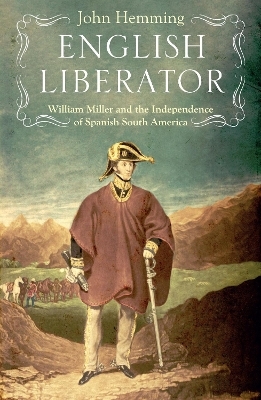
English Liberator
William Miller and the Independence of Spanish South America
Seiten
2025
Haus Publishing (Verlag)
978-1-914979-35-4 (ISBN)
Haus Publishing (Verlag)
978-1-914979-35-4 (ISBN)
English Patriot is the extraordinary story of Henry Miller, a baker's son from Kent who became the only non-Hispanic General in the six-year Spanish American War of Independence. This vivid account of Miller’s life set against the backdrop of hard-fought, anti-colonial battles leading to the independence of Spanish South America
During Admiral Thomas Cochrane’s demolition of imperial Spain’s naval presence in the Pacific during the revolutionary wars for Spanish South America, all the raids were carried out by his marines under a young officer called William Miller. He came from nowhere – one of three sons of a baker in a small village in Kent, with no family influence, money, or even secondary education – but, following his service as a teenaged soldier in Wellington’s Peninsular War, went on to have a meteoric rise in the armies that liberated the nations of Chile and Peru.
Inspired by some South Americans’ wish to leave Spain’s colonial empire, Miller went not to join Simón Bolívar in the north (as did many demobilised European soldiers), but to the south, to José de San Martín in Argentina and Chile. By the time of Ayacucho in 1824, the large battle that ended Spanish rule in South America, there were seven generals in the royalist Spanish army and five on the patriot side. Eleven of these generals were Hispanic; Miller was the only foreigner.
Miller was passionately anti-imperialist, anti-slavery, and unusually kind to ordinary people and peasant farmers due to his own humble origins. He was highly regarded by all the leaders of independence and popular with his men and fellow officers, and when he died decades after the battles in which he made his name he was buried in the Pantheon of founding fathers of Peru. William (or Guillermo, as he is known in South America) Miller is well recognised and loved particularly in modern Peru, but also across the swathe of nations liberated from Spanish rule during this period.
During Admiral Thomas Cochrane’s demolition of imperial Spain’s naval presence in the Pacific during the revolutionary wars for Spanish South America, all the raids were carried out by his marines under a young officer called William Miller. He came from nowhere – one of three sons of a baker in a small village in Kent, with no family influence, money, or even secondary education – but, following his service as a teenaged soldier in Wellington’s Peninsular War, went on to have a meteoric rise in the armies that liberated the nations of Chile and Peru.
Inspired by some South Americans’ wish to leave Spain’s colonial empire, Miller went not to join Simón Bolívar in the north (as did many demobilised European soldiers), but to the south, to José de San Martín in Argentina and Chile. By the time of Ayacucho in 1824, the large battle that ended Spanish rule in South America, there were seven generals in the royalist Spanish army and five on the patriot side. Eleven of these generals were Hispanic; Miller was the only foreigner.
Miller was passionately anti-imperialist, anti-slavery, and unusually kind to ordinary people and peasant farmers due to his own humble origins. He was highly regarded by all the leaders of independence and popular with his men and fellow officers, and when he died decades after the battles in which he made his name he was buried in the Pantheon of founding fathers of Peru. William (or Guillermo, as he is known in South America) Miller is well recognised and loved particularly in modern Peru, but also across the swathe of nations liberated from Spanish rule during this period.
John Hemming is the former Director of the Royal Geographical Society in London. He has travelled in and written extensively about the Amazon region. His previous books include Tree of Rivers: The Story of the Amazon, The Conquest of the Incas and more recently Naturalists in Paradise: Wallace, Bates and Spruce in the Amazon.
Introduction 1
1. Spanish initiation 5
2. Naval heroics 29
3. Special force 75
4. Intermediate ports 119
5. Cavalry 139
6. Ayacucho to Potos. 163
7. Home, to write 191
8. Turbulent Peru 203
9. Hawaii 237
10. Valediction 261
Picture sources 269
Bibliography 271
Notes 279
| Erscheinungsdatum | 27.09.2025 |
|---|---|
| Zusatzinfo | Bibliography; 23 Illustrations, black and white; 3 Maps |
| Verlagsort | London |
| Sprache | englisch |
| Maße | 153 x 234 mm |
| Gewicht | 500 g |
| Themenwelt | Literatur ► Biografien / Erfahrungsberichte |
| Sachbuch/Ratgeber ► Geschichte / Politik | |
| Geschichte ► Teilgebiete der Geschichte ► Militärgeschichte | |
| Sozialwissenschaften ► Politik / Verwaltung | |
| ISBN-10 | 1-914979-35-4 / 1914979354 |
| ISBN-13 | 978-1-914979-35-4 / 9781914979354 |
| Zustand | Neuware |
| Informationen gemäß Produktsicherheitsverordnung (GPSR) | |
| Haben Sie eine Frage zum Produkt? |
Mehr entdecken
aus dem Bereich

aus dem Bereich
von der Wiederbewaffnung bis zur Zeitenwende
Buch | Softcover (2025)
C.H.Beck (Verlag)
CHF 16,80
Deutschlands großer Volksaufstand
Buch | Softcover (2024)
Propyläen Verlag
CHF 30,80


