


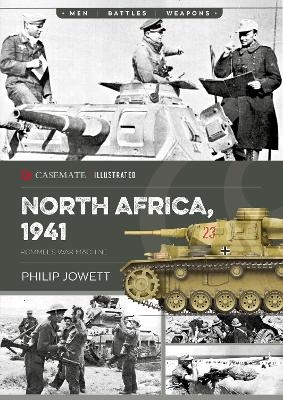
North Africa, 1941
Rommel's War Machine
Seiten
2026
Casemate Publishers (Verlag)
978-1-63624-578-2 (ISBN)
Casemate Publishers (Verlag)
978-1-63624-578-2 (ISBN)
In 1941, Rommel’s Afrika Korps and their Italian allies clashed with British forces in a series of desert battles. Despite limited resources, Rommel outmaneuvered the British, pushing them back into Egypt and besieging Tobruk. This detailed account, featuring maps, artwork, and over 150 photographs, explores the shifting fortunes of the campaign.
As 1941 dawned, the British were mopping up the last Italian strongholds in Libya after seven months of fighting. The outnumbered British Western Desert force of 30,000 men had effectively defeated an Italian force of 250,000. The British had captured hundreds of thousands of Italian soldiers, plus hundreds of tanks and artillery pieces and several thousand valuable trucks, and pushed the Italians out of Egypt and then across the coastline of Libya until they controlled only a small section of western Libya.
In response to this collapse, Adolf Hitler intervened, sending the Afrika Korps under General Erwin Rommel to reinforce Mussolini’s struggling forces. From March to December 1941, German and Italian troops clashed with the British Commonwealth forces in a series of major battles. Despite limited resources, Rommel’s tactical prowess allowed him to outmaneuver the British, launching rapid offensives that pushed them back into western Egypt. The British, determined to protect the Suez Canal, mounted their own counteroffensives—Operations Brevity, Battleaxe, and Crusader—but struggled to gain the upper hand.
A key flashpoint was the port of Tobruk—the only major port in the theater still held by the British. Besieged for much of 1941, its defenders withstood repeated Axis assaults, preventing Rommel from securing a crucial supply hub. By the end of the year, both sides had suffered heavy losses, and the campaign ended in a stalemate, setting the stage for further clashes in 1942.
Featuring over 150 photographs, detailed maps, and artwork, this book provides an in-depth look at the soldiers, strategies, and shifting tides of the 1941 desert war.
As 1941 dawned, the British were mopping up the last Italian strongholds in Libya after seven months of fighting. The outnumbered British Western Desert force of 30,000 men had effectively defeated an Italian force of 250,000. The British had captured hundreds of thousands of Italian soldiers, plus hundreds of tanks and artillery pieces and several thousand valuable trucks, and pushed the Italians out of Egypt and then across the coastline of Libya until they controlled only a small section of western Libya.
In response to this collapse, Adolf Hitler intervened, sending the Afrika Korps under General Erwin Rommel to reinforce Mussolini’s struggling forces. From March to December 1941, German and Italian troops clashed with the British Commonwealth forces in a series of major battles. Despite limited resources, Rommel’s tactical prowess allowed him to outmaneuver the British, launching rapid offensives that pushed them back into western Egypt. The British, determined to protect the Suez Canal, mounted their own counteroffensives—Operations Brevity, Battleaxe, and Crusader—but struggled to gain the upper hand.
A key flashpoint was the port of Tobruk—the only major port in the theater still held by the British. Besieged for much of 1941, its defenders withstood repeated Axis assaults, preventing Rommel from securing a crucial supply hub. By the end of the year, both sides had suffered heavy losses, and the campaign ended in a stalemate, setting the stage for further clashes in 1942.
Featuring over 150 photographs, detailed maps, and artwork, this book provides an in-depth look at the soldiers, strategies, and shifting tides of the 1941 desert war.
Interested in military history from an early age, Philip Jowett has published many books over the last twenty-five years, specialising in the armies of Asia in the first half of the twentieth century, the Russo-Japanese War, and the armies of the Second World War. A rugby league enthusiast and amateur genealogist, he is married and lives in Lincolnshire.
| Erscheinungsdatum | 06.08.2025 |
|---|---|
| Zusatzinfo | 120 photographs and 10 profiles |
| Sprache | englisch |
| Maße | 178 x 254 mm |
| Themenwelt | Geschichte ► Allgemeine Geschichte ► 1918 bis 1945 |
| Geisteswissenschaften ► Geschichte ► Regional- / Ländergeschichte | |
| Geschichte ► Teilgebiete der Geschichte ► Militärgeschichte | |
| ISBN-10 | 1-63624-578-1 / 1636245781 |
| ISBN-13 | 978-1-63624-578-2 / 9781636245782 |
| Zustand | Neuware |
| Informationen gemäß Produktsicherheitsverordnung (GPSR) | |
| Haben Sie eine Frage zum Produkt? |
Mehr entdecken
aus dem Bereich


aus dem Bereich
Deutschland 1933 bis 1945
Buch | Hardcover (2025)
S. Fischer (Verlag)
CHF 47,60
ein Psychologe erlebt das Konzentrationslager
Buch | Hardcover (2024)
Kösel (Verlag)
CHF 30,80


