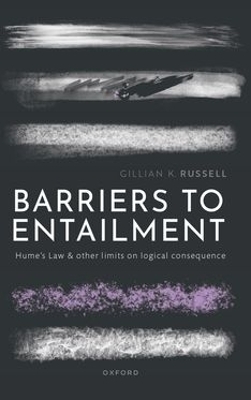
Barriers to Entailment
Oxford University Press (Verlag)
978-0-19-898014-8 (ISBN)
A barrier to entailment exists if you can't get conclusions of a certain kind from premises of another. One of the most famous barriers in philosophy is Hume's Law, which says that you can't get normative conclusions from descriptive premises, or in slogan form: you can't get an ought from an is. This barrier is highly controversial, and many famous counterexamples were proposed in the last century. But there are other barriers which function almost as philosophical platitudes: no Universal conclusions from Particular premises, no Future conclusions from premises about the Past, and no claims that attribute Necessity from premises that merely tell us how things happen to be in the Actual world. Barriers to Entailment proposes a unified logical account of five barriers that have played important roles in philosophy, in the process showing how to diagnose proposed counterexamples and arguing that the case for Hume's Law is as strong as that for the platitudinous barriers.
The first two parts of the book employ techniques from formal logic, but present them in an accessible way, suitable for any reader with some background in first-order model theory (of the kind that might be taught in a first class in logic). Gillian Russell introduces tense, modal, indexical, and deontic formal logics, but always avoids unneeded complexity. Each barrier is connected to broader philosophical topics: universality, time, necessity, context-sensitivity, and normativity. Russell brings out under-recognised connections between the domains and lays the groundwork for further work at the intersections.
The last part of the book transposes the formal work to informal barrier theses in the philosophy of language, in the process doing new work on the concept of logical consequence, and providing new responses to proposed informal counterexamples to Hume's Law which employ hard-to-formalise tools from natural language, such as speech acts and thick normative expressions.
Gillian K, Russell is Professor in philosophy at Australian National University in Canberra. Her PhD is from Princeton University (2004) and in the interim she has been a postdoc at the University of Alberta, Assistant and Associate Professor at Washington University in St Louis, Professor and Alumni Distinguished Professor at UNC Chapel Hill, Professor at the Dianoia Research Institute at ACU Melbourne, and a Professorial Fellow at the Arché Research Center at the University of St Andrews. She mostly works in the philosophy of language and logic, and her previous books include Truth in Virtue of Meaning: A Defence of the Analytic/Synthetic Distinction.
Acknowledgements
Introduction
Part One: Getting Started
1: Survey of counterexamples
2: Universality
3: Time
4: General barrier theorems
5: Modality
Part 2: Getting complex
6: Can, should, will
7: Context-Sensitivity
8: Normativity
9: All the barriers
Part 3: Getting Informal
10: Informal models, informal logic
11: Informal Barriers
Latex Symbol List
Bibliography
Index
| Erscheinungsdatum | 12.08.2025 |
|---|---|
| Verlagsort | Oxford |
| Sprache | englisch |
| Maße | 155 x 235 mm |
| Gewicht | 497 g |
| Themenwelt | Geisteswissenschaften ► Philosophie ► Ethik |
| Geisteswissenschaften ► Philosophie ► Logik | |
| ISBN-10 | 0-19-898014-0 / 0198980140 |
| ISBN-13 | 978-0-19-898014-8 / 9780198980148 |
| Zustand | Neuware |
| Informationen gemäß Produktsicherheitsverordnung (GPSR) | |
| Haben Sie eine Frage zum Produkt? |
aus dem Bereich