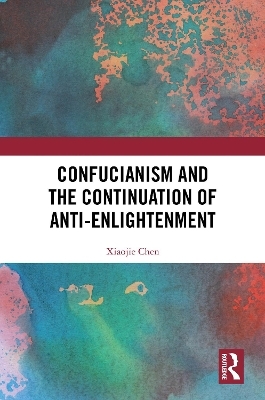
Confucianism and the Continuation of Anti-Enlightenment
Routledge (Verlag)
978-1-041-05111-4 (ISBN)
In 18th-century Europe, before the “Counter-Enlightenment,” two coexisting perspectives emerged within the Enlightenment: the first was the belief that humans were endowed with the capacity to think independently, which led to the possibility of egalitarianism; the second was the restriction of the faculty’s scope of application, which argued that the people must rely on intellectuals as their new shepherds. The latter is “Anti-Enlightenment” and anti-egalitarian.
This book argues that Neo-Confucianism showed these two Enlightenment trends after the 11th century. The imperial examination reform allowed commoners to rise to the bureaucratic elite, thereby achieving top-down “Enlightenment”. Despite the emerging elite’s claims of caring for the people, this benevolence does not expect the people to become self-sufficient adults, which brings up this book’s second theme of comparing French Revolution “Fraternity” with Confucian “Benevolence.”
Taking “Enlightenment” and “Fraternity” as clues, the author analyses the intellectual history in four countries (China, Japan, Germany, and France), revealing not only the inherent “Anti-Enlightenment” mentality within the European Enlightenment, but also the process of “Enlightenment” commenced as early as the 11th century in China.
This book will appeal to scholars of Enlightenment, intellectual history, and comparative study of East-West thought.
Xiaojie Chen is Assistant Professor at the School of Philosophy, Wuhan University. He holds a PhD from Kansai University in Japan and was a visiting scholar at École des hautes études en sciences sociales (EHESS) in France. He mainly researches on Neo-Confucianism, Enlightenment, and French Revolution. He has published one monograph and two translations.
Chapter 1 Enlightenment and Anti-Enlightenment: The Convergence of Chinese Neo-Confucians and 18th- Century European Philosophers Section1 Is 啓蒙(けいもう) (Enlightenment) a mistranslation and a fundamental misunderstanding? Section 2 The Seduction of the Anti-Enlightenment: The “Dual Truth Principle” or the “Pious Fraud” Section 3 Tang-Song Transformation and the Birth of Zhuzi School: Chinese Aufklärung at least 500 years before Europe? Section 4 The End and Repetition of Chinese Aufklärung: “illustrate bright virtue” and “renovate the people” in 20th century Section 5 The continuation and convergence of the Anti-Enlightenment Chapter 2 Benevolence and Fraternité: On the various forms of social intergration Section 1 Fraternity’s Journey: From the West to China via Meiji Japan’s Benevolence Section 2 Fraternité in the early Revolutionary France (1789–1790) Section 3 The Ren as benevolence and the vertical “love” Section 4 Perspectives on Social Intergration
| Erscheinungsdatum | 22.05.2025 |
|---|---|
| Zusatzinfo | 2 Halftones, black and white; 2 Illustrations, black and white |
| Verlagsort | London |
| Sprache | englisch |
| Maße | 156 x 234 mm |
| Gewicht | 490 g |
| Themenwelt | Geisteswissenschaften ► Philosophie ► Östliche Philosophie |
| Geisteswissenschaften ► Philosophie ► Philosophie der Neuzeit | |
| Geisteswissenschaften ► Religion / Theologie ► Weitere Religionen | |
| ISBN-10 | 1-041-05111-5 / 1041051115 |
| ISBN-13 | 978-1-041-05111-4 / 9781041051114 |
| Zustand | Neuware |
| Informationen gemäß Produktsicherheitsverordnung (GPSR) | |
| Haben Sie eine Frage zum Produkt? |
aus dem Bereich