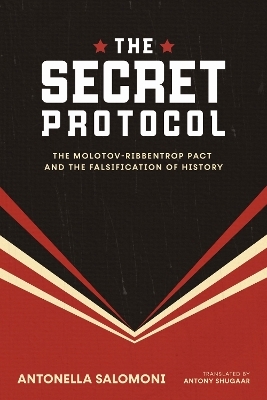
The Secret Protocol
University of Wisconsin Press (Verlag)
978-0-299-35490-9 (ISBN)
- Noch nicht erschienen (ca. Januar 2026)
- Versandkostenfrei
- Auch auf Rechnung
- Artikel merken
From the moment of the secret protocol’s inception—and the near-instantaneous rumors of its existence—it generated friction and competing narratives. The document became public during the Nuremberg trials, but the USSR declared it a fabrication evidencing the West’s willingness to falsify history. It continues to be relevant to the reconfiguration of history currently advanced by Vladimir Putin. By centering the rumors, accusations, and propaganda the pact precipitated, Salomoni illuminates how political actors can use and abuse history, how they create and disseminate truths and falsehoods, and how they can blur the boundary between facts and fictions even in the glaring face of black-and-white documentation.
Antonella Salomoni is a professor of contemporary history in the Department of Political and Social Sciences at the University of Calabria, where she teaches the history of human rights and social services, as well as cultures of peace. She also teaches the history of the Shoah and genocides in the Department of History and Cultures at the University of Bologna. Antony Shugaar is a writer and translator from the Italian and the French. The recipient of two National Endowment for the Arts fellowships, he has been shortlisted for both the PEN and ALTA Italian translation awards. He is the English-language editor of FMR magazine.
Chapter 1: The Pact
Chapter 2: State Secrecy
Chapter 3: The Paradigm of “Falsification”
Chapter 4: Democracy, Transparency, Truth
Chapter 5: Unraveling
Conclusion
Notes
Index
| Erscheint lt. Verlag | 31.1.2026 |
|---|---|
| Übersetzer | Antony Shugaar |
| Verlagsort | Wisconsin |
| Sprache | englisch |
| Maße | 152 x 229 mm |
| Gewicht | 399 g |
| Themenwelt | Geschichte ► Allgemeine Geschichte ► 1918 bis 1945 |
| Geschichte ► Allgemeine Geschichte ► Zeitgeschichte | |
| Geisteswissenschaften ► Geschichte ► Regional- / Ländergeschichte | |
| Geschichte ► Teilgebiete der Geschichte ► Militärgeschichte | |
| ISBN-10 | 0-299-35490-3 / 0299354903 |
| ISBN-13 | 978-0-299-35490-9 / 9780299354909 |
| Zustand | Neuware |
| Informationen gemäß Produktsicherheitsverordnung (GPSR) | |
| Haben Sie eine Frage zum Produkt? |
aus dem Bereich