


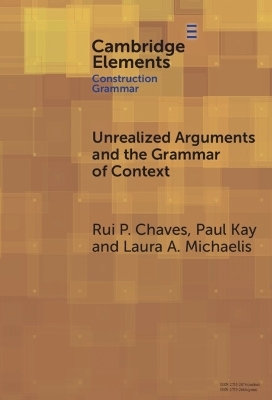
Unrealized Arguments and the Grammar of Context
Seiten
2025
Cambridge University Press (Verlag)
978-1-009-66382-3 (ISBN)
Cambridge University Press (Verlag)
978-1-009-66382-3 (ISBN)
This Element discusses null instantiation (NI) in linguistics, highlighting how unexpressed arguments can receive anaphoric or existential interpretation. It argues that NI potential is influenced by both lexical and constructional factors, not just semantic or pragmatic ones, and provides a lexical treatment using sign-based construction grammar.
In null instantiation (NI) an optionally unexpressed argument receives either anaphoric or existential interpretation. One cannot accurately predict a predicator's NI potential based either on semantic factors (e.g., Aktionsart class of the verb) or pragmatic factors (e.g., relative discourse prominence of arguments), but NI potential, while highly constrained, is not simply lexical idiosyncrasy. It is instead the product of both lexical and constructional licensing. In the latter case, a construction can endow a verb with NI potential that it would not otherwise have. Using representational tools of sign based construction grammar, this Element offers a lexical treatment of English null instantiation that covers both distinct patterns of construal of null-instantiated arguments and the difference between listeme-based and contextually licensed, thus construction-based, null complementation.
In null instantiation (NI) an optionally unexpressed argument receives either anaphoric or existential interpretation. One cannot accurately predict a predicator's NI potential based either on semantic factors (e.g., Aktionsart class of the verb) or pragmatic factors (e.g., relative discourse prominence of arguments), but NI potential, while highly constrained, is not simply lexical idiosyncrasy. It is instead the product of both lexical and constructional licensing. In the latter case, a construction can endow a verb with NI potential that it would not otherwise have. Using representational tools of sign based construction grammar, this Element offers a lexical treatment of English null instantiation that covers both distinct patterns of construal of null-instantiated arguments and the difference between listeme-based and contextually licensed, thus construction-based, null complementation.
1. Introduction; 2. Null instantiation; 3. Formalization; 4. Conclusion; References.
| Erscheinungsdatum | 26.08.2025 |
|---|---|
| Reihe/Serie | Elements in Construction Grammar |
| Zusatzinfo | Worked examples or Exercises |
| Verlagsort | Cambridge |
| Sprache | englisch |
| Gewicht | 500 g |
| Themenwelt | Geisteswissenschaften ► Sprach- / Literaturwissenschaft ► Sprachwissenschaft |
| ISBN-10 | 1-009-66382-8 / 1009663828 |
| ISBN-13 | 978-1-009-66382-3 / 9781009663823 |
| Zustand | Neuware |
| Informationen gemäß Produktsicherheitsverordnung (GPSR) | |
| Haben Sie eine Frage zum Produkt? |
Mehr entdecken
aus dem Bereich


aus dem Bereich
Eine Wiederentdeckung
Buch | Softcover (2025)
Piper (Verlag)
CHF 19,55
Das umfassende Standardwerk auf der Grundlage der aktuellen amtlichen …
Buch | Hardcover (2024)
Duden (Cornelsen Verlag)
CHF 48,95


