


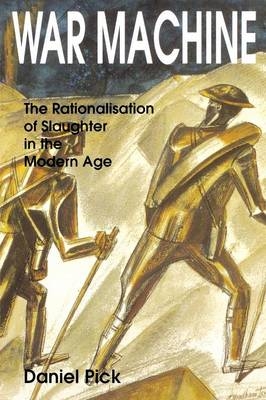
War Machine
The Rationalisation of Slaughter in the Modern Age
Seiten
1996
Yale University Press (Verlag)
9780300067194 (ISBN)
Yale University Press (Verlag)
9780300067194 (ISBN)
- Titel z.Zt. nicht lieferbar
- Versandkostenfrei
- Auch auf Rechnung
- Artikel merken
Examines Western perceptions of war in and beyond the 19th century, surveying the writings of novelists, anthropologists, psychiatrists, poets, natural scientists, journalists and soldiers to trace the origins of modern philosophies about the nature of war and conflict.
This fascinating book examines Western perceptions of war in and beyond the nineteenth century, surveying the writings of novelists, anthropologists, psychiatrists, poets, natural scientists, and journalists to trace the origins of modern philosophies about the nature of war and conflict.
Daniel Pick compares philosophical and historical models of conflict with fictions of invasion and biological speculation about the nature and value of conquest. He discusses the work of such familiar commentators on war as Clausewitz, Engels, and von Bernhardi, and examines little-known writings by Proudhon, De Quincey, Ruskin, Valery, and many others. He explores nineteenth-century English fears of French contamination through the Channel Tunnel and the widespread continuing dread of German domination. And he analyzes the history of the widely-shared European belief that war is beneficial or at least functionally necessary.
A central theme of the book is the disturbing relationship between machinery and destruction. According to Pick, relentless technological progress and the irresistible rise of the military-industrial complex risks turning conflict into little more than a sophisticated game played out by high-precision automata. Shorn of human agency or responsibility, war could become technologically unstoppable, a flawless mechanism for human slaughter.
This fascinating book examines Western perceptions of war in and beyond the nineteenth century, surveying the writings of novelists, anthropologists, psychiatrists, poets, natural scientists, and journalists to trace the origins of modern philosophies about the nature of war and conflict.
Daniel Pick compares philosophical and historical models of conflict with fictions of invasion and biological speculation about the nature and value of conquest. He discusses the work of such familiar commentators on war as Clausewitz, Engels, and von Bernhardi, and examines little-known writings by Proudhon, De Quincey, Ruskin, Valery, and many others. He explores nineteenth-century English fears of French contamination through the Channel Tunnel and the widespread continuing dread of German domination. And he analyzes the history of the widely-shared European belief that war is beneficial or at least functionally necessary.
A central theme of the book is the disturbing relationship between machinery and destruction. According to Pick, relentless technological progress and the irresistible rise of the military-industrial complex risks turning conflict into little more than a sophisticated game played out by high-precision automata. Shorn of human agency or responsibility, war could become technologically unstoppable, a flawless mechanism for human slaughter.
| Erscheint lt. Verlag | 24.4.1996 |
|---|---|
| Zusatzinfo | 11 b-w illus. |
| Sprache | englisch |
| Maße | 159 x 241 mm |
| Gewicht | 426 g |
| Themenwelt | Geisteswissenschaften |
| Sozialwissenschaften ► Politik / Verwaltung | |
| ISBN-13 | 9780300067194 / 9780300067194 |
| Zustand | Neuware |
| Informationen gemäß Produktsicherheitsverordnung (GPSR) | |
| Haben Sie eine Frage zum Produkt? |
Mehr entdecken
aus dem Bereich


aus dem Bereich
Grundzüge eines neoliberalen Raumregimes
Buch | Softcover (2025)
Matthes & Seitz Berlin (Verlag)
CHF 20,95
Grundlagen, Entwicklungen, Positionen
Buch | Hardcover (2023)
wbg Academic (Verlag)
CHF 55,95


