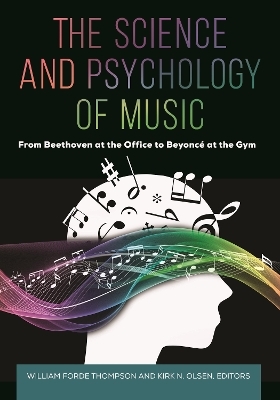
The Science and Psychology of Music
Bloomsbury Academic (Verlag)
979-8-216-20161-8 (ISBN)
Why are some people unable to carry a tune while others are musical savants? What do our musical preferences say about our personality and the culture in which we were raised? Why do certain songs remind us so strongly of particular people, places, or events? How can music be therapeutically used to help those with autism, Parkinson's, and other medical conditions? The Science and Psychology of Music: From Beethoven at the Office to Beyoncé at the Gym answers these and other questions.
This book provides a broad and accessible introduction to the fascinating field of music psychology. Despite its name, music psychology includes a number of fields, including neuroscience, psychology, social psychology, sociology, and health. Through a collection of thematically organized chapters, readers will discover how our brains recognize elements of music, how music can affect us and shape our identities, and the many real-world applications for such information.
William Forde Thompson, PhD, is a Professor in Psychology at Bond University, Australia, and an Emeritus Professor at Macquarie University, Australia. Kirk N. Olsen, PhD, is a Research Centre Manager at the Australian Institute of Health Innovation, Macquarie University, Australia. He is also the Research Manager of the Macquarie University hub of the Music, Sound and Performance Research Group.
Preface
Acknowledgments
Part 1: Understanding Music
What Is Music?
1. Defining Music
2. Sound Waves: The Music inside Sound
3. Pitch, Timbre, and Rhythm
4. Scales, Intervals, and Tuning Systems
Music across Cultures
5. Defining Culture
6. Cross-Cultural Research in Music Psychology
7. Nature versus Nurture
8. Musical Universals
Musical Expertise
9. What Is Musical Expertise?
10. Musical Genius
11. Genetics and Musical Expertise
12. Competitions: Judging Expertise
Musical Prodigies and Savants
13. Becoming a Musical Prodigy: Hard Work or Born That Way?
14. Prodigies in Performance
15. Prodigies in Musical Creativity
16. Musical Savants
Music and the Brain
17. Contemporary Approaches to the Neuroscience of Music
18. Music and the Brain across the Life Span
19. Tone Deafness
20. Music and Language
Part 2: Psychological and Social Implications of Music
Music and Identity
21. Defining Ourselves through Music
22. Music and Cultural Identity
23. Gender Bias in Music History
24. Music and Social Class
Music and Personality
25. Personality and Listeners
26. Personality and Musicians
27. Who Likes Sad Music and Why?
28. Violence and Music
Music and Ritual
29. Maternal Songs as Bonding Rituals
30. Music and Ecstatic States
31. Music and Rites of Passage
32. Music and Death
Music and Belief
33. Religion and Music
34. Music and Lyrics
35. Music and Advertising
36. Music and Healing Rituals
Music and Social Bonding
37. Lullabies
38. Love and Music
39. Intercultural Relations through Music
40. Music as Social Grooming
Part 3: Impact and Applications of Music
Music and Emotion
41. Why Is Music Emotional? Theories of Music and Emotion
42. Contemporary Research on Music and Emotion
43. Music as Emotion Management
44. Music and Emotion across Cultures
Music and Memory
45. What Is Memory for Music?
46. Music and Studying
47. Earworms
48. Music-Evoked Autobiographical Memories (MEAMs)
Music and Movement
49. Movement and Music Performance
50. The Case of Ensemble Performance
51. Music and Dance
52. Why Do People Exercise to Music?
Music and Health
53. Defining Music, Health, and Well-Being
54. Five Healthy Ingredients of Music
55. Music Therapy
56. Music and Healthy Aging
Music Education
57. Music in Schools
58. Music Learning across the Life Span
59. Music in the Community
60. Media and Technology in Music Education
About the Editors and Contributors
Index
| Erscheinungsdatum | 17.07.2025 |
|---|---|
| Zusatzinfo | 33 bw illus |
| Verlagsort | New York |
| Sprache | englisch |
| Maße | 174 x 254 mm |
| Gewicht | 680 g |
| Themenwelt | Kunst / Musik / Theater ► Musik ► Musiktheorie / Musiklehre |
| Geisteswissenschaften ► Psychologie ► Sozialpsychologie | |
| Medizin / Pharmazie ► Physiotherapie / Ergotherapie ► Ergotherapie | |
| ISBN-13 | 979-8-216-20161-8 / 9798216201618 |
| Zustand | Neuware |
| Informationen gemäß Produktsicherheitsverordnung (GPSR) | |
| Haben Sie eine Frage zum Produkt? |
aus dem Bereich