


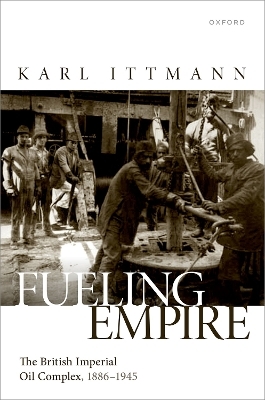
Fuelling Empire
The British Imperial Oil Complex, 1886–1945
Seiten
2025
Oxford University Press (Verlag)
978-0-19-896327-1 (ISBN)
Oxford University Press (Verlag)
978-0-19-896327-1 (ISBN)
The book shifts the focus from company and government offices to working conditions, health and safety, and daily life in imperial oil fields. It also links British efforts to maintain control of oil states before 1945 to their postcolonial histories.
Beginning in the late nineteenth century, British companies used the resources of empire to create an imperial oil industry that controlled 20% of global oil reserves by 1939 and allowed for the movement of capital and labor between regions and companies. The imperial oil complex encompassed colonies-Burma and Trinidad -and dependent states-Iraq and Iraq. In both, the imperial state used its political and military power to support British oil interests. The oil complex drew on the resources of empire but also bolstered it with profits and tax revenues while a global set of oil sites supplied the British military and civilian consumers. British companies built an infrastructure of oil production that gave them quasi-state power in oil regions while connecting these areas to global and imperial networks of communication and transportation.
Fueling Empire highlights the significance of Britain to the development of the global oil industry. It demonstrates the ways in which the global histories of oil and empire are inextricably interlinked. The imperial oil complex relied on a racially stratified hierarchy of labour where white supervisors managed indigenous and migrant workers. The harsh conditions of work and low pay fuelled labour conflicts that resonated with emerging colonial nationalist movements that sought to limit the power of oil companies. Despite robust private and state security operations, the imperial oil complex faced greater insecurity before World War II. While the imperial oil complex survived the war, in the postwar era decolonization and Britain's financial weakness led to its decline.
Beginning in the late nineteenth century, British companies used the resources of empire to create an imperial oil industry that controlled 20% of global oil reserves by 1939 and allowed for the movement of capital and labor between regions and companies. The imperial oil complex encompassed colonies-Burma and Trinidad -and dependent states-Iraq and Iraq. In both, the imperial state used its political and military power to support British oil interests. The oil complex drew on the resources of empire but also bolstered it with profits and tax revenues while a global set of oil sites supplied the British military and civilian consumers. British companies built an infrastructure of oil production that gave them quasi-state power in oil regions while connecting these areas to global and imperial networks of communication and transportation.
Fueling Empire highlights the significance of Britain to the development of the global oil industry. It demonstrates the ways in which the global histories of oil and empire are inextricably interlinked. The imperial oil complex relied on a racially stratified hierarchy of labour where white supervisors managed indigenous and migrant workers. The harsh conditions of work and low pay fuelled labour conflicts that resonated with emerging colonial nationalist movements that sought to limit the power of oil companies. Despite robust private and state security operations, the imperial oil complex faced greater insecurity before World War II. While the imperial oil complex survived the war, in the postwar era decolonization and Britain's financial weakness led to its decline.
Karl Ittmann received his PhD from the University of Pennsylvania. He was a lecturer at Princeton University before joining the faculty at the University of Houston where he is a Professor of History. He is a specialist in modern Britain and its empire with an emphasis on energy, labour, historical demography and social history.
| Erscheinungsdatum | 14.06.2025 |
|---|---|
| Verlagsort | Oxford |
| Sprache | englisch |
| Maße | 160 x 240 mm |
| Gewicht | 657 g |
| Themenwelt | Geschichte ► Allgemeine Geschichte ► Neuzeit (bis 1918) |
| Geisteswissenschaften ► Geschichte ► Regional- / Ländergeschichte | |
| ISBN-10 | 0-19-896327-0 / 0198963270 |
| ISBN-13 | 978-0-19-896327-1 / 9780198963271 |
| Zustand | Neuware |
| Informationen gemäß Produktsicherheitsverordnung (GPSR) | |
| Haben Sie eine Frage zum Produkt? |
Mehr entdecken
aus dem Bereich
aus dem Bereich
Geschichte einer wilden Handlung
Buch | Hardcover (2024)
C.H.Beck (Verlag)
CHF 47,60


