


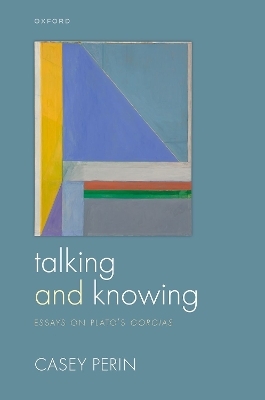
Talking and Knowing
Essays on Plato's Gorgias
Seiten
2025
Oxford University Press (Verlag)
978-0-19-895851-2 (ISBN)
Oxford University Press (Verlag)
978-0-19-895851-2 (ISBN)
Written in clear and engaging prose accessible to anyone with an interest in philosophy, this book offers a series of essays that examine one of Plato's well-loved dialogue, Gorgias. The book discusses all the important philosophical issues that raises, including adiscussion of the ways of reading a Platonic dialogue.
The Gorgias is one of Plato's most important and interesting dialogues. This book consists of a set of independent but interconnected essays on its philosophical riches. Casey Perin devotes two essays to each of the three major episodes within the dialogue: Socrates' successive conversations with first Gorgias, then Polus, and finally Callicles. He begins by examining Gorgias' conception of rhetoric and Socrates criticism of it, including Socrates' notorious refutation of Gorgias. Perin then turns to Socrates' curious claim that orators, like tyrants, have no real power and to the no less curious distinction he draws between wanting to do something and thinking it best to do it. Perin then offers a novel diagnosis of Socrates' failure to refute Polus' claims about the value of injustice and the disvalue of justice.
The most arresting and philosophically engaging character in the dialogue, Callicles, introduces a distinction between natural and conventional norms of justice and shame. Perin offers an extended analysis of that distinction and the difficulties it creates for Callicles, and he compares Callicles' genealogy of conventional norms with Nietzsche's genealogy of Christian morality. Callicles also presents a comprehensive and compelling indictment of philosophy as the organizing activity of an adult life. Perin argues that (perhaps predictably) its force has been underappreciated by philosophers. That indictment is closely aligned with Callicles' distinctive conception of the superior human being. Perin claims that so conceived the superior person is not the crude because indiscriminate satisfier of a maximum number of maximally strong desires, but someone who exemplifies a non-conventional form of discipline and self-control.
The book closes with an extended argument against reading Plato's dialogues with the goal of discovering what he thinks. Instead, Perin suggests, we should read Plato as doing in the dialogues what we do when we read them, namely, engaging in the amorphous and heterogenous activity of philosophical exploration--an activity whose interest, value, and success does not depend on it generating a philosophical view.
The Gorgias is one of Plato's most important and interesting dialogues. This book consists of a set of independent but interconnected essays on its philosophical riches. Casey Perin devotes two essays to each of the three major episodes within the dialogue: Socrates' successive conversations with first Gorgias, then Polus, and finally Callicles. He begins by examining Gorgias' conception of rhetoric and Socrates criticism of it, including Socrates' notorious refutation of Gorgias. Perin then turns to Socrates' curious claim that orators, like tyrants, have no real power and to the no less curious distinction he draws between wanting to do something and thinking it best to do it. Perin then offers a novel diagnosis of Socrates' failure to refute Polus' claims about the value of injustice and the disvalue of justice.
The most arresting and philosophically engaging character in the dialogue, Callicles, introduces a distinction between natural and conventional norms of justice and shame. Perin offers an extended analysis of that distinction and the difficulties it creates for Callicles, and he compares Callicles' genealogy of conventional norms with Nietzsche's genealogy of Christian morality. Callicles also presents a comprehensive and compelling indictment of philosophy as the organizing activity of an adult life. Perin argues that (perhaps predictably) its force has been underappreciated by philosophers. That indictment is closely aligned with Callicles' distinctive conception of the superior human being. Perin claims that so conceived the superior person is not the crude because indiscriminate satisfier of a maximum number of maximally strong desires, but someone who exemplifies a non-conventional form of discipline and self-control.
The book closes with an extended argument against reading Plato's dialogues with the goal of discovering what he thinks. Instead, Perin suggests, we should read Plato as doing in the dialogues what we do when we read them, namely, engaging in the amorphous and heterogenous activity of philosophical exploration--an activity whose interest, value, and success does not depend on it generating a philosophical view.
Casey Perin is Professor of Philosophy at the University of California, Irvine. He is the author of The Demands of Reason: An Essay on Pyrrhonian Scepticism (Oxford, 2010) and articles on Homer, Plato, Aristotle's metaphysics, Stoic epistemology, ancient scepticism, and Descartes.
| Erscheinungsdatum | 25.07.2025 |
|---|---|
| Verlagsort | Oxford |
| Sprache | englisch |
| Maße | 164 x 240 mm |
| Gewicht | 447 g |
| Themenwelt | Geisteswissenschaften ► Philosophie ► Erkenntnistheorie / Wissenschaftstheorie |
| Geisteswissenschaften ► Philosophie ► Philosophie Altertum / Antike | |
| ISBN-10 | 0-19-895851-X / 019895851X |
| ISBN-13 | 978-0-19-895851-2 / 9780198958512 |
| Zustand | Neuware |
| Informationen gemäß Produktsicherheitsverordnung (GPSR) | |
| Haben Sie eine Frage zum Produkt? |
Mehr entdecken
aus dem Bereich


aus dem Bereich
Buch | Softcover (2023)
Reclam, Philipp (Verlag)
CHF 9,80
die Evolution des Geistes
Buch | Softcover (2025)
Suhrkamp (Verlag)
CHF 41,95


