


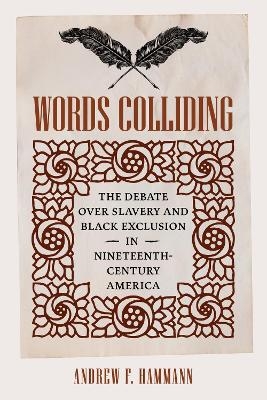
Words Colliding
The Debate Over Slavery and Black Exclusion in Nineteenth-Century America
Seiten
2025
University of Virginia Press (Verlag)
978-0-8139-5368-7 (ISBN)
University of Virginia Press (Verlag)
978-0-8139-5368-7 (ISBN)
The long history and lasting impact of the rhetoric of Black exclusion in American politics and culture
In 1787, Thomas Jefferson declared that the United States was destined to become a nation free of slavery - and of its entire Black population. Following his cue, Henry Clay and other prominent politicians founded the American Colonization Society in 1816, launching the Black expatriation ('colonization') movement, a political force that, over the next eighty years, promoted the removal, with federal support, of the nation's Black population. Throughout this time, Frederick Douglass and the overwhelming majority of Black Americans opposed the colonization movement with great vigor and conviction, characterizing it as one of their greatest enemies, second only to slavery itself.
Words Colliding offers the fullest account to date of this political debate, highlighting its dramatic impact on the national conversations regarding enslavement and Black civil rights. Colonization advocates claimed that centuries of racialized bondage had made civic equality impossible. Black activists vehemently rejected this claim, denying that Black freedom was a national problem and warning that colonization rhetoric encouraged and justified racial oppression, in its varied forms, both during the pre-Civil War decades and the long era of Jim Crow, the afterlives of which persist to this day.
In 1787, Thomas Jefferson declared that the United States was destined to become a nation free of slavery - and of its entire Black population. Following his cue, Henry Clay and other prominent politicians founded the American Colonization Society in 1816, launching the Black expatriation ('colonization') movement, a political force that, over the next eighty years, promoted the removal, with federal support, of the nation's Black population. Throughout this time, Frederick Douglass and the overwhelming majority of Black Americans opposed the colonization movement with great vigor and conviction, characterizing it as one of their greatest enemies, second only to slavery itself.
Words Colliding offers the fullest account to date of this political debate, highlighting its dramatic impact on the national conversations regarding enslavement and Black civil rights. Colonization advocates claimed that centuries of racialized bondage had made civic equality impossible. Black activists vehemently rejected this claim, denying that Black freedom was a national problem and warning that colonization rhetoric encouraged and justified racial oppression, in its varied forms, both during the pre-Civil War decades and the long era of Jim Crow, the afterlives of which persist to this day.
Andrew F. Hammann is a Senior Historian of the New American History initiative at the University of Richmond.
| Erscheinungsdatum | 17.10.2025 |
|---|---|
| Reihe/Serie | A Nation Divided |
| Verlagsort | Charlottesville |
| Sprache | englisch |
| Maße | 152 x 229 mm |
| Themenwelt | Geschichte ► Allgemeine Geschichte ► Neuzeit (bis 1918) |
| Geisteswissenschaften ► Geschichte ► Regional- / Ländergeschichte | |
| Geschichte ► Teilgebiete der Geschichte ► Kulturgeschichte | |
| ISBN-10 | 0-8139-5368-5 / 0813953685 |
| ISBN-13 | 978-0-8139-5368-7 / 9780813953687 |
| Zustand | Neuware |
| Informationen gemäß Produktsicherheitsverordnung (GPSR) | |
| Haben Sie eine Frage zum Produkt? |
Mehr entdecken
aus dem Bereich


aus dem Bereich
Geschichte einer wilden Handlung
Buch | Hardcover (2024)
C.H.Beck (Verlag)
CHF 47,60


