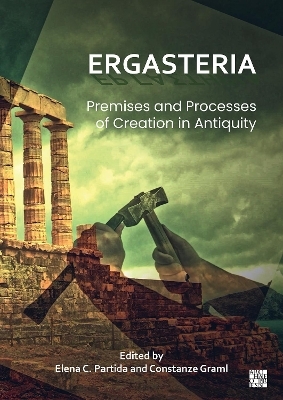
Ergasteria: Premises and Processes of Creation in Antiquity
Archaeopress Archaeology (Verlag)
978-1-80327-825-4 (ISBN)
Ergasteria offers insights into aspects of creation, manufacture and processing in antiquity, viewing craftsmen and artists in their socio-cultural and geopolitical setting. New finds from Greece, North Africa, the Black Sea, Italy and Central Europe provide a trigger for discussion. Bronze foundries for life-size statues were the birthplace of proportions and harmony which imbued the perception of beauty, but could also be a source of nuisance. The mastery of modelling in any material evolved from coping with constraints in the course of manufacture, and craftsmen invented ways of overcoming obstacles. Polyvalent ateliers suggest the artisans’ adaptability, in addition to their specialisation. An investigation of the first step in the process, namely the extraction of material, reveals that quarries were manned with a specialised workforce (stonecutters, sculptors) who carved the marble volumes to an advanced stage, prior to their refinement. Meticulous preparation was also crucial in the field of logistics, particularly in large-scale public works, such as temples or fortifications. Interaction of artists with architects and the workforce in general can be primarily observed in sanctuaries, which became open-air workshops of stonemasons, carpenters etc. Accordingly, part of the book is devoted to construction-sites, the mobility of craftspeople who propelled the diffusion of knowledge, and the range of practices employed in individual settings thereby allowing us to grasp both the diversity of artistic expression and the composite population that it may reflect. The mountainous, littoral, urban or suburban space in which manufacturing took place is also taken into account, along with the socio-historical context, which had an impact upon artisans, as politics and military coalitions could instigate or disrupt a creative process. Cases of adaptive reuse are evaluated from the viewpoint of aesthetics, ergonomics, managerial issues concerning spolia, and the technical skills required. The book benefits from the intersection of the contributors’ perspectives, mirroring the multifaceted nature of the topic.
Elena C. Partida is a Research Archaeologist at the Hellenic Ministry of Culture. She leads interdisciplinary studies on the architecture and sculpture of the Graeco-Roman world with emphasis on ancient Greek sanctuaries, the archaeology of Delphi, Achaea and Paros. Author of museum and open-air exhibitions, she is a member of the Campana Reliefs Network, co-director of the architectural investigation of the Temple of Zeus at Lebadea, and co-editor of the collective volume Listening to the Stones (Archaeopress 2019). Constanze Graml is currently a Lecturer on Classical Archaeology at the universities of Regensburg and Gießen, Germany. Her research interests centre on ancient Greek religion, sacred landscapes and digital archaeology, and she is currently conducting a study on the rock-cut reliefs of Philippi, ancient Macedon. She is a member of the Trochoeides Network on the study of the archaeology of pre-Classical Athens and co-editor of the associated conference proceedings Rethinking Athens before the Persian Wars (2019).
List of Figures
Chapter 1: ΕΡΓΑΣΤΗΡΙΑ: Premises and Processes of Creation in Antiquity. An introduction – Elena C. Partida and Constanze Graml
Α spatial approach to workplaces: Urban, religious, littoral context
Chapter 2: Tales from the workshop and normative beauty – Gerhard Zimmer
Chapter 3: Craft production and nuisance in the ancient Greek city: Spatial and functional approaches to urban industrial activities – Giorgos M. Sanidas
Chapter 4: Dyeworks network around the Gulf of Corinth: A specialised seaside textile workshop in Late Classical-Hellenistic Helike – Dora Katsonopoulou
Chapter 5: Workplaces in the southern sacred area at Olbia Pontica – Alla V. Bujskikh
Chapter 6: Handicraft activities in the small town of Fanum Martis (Famars, northern France): analysing and interpreting spatial organisation and production size – Raphaël Clotuche, Sonja Willems, Jean-Hervé Yvinec, Marie Derreumeaux, Jennifer Clerget, Nicolas Tisserand, Bérangère Fort and Gaëtan Jouanin
Chapter 7: Evocations of Apollo in northern Gaul and craftsmen engaged in his representation: The example of Fanum Martis – Raphaël Clotuche and Damien Censier (with the collaboration of Sabine Groetembril)
Workshops related to quarries and sculpture
Chapter 8: Ancient Greek quarries: installations and workshops – extraction and sculpture techniques – Georgia Kokkorou-Alevras
Chapter 9: New evidence about the exploitation of Nisyrian millstone lava and its use in nisyrian workshops in antiquity – Eirene A. Poupaki
Chapter 10: Heracles rock reliefs at quarries and construction sites in Roman Greece: An interpretative approach – Georgios Doulfis
Chapter 11: Roman calcite alabasters in Tunisia – Ameur Younès
Chapter 12: All about marble carving? In search of craftspeople of polychromy in the ancient Roman sculpture workshop – Amalie Skovmøller
In the ateliers of potters and coroplasts
Chapter 13: The ‘Cracking the Code’ project: Stamna’s pithoi workshops – unveiling pottery heritage – Gioulika Christakopoulou and Helene Simoni
Chapter 14: The coroplast’s workshop and its production: Reflecting on the craft practices of the archaic πλάστης in Magna Graecia – Eukene Bilbao Zubiri
Chapter 15: Localisation, distribution and nature of pottery production of the fourth-century BC ceramic workshops in Ano Petralona, Athens: A synthesis of the available archaeological evidence – Marilena Kontopanagou
Chapter 16: Local knowledgescapes in pottery production: A new heuristic approach to the Iron Age pottery workshops between the Arno Valley and the Po Plain – Raffaella Da Vela
Construction sites, open-air workshops and building workforce
Chapter 17: Athenian architecture abroad in the fifth century: Fashion or imperialism? – Jacques des Courtils
Chapter 18: More on Athenian architecture abroad: Xanthos as a case study – Laurence Cavalier
Chapter 19: Contextualizing the scaffold: Workspace within cult space and the dynamics of construction sites at Delphi – Elena C. Partida
Chapter 20: Building procedures of the fortification at Kastraki on Milesian Agathonisi: Quarrying and construction sites as open-air provisional ergasteria – Konstantinos Sarantidis
Repair, re-use and spolia: Concepts of chaîne operatoire
Chapter 21: Less piety, more pragmatics: Some diachronic observations on the re-use of Greek funerary monuments – Constanze Graml
Chapter 22: The practicalities of spoliation: Tool marks, craftspeople, and building logic – Anna M. Sitz
Chapter 23: Learning by ...? And learning what? Possibilities and limitations of chaîne(s) opératoire(s)-approaches using the example of the Elgin Lyre – Susanne Bosche
Academic apparatus
Abbreviations
Bibliography
Indices
| Erscheinungsdatum | 06.06.2025 |
|---|---|
| Zusatzinfo | 333 figures, 11 tables, 30 plates (colour throughout) |
| Verlagsort | Oxford |
| Sprache | englisch |
| Maße | 205 x 290 mm |
| Gewicht | 1781 g |
| Themenwelt | Geisteswissenschaften ► Archäologie |
| Geschichte ► Allgemeine Geschichte ► Altertum / Antike | |
| ISBN-10 | 1-80327-825-0 / 1803278250 |
| ISBN-13 | 978-1-80327-825-4 / 9781803278254 |
| Zustand | Neuware |
| Informationen gemäß Produktsicherheitsverordnung (GPSR) | |
| Haben Sie eine Frage zum Produkt? |
aus dem Bereich