


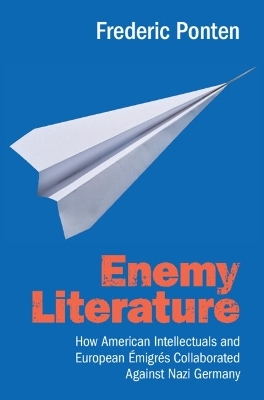
Enemy Literature
How American Intellectuals and European Émigrés Collaborated Against Nazi Germany
Seiten
2025
Cambridge University Press (Verlag)
978-1-009-33538-6 (ISBN)
Cambridge University Press (Verlag)
978-1-009-33538-6 (ISBN)
Readers alarmed by the current resurgence of authoritarianism and fascist movements will learn from the work of those activists who analyzed Nazi Germany during World War II. The book provides pointed introductions to the main intellectual projects, their unique collaborative spirit, and their epochal results.
An entire forgotten corpus of US writing on the Nazi German enemy boomed in a matter of a few years, peaked during World War II, and collapsed within months of the war ending. For a fleeting moment in history, significant parts of the intellectual world in the United States converged to provide a cool-headed analysis of the Nazi threat and a clear identification of the enemy. Starting in 1944, these writers also offered an elaborate plan for a postwar re-education that would transform the National Socialist German nation into a democratic ally. Readers alarmed by the current resurgence of authoritarianism will learn from the work of those activists who analyzed Nazi Germany during World War II. This book, the first monographic study of this literature, provides pointed introductions to the main intellectual projects, their unique collaborative spirit, and their epochal results.
An entire forgotten corpus of US writing on the Nazi German enemy boomed in a matter of a few years, peaked during World War II, and collapsed within months of the war ending. For a fleeting moment in history, significant parts of the intellectual world in the United States converged to provide a cool-headed analysis of the Nazi threat and a clear identification of the enemy. Starting in 1944, these writers also offered an elaborate plan for a postwar re-education that would transform the National Socialist German nation into a democratic ally. Readers alarmed by the current resurgence of authoritarianism will learn from the work of those activists who analyzed Nazi Germany during World War II. This book, the first monographic study of this literature, provides pointed introductions to the main intellectual projects, their unique collaborative spirit, and their epochal results.
Frederic Ponten is Assistant Professor of German studies at the University of Regensburg.
Acknowledgements; List of figures; 1. Introduction: the rise of gray literature; 2. Cool collaboration; 3. The invention of the intelligence report; 4. Applied German folklore; 5. Nazi German media theory; 6. Germany as a conceptual scheme; 7. The identity of the enemy; 8. Epilogue: to whom it may concern; Bibliography; Index.
| Erscheinungsdatum | 25.11.2025 |
|---|---|
| Zusatzinfo | Worked examples or Exercises |
| Verlagsort | Cambridge |
| Sprache | englisch |
| Maße | 152 x 229 mm |
| Gewicht | 574 g |
| Themenwelt | Geschichte ► Allgemeine Geschichte ► Neuzeit (bis 1918) |
| Geschichte ► Allgemeine Geschichte ► 1918 bis 1945 | |
| Geisteswissenschaften ► Geschichte ► Regional- / Ländergeschichte | |
| Geschichte ► Teilgebiete der Geschichte ► Militärgeschichte | |
| ISBN-10 | 1-009-33538-3 / 1009335383 |
| ISBN-13 | 978-1-009-33538-6 / 9781009335386 |
| Zustand | Neuware |
| Informationen gemäß Produktsicherheitsverordnung (GPSR) | |
| Haben Sie eine Frage zum Produkt? |
Mehr entdecken
aus dem Bereich
aus dem Bereich
Geschichte einer wilden Handlung
Buch | Hardcover (2024)
C.H.Beck (Verlag)
CHF 47,60


