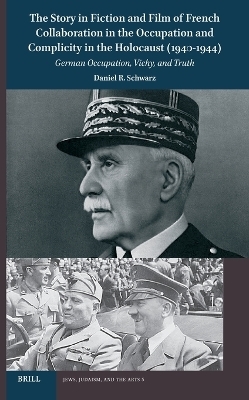
The Story in Fiction and Film of French Collaboration in the Occupation and Complicity in the Holocaust (1940-1944)
Brill (Verlag)
978-90-04-72927-8 (ISBN)
More than anything, what changed the dominant narrative of the Occupation years are documentaries and creative works which imaginatively selected and arranged the presentation of neglected and suppressed facts. By stressing how documentaries, novels, and imaginative films changed the dominant narrative of 1940-1944, the author is also arguing how cultural production transformed history.
Daniel R. Schwarz is the Frederic J. Whiton Professor of English Literature and Stephen H. Weiss Presidential Fellow at Cornell University, where he has taught since 1968. He is a renowned teacher, scholar, and public intellectual. He is the author of nineteen books including Reading Joyce’s Ulysses (St. Martin's Press, 1987), Reconfiguring Modernism: Explorations in the Relationship Between Modern Art and Modern Literature (Palgrave Macmillan, 1997) and Imagining the Holocaust (St. Martin's Griffin, 2000).
Books by Daniel R. Schwarz
Acknowledgements
Introduction: France Awakens from Historical Amnesia
1 France Recognizes Its Active Role in the Holocaust
2 Pompidou Centre Reckons with the Past
3 French Nativism and Anti-Semitism
4 National Amnesia
5 Recent Anti-Semitism in France
6 Dubuffet’s Scathing Anatomy of France
7 Conclusion
1 Remembering Occupied France, Vichy Collaboration, and France’s Role in the Holocaust
1 The Historical Narrative
2 The Holocaust in France
3 Vichy Collaboration and Its Aftermath
4 The Revisionist Post-War Narrative
5 Holocaust Narratives: a Humanistic Approach with Moral Implications
6 The Role of Narrative in Shaping History
7 Taking Account of the Uncanny and Traumatic
8 The Lessons of Camus’s The Plague
9 Conclusion
2 Visualizing the Inexpressible: the Documentary Tradition
1 Introduction
2 Cinematic Rendering of the Holocaust
3 The Importance of Resnais’ Night and Fog (1955)
4 Marcel Ophuls’ The Sorrow and the Pity (1969)
5 Claude Lanzmann’s Shoah (1985)
6 Conclusion
3 Patrick Modiano’s Obsessive Imagination: Reconfiguring the German Occupation of France 1940–1944
1 Introduction
2 Modiano’s Obsession and Repetition Compulsion
3 Post-Memory in Modiano’s The Occupation Trilogy
4 The Author in the Text
5 Constructing Identity: Modiano’s Pedigree—A Memoir and the Search for His Past
6 History and Place in Modiano’s The Occupation Trilogy
7 La Place de l’étoile (1968): Conflating Time and Space in a Surrealistic Narrative
8 The Night Watch (1969); Originally Published as Night Rounds
9 Ring Roads (1974)
10 Conclusion
4 The Importance of W. G. Sebald’s Austerlitz (2001) as a French Holocaust Text: Personal Trauma and Narrative Resistance
1 Introduction
2 Narrative Form in Austerlitz
3 The Role of Photos
4 Multi-Narrativity
5 The German Occupation and the Holocaust in France: How Fiction Reshapes History
6 Austerlitz in Paris
7 The Significance of the New Bibliothèque Nationale
8 Austerlitz’s Failed Intimacy and Trauma in Post-World War II France
9 The Ending of Austerlitz
10 Literary Monumentalism
11 Conclusion
5 How Cinema Responded to the Rise of Nazism and the Holocaust
1 How the Film Industry Addressed the Rise of Nazism: The Great Dictator (1940), Casablanca (1943), and To Be or Not to Be (1942)
2 The Great Dictator (1940)
3 The Influence of Chaplin on French Holocaust Films
4 Casablanca (1942)
5 To Be or Not to Be (1942)
6 The Contribution of American Films to Holocaust Narrative
7 Jean Renoir’s This Land is Mine (1943)
8 The Diary of Anne Frank (1959): Giving the Holocaust a Human Face
9 Judgment at Nuremberg (1961): Revisiting History Through the Prism of Conscience
10 The Pawnbroker (1964): the Trauma Paradigm
11 Schindler’s List (1993): Spielberg’s Epic Imagination
12 Conclusion
6 The First Wave of Imaginative French Films on the German Occupation and the Holocaust
1 Children of Paradise (1945): Filmmaking as an Act of Resistance
2 The Influence of Children of Paradise on Truffaut’s The Last Metro
3 Melville’s Army of Shadows (1969) and His Two Other Occupation Films, Le Silence de la Mer (1949) and Léon Morin, Priest (1961): Rendering the Occupation and Demystifying the Resistance
4 Gillo Pontecorvo’s The Battle of Algiers (1966)
5 Conclusion
7 Visualizing the Inexpressible (II): the Imaginative Tradition in French Occupation and Holocaust Films to 1980
1 The Imaginative Tradition in French Holocaust Films
2 The Focus on French Collaboration
3 The Two of Us (1967)
4 Modiano and Malle’s Lacombe, Lucien (1975): the Path of Collaboration
5 Joseph Losey’s Mr. Klein (1976)
6 Conclusion
8 Visualizing the Inexpressible (III): the Imaginative Tradition in French Occupation and Holocaust Films from 1980
1 François Truffaut’s The Last Metro (1980)
2 Malle’s Au revoir, les enfants (1987)
3 Paquet-Brenner’s Sarah’s Key (2009)
4 Roselyne Bosch’s The Round Up (2010)
5 Conclusion
9 Polyphonic Narrative in “Un village français” (A French Village): Revisiting French History during the German Occupation
1 The Importance of A French Village
2 The Force of History: Themes in A French Village
3 Rendering the Holocaust
4 The Role of the Communists
5 Eulogy for Agrarian Life
6 Humanistic Values
7 The Role of the Catholic Church
8 Beginnings
9 Chaos
10 Episode 2.8: “The Choice” and the Choices Daniel Makes
11 Narrative Strategies and Cinematic Techniques
12 Narrative Resonance
13 Post-modernist Aspects of A French Village
14 Liberation
15 Conclusion
Conclusion: “Who Will Tell [the] Story?” History as Fiction, Fiction as History
1 The Power of Narrative
Works Cited and Selected Bibliography
Index
| Erscheinungsdatum | 24.06.2025 |
|---|---|
| Reihe/Serie | Jews, Judaism, and the Arts |
| Verlagsort | Leiden |
| Sprache | englisch |
| Maße | 155 x 235 mm |
| Gewicht | 538 g |
| Themenwelt | Geschichte ► Allgemeine Geschichte ► 1918 bis 1945 |
| ISBN-10 | 90-04-72927-5 / 9004729275 |
| ISBN-13 | 978-90-04-72927-8 / 9789004729278 |
| Zustand | Neuware |
| Informationen gemäß Produktsicherheitsverordnung (GPSR) | |
| Haben Sie eine Frage zum Produkt? |
aus dem Bereich