


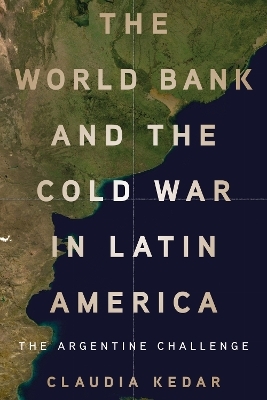
The World Bank and the Cold War in Latin America
The Argentine Challenge
Seiten
2025
|
New edition
Stanford University Press (Verlag)
978-1-5036-4508-0 (ISBN)
Stanford University Press (Verlag)
978-1-5036-4508-0 (ISBN)
Established at the Bretton Woods conference in 1944, the World Bank soon emerged as a central pillar of the postwar order, and the world's leading development institution. This book provides a comprehensive exploration of the World Bank's pivotal role in the Cold War in Latin America through an examination of its interactions with Argentina—one of Latin America's largest economies, and a heavy borrower of the World Bank. In doing so, it unveils the surprisingly complex interplay between the World Bank's bureaucratic goals, US administrations, and Argentina's efforts to serve its own national interests.
Drawing on a multi-archival corpus of primary sources, including newly declassified documents from the World Bank archives, the author examines the Bank's often-counterintuitive responses to major economic and political challenges posed by Argentina, including populism, developmentalism, economic nationalism, authoritarianism, human rights violations, and the "Lost Decade" of the 1980s. Showing how the World Bank ranged from full alignment with US interests to neutrality and subtle dissent, the book reveals the integral influence of the Bank as a Cold War actor. Raising vital questions about the role of international organizations in developing countries, this book reframes our understanding of the economic Cold War in Latin America and beyond.
Drawing on a multi-archival corpus of primary sources, including newly declassified documents from the World Bank archives, the author examines the Bank's often-counterintuitive responses to major economic and political challenges posed by Argentina, including populism, developmentalism, economic nationalism, authoritarianism, human rights violations, and the "Lost Decade" of the 1980s. Showing how the World Bank ranged from full alignment with US interests to neutrality and subtle dissent, the book reveals the integral influence of the Bank as a Cold War actor. Raising vital questions about the role of international organizations in developing countries, this book reframes our understanding of the economic Cold War in Latin America and beyond.
Claudia Kedar is Chair of Spanish, Portuguese, and Latin American Studies at the Hebrew University of Jerusalem. She is the author of The International Monetary Fund and Latin America: The Argentine Puzzle in Context (2013).
| Erscheinungsdatum | 19.11.2025 |
|---|---|
| Zusatzinfo | 4 tables |
| Verlagsort | Palo Alto |
| Sprache | englisch |
| Maße | 152 x 229 mm |
| Themenwelt | Geisteswissenschaften ► Geschichte ► Regional- / Ländergeschichte |
| Wirtschaft ► Volkswirtschaftslehre ► Wirtschaftspolitik | |
| ISBN-10 | 1-5036-4508-8 / 1503645088 |
| ISBN-13 | 978-1-5036-4508-0 / 9781503645080 |
| Zustand | Neuware |
| Informationen gemäß Produktsicherheitsverordnung (GPSR) | |
| Haben Sie eine Frage zum Produkt? |
Mehr entdecken
aus dem Bereich


aus dem Bereich
die Geschichte meiner Urgroßmutter
Buch | Hardcover (2025)
C.H.Beck (Verlag)
CHF 32,15
Träume und Macht : eine Biografie
Buch | Hardcover (2025)
C.H.Beck (Verlag)
CHF 61,60


