


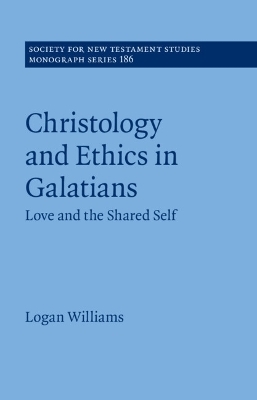
Christology and Ethics in Galatians
Love and the Shared Self
Seiten
2026
Cambridge University Press (Verlag)
978-1-009-37338-8 (ISBN)
Cambridge University Press (Verlag)
978-1-009-37338-8 (ISBN)
- Noch nicht erschienen (ca. Januar 2026)
- Versandkostenfrei
- Auch auf Rechnung
- Artikel merken
In this study, Logan Williams explores Paul's Christology and ethics beyond the egoism-altruism dichotomy. He provides a fresh evaluation Christological material in Paul to show that Paul's ethics do not idealise self-sacrifice but are oriented towards the construction of a relationship of shared selves.
Pauline scholars have misconstrued key features of Paul's portrayal of love by arguing that Paul idealises self-sacrifice and 'altruism'. In antiquity, ideal loving behaviour was intended to construct a relationship of shared selves with shared interests; by contrast, modern ethics has rejected this notion of love and selfhood. In this study, Logan Williams explores Paul's Christology and ethics beyond the egoism-altruism dichotomy. He provides a fresh evaluation of self-giving language in Greek literature and shows that 'gave himself' is not a fixed phrase for self-sacrifice. In Galatians, for example, self-giving languages depict Jesus' love as an act of self-gifting. By re-evaluating the apostle's description of Christ's loving action, Williams demonstrates that Paul portrays Jesus' loving action as his positive participation in the condition of others. He also interrogates the ethics in Galatians and shows that Paul's love-ethics encourage the Galatians not to sacrifice themselves for others but to share themselves with others.
Pauline scholars have misconstrued key features of Paul's portrayal of love by arguing that Paul idealises self-sacrifice and 'altruism'. In antiquity, ideal loving behaviour was intended to construct a relationship of shared selves with shared interests; by contrast, modern ethics has rejected this notion of love and selfhood. In this study, Logan Williams explores Paul's Christology and ethics beyond the egoism-altruism dichotomy. He provides a fresh evaluation of self-giving language in Greek literature and shows that 'gave himself' is not a fixed phrase for self-sacrifice. In Galatians, for example, self-giving languages depict Jesus' love as an act of self-gifting. By re-evaluating the apostle's description of Christ's loving action, Williams demonstrates that Paul portrays Jesus' loving action as his positive participation in the condition of others. He also interrogates the ethics in Galatians and shows that Paul's love-ethics encourage the Galatians not to sacrifice themselves for others but to share themselves with others.
Logan Williams is Kirby Laing Research Fellow in New Testament at University of Aberdeen. He previously was a lecturer at University of Exeter and a postdoctoral fellow at Hebrew University of Jerusalem.
1. Introduction; 2. The self, the other, and the telos of prosocial action: Paul and ethicists ancient and modern; 3. The self-gift of a crucified Messiah; 4. The self-sharing Messiah; 5. Paul's incarnational ethic; 6. Conclusion.
| Erscheint lt. Verlag | 31.1.2026 |
|---|---|
| Reihe/Serie | Society for New Testament Studies Monograph Series |
| Zusatzinfo | Worked examples or Exercises |
| Verlagsort | Cambridge |
| Sprache | englisch |
| Themenwelt | Religion / Theologie ► Christentum ► Kirchengeschichte |
| ISBN-10 | 1-009-37338-2 / 1009373382 |
| ISBN-13 | 978-1-009-37338-8 / 9781009373388 |
| Zustand | Neuware |
| Informationen gemäß Produktsicherheitsverordnung (GPSR) | |
| Haben Sie eine Frage zum Produkt? |
Mehr entdecken
aus dem Bereich


aus dem Bereich
eine andere Geschichte der Papststadt
Buch | Softcover (2024)
C.H.Beck (Verlag)
CHF 25,20
die Macht des Dunklen in unserer Zeit und wie wir ihr entgegentreten
Buch | Hardcover (2025)
Verlag Herder
CHF 27,90


