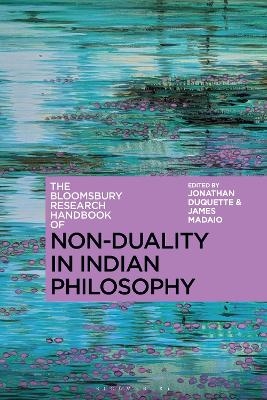
The Bloomsbury Research Handbook of Non-Duality in Indian Philosophy
Bloomsbury Academic (Verlag)
978-1-350-29834-7 (ISBN)
- Noch nicht erschienen (ca. November 2026)
- Versandkostenfrei
- Auch auf Rechnung
- Artikel merken
The concept of non-duality is foundational to various Asian religious and philosophical traditions, finding its most sophisticated and diversified expressions in Indian thought. Focusing on a rich array of premodern Indian texts across multiple languages and traditions, this handbook charts the different articulations, functions and typologies of non-duality for the first time.
Chapters highlight the seminal thinkers who creatively developed or engaged innovatively with an aspect of non-dualistic thought and praxis in their tradition. Written by a team of recognized experts, they cover all major Sanskrit-language religious and philosophical traditions of India—brahmanical, Buddhist, Jain and tantric—and vernacular works. Each contribution introduces critical terms, concepts and definitions used to convey and qualify non-duality, speaking directly to fundamental questions such as what is a key element of non-duality in this philosophical system or religious tradition? What work does it accomplish therein and how?
Weaving together traditions that are often discussed in isolation, it reframes the scholarly approach to non-duality in premodern India and provides a comprehensive treatment of a complex and central issue in Indian philosophy and religion. This is an invaluable and accessible resource for scholars and students alike.
James Madaio is Research Fellow in the Oriental Institute at the Czech Academy of Sciences, Lecturer in the Asian Studies Department at Charles University, Czech Republic, and Fellow at the Oxford Centre for Hindu Studies, UK. He is Associate Editor of the Journal of Hindu Studies and Regional Editor (Indic Traditions) for the Bloomsbury Introductions to World Philosophies. Jonathan Duquette is Affiliated Researcher in the Faculty of Asian and Middle Eastern Studies and Affiliated Lecturer in Sanskrit at the University of Cambridge, UK, and Global Philosophy of Religion Project Postdoctoral Fellow at the University of Birmingham, UK. He is Associate Editor of the Journal of Indian Philosophy.
Introduction
Vedanta traditions
Bhedabheda Vedanta
1. Bhaskara (Aleksandar Uskokov, Yale University, USA)
2. Caitanya (Rembert Lutjeharms, Oxford Centre for Hindu Studies, UK)
3. Vallabha (David Haberman, Indiana University, Bloomington, USA)
Advaita Vedanta
4. Sankara (Jacqueline Suthren Hirst, University of Manchester, UK)
5. Vidyaranya (James Madaio, Czech Academy of Sciences, Czech Republic)
6. Sadananda (Pawel Odyniec, Karlstad University, Sweden)
Visistadvaita Vedanta
7. Pañcaratra (and other Samhitas) (Marion Rastelli, Austrian Academy of Sciences, Austria)
8. Ramanuja (Julius Lipner, University of Cambridge, UK)
9. Venkatanatha (Marcus Schmuecker, Austrian Academy of Sciences, Austria)
Sivadvaita / Saktivisistadvaita Vedanta
10. Srikantha and the Virasaiva Tradition (Jonathan Duquette, University of Cambridge, UK)
Buddhist and Jain traditions
Mahayana
11. Prajñaparamita (Pierre-Julien Harter, University of New Mexico, USA)
12. Tathagatagarbha (Christopher Jones, University of Cambridge, UK)
Yogacara
13. Vasubandhu (Dan Lusthaus, Harvard University, USA)
Madhyamika
14. Nagarjuna (Jan Westeroff, University of Oxford, UK)
Late Indian Buddhism / Tantra
15. Ratnakarasanti (Gregory M. Seton, Dartmouth University, USA)
16. Tattvaratnavali (Torsten Gerloff, University of Hamburg, Germany)
Jainism
17. Anekantavada / Liberated Siddhas (Ana Bajzelj, University of California, Riverside, USA)
Linguistic and narrative traditions
18. Bhartrhari (Marco Ferrante, Austrian Academy of Sciences, Austria)
19. Yogavasistha (Moksopaya) (Sthaneshwar Timalsina, University of San Diego, USA)
Saiva and Sakta traditions
20. Somananda (John Nemec, University of Virginia, USA)
21. Utpaladeva (Yohei Kawajari, Chikushi Jogakuen University, Japan)
22. Abhinavagupta (Mrinal Kaul, Manipal University, India)
23. Srividya (Silvia Schwartz, Leipzig University, Germany)
Vernacular traditions
24. Jñanesvara (Marathi) (Madhav Deshpande, University of Michigan, USA)
25. Kabir (Old Hindi) (Linda Hess, Stanford University, USA)
26. Guru Nanak (Arvind-Pal Mandair, University of Michigan, USA)
27. Tattvarayar (Tamil Advaita) (Eric Steinschneider, Ithaca College, USA)
28. Nepalese Traditions (Diwakar Acharya, University of Oxford, UK)
Bibliography
Index
| Erscheint lt. Verlag | 12.11.2026 |
|---|---|
| Reihe/Serie | Bloomsbury Research Handbooks in Asian Philosophy |
| Verlagsort | London |
| Sprache | englisch |
| Maße | 156 x 234 mm |
| Themenwelt | Geisteswissenschaften ► Philosophie ► Östliche Philosophie |
| Geisteswissenschaften ► Religion / Theologie ► Hinduismus | |
| ISBN-10 | 1-350-29834-4 / 1350298344 |
| ISBN-13 | 978-1-350-29834-7 / 9781350298347 |
| Zustand | Neuware |
| Informationen gemäß Produktsicherheitsverordnung (GPSR) | |
| Haben Sie eine Frage zum Produkt? |
aus dem Bereich