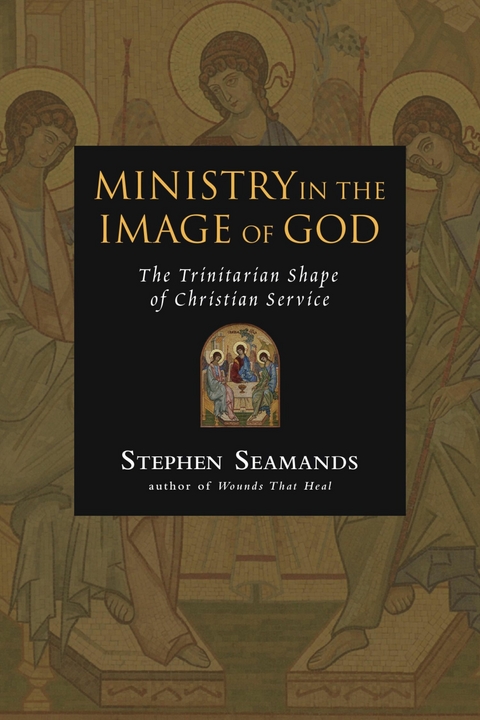
Ministry in the Image of God (eBook)
189 Seiten
IVP (Verlag)
978-1-5140-1464-6 (ISBN)
Stephen Seamands (PhD, Drew University) is professor of Christian doctrine at Asbury Theological Seminary in Wilmore, Kentucky. He also frequently speaks and leads retreats and seminars on such issues as emotional healing and spiritual renewal. His books include Christology and Transition in the Theology of Edwin Lewis (University Press of America, 1987), Holiness of Heart and Life (Abingdon, 1990), A Conversation with Jesus (Victor, 1994) and Wounds That Heal (InterVarsity Press, 2003).
Stephen Seamands (PhD, Drew University) is professor of Christian doctrine at Asbury Theological Seminary in Wilmore, Kentucky. He also frequently speaks and leads retreats and seminars on such issues as emotional healing and spiritual renewal. His books include Christology and Transition in the Theology of Edwin Lewis (University Press of America, 1987), Holiness of Heart and Life (Abingdon, 1990), A Conversation with Jesus (Victor, 1994) and Wounds That Heal (InterVarsity Press, 2003).
Two
Relational Personhood
The Nature of Trinitarian Ministry
Because God is personal and not impersonal,
God exists as the mystery of persons in communion.
CATHERINE MOWRY LACUGNA
After twenty-five years as a psychotherapist, professor, director of a counseling institute and author of bestselling books, Larry Crabb was a distinguished, respected leader in the field of Christian counseling. But in the mid-1990s, he shocked many of his colleagues when he openly questioned the value of much Christian psychotherapy and dared to suggest that the Christian counseling industry be dismantled. “You’re committing professional suicide,” a close friend warned him, yet Crabb continued speaking out.
In 1997 his groundbreaking book Connecting was published. In the introduction, Crabb boldly offered his prescription for healing soul wounds:
We must do something other than train professional experts to fix damaged psyches. Damaged psyches aren’t the problem. The problem beneath our struggles is a disconnected soul. And we must do something more than exhort people to do what’s right and then hold them accountable. Groups tend to emphasize accountability when they don’t know how to relate. Better behavior through exhortation isn’t the solution, though it sometimes is part of it. Rather than fixing psyches or scolding sinners, we must provide nourishment for the disconnected soul that only a community of connected people can offer.1
Our greatest need, he argued, is not for more Christian therapists and moralists but for authentic Christian communities, communities where “the heart of God is home, where the humble and wise learn to shepherd those on the path behind them, where trusting strugglers lock arms with others as together they journey on.”2
Crabb urged America’s churches to become such communities and to assume their indispensable role in healing wounded souls. Too often they have abdicated that role by simply referring people with emotional problems to therapists without providing them a vital community where healing can take place. Crabb also advised those working with broken people that therapy, discipleship and spiritual direction are more about relationships than about knowledge, programs or techniques. In 1977 he had written that “counseling is centrally and critically a relationship between people who care.”3 Now he was insisting that the relationship itself is what heals and nurtures human souls.
What prompted this change in Larry Crabb? Whether we completely agree with him or not, how do we account for his radical new vision? Connecting indicates that a number of factors—personal, spiritual, intellectual and theological—contributed to it. Above all, he had been brought to a profound awareness that human beings, created in the image of the triune God, are constituted for relationship. Crabb perceived that relational personhood, which characterizes the inner life of the Father, Son and Holy Spirit, is fundamental to human personhood as well.
This particular characteristic of trinitarian life is the focus of this chapter. Of all the seven characteristics we are considering, “relationality,” as it’s often called, has received the most attention in the recent trinitarian renaissance. Let’s consider, then, how the Trinity reveals the relational nature of personhood. Then I’ll draw out some of its implications for the vocation of ministry.
Trinity and Personhood
Ever since Augustine’s Confessions with its introspective approach of searching for God within the human soul, we in the West have generally conceived of persons as separate selves with individual centers of consciousness. In the sixth century the Christian philosopher Boethius thus defined a person as “an individual substance of a rational nature.”4 His ancient definition has profoundly shaped our modern Western understanding where persons are viewed as free subjects who act on their own volition to establish relationships with others. Relationships, however, are not considered essential to personhood. They may be necessary for growth and maturity, but persons, as typically conceived, can exist apart from relationships.
That’s why we generally define human dignity in terms of self-sufficiency and self-determination. Identity is conceived in self-referential terms, so that the authentic self is the inner self. Persons are autonomous and distinct from one another, determining their own goals and desires.
Such an understanding has led to the individualism and hyper-individualism that pervade American culture. As Robert Bellah observes, “Individualism lies at the very core of American culture. American individualism with its primary emphasis on self-reliance has led to the notion of pure, undetermined choice, free of tradition, obligation, or commitment, as the essence of the self.”5
If, however, we begin with the triune God, existing as one in the communion of three persons, Father, Son and Holy Spirit, we arrive at a distinctively different understanding of personhood. The very names of the three persons imply existence in relationship. The Father is identified as Father only by virtue of his relationship to the Son, and vice versa. The Spirit is Spirit by virtue of his interaction with the other two. To think of the trinitarian persons, then, is to think of relations. The Father, Son and Holy Spirit are distinct persons by virtue of their relationships with one another. As Colin Gunton states, “God is no more than what Father, Son and Spirit give to and receive from each other in the inseparable communion that is the outcome of their love. . . . There is no ‘being’ of God other than this dynamic of persons in relation.”6
Gunton goes on to distinguish a person, who is defined in terms of relations with other persons, from an individual, who is defined in terms of separation from other individuals. He also stresses that one person of the Trinity is “not the tool or extension of another.” Though never separate from one another, the trinitarian persons are nevertheless distinct from one another. They never blend or merge or are subsumed by one another. Finally, there is freedom in their relations with each other—not freedom from the other persons (the typical Western conception) but freedom for the others, in which, paradoxically, the uniqueness and distinctiveness of each person finds its highest expression.7
Convinced that this trinitarian understanding of personhood is foundational to our understanding of human personhood, a growing number of theologians today, following the lead of early-twentieth-century theologians like Karl Barth, Emil Brunner and Dietrich Bonhoeffer, maintain that trinitarian personhood is the key to understanding the image of God (imago Dei) in humanity.8 After all, the key biblical text for this doctrine says, “Let us make humankind in our image, according to our likeness” (Genesis 1:26). As Gunton maintains, “To be a person is to be made in the image of God: that is the heart of the matter. If God is a communion of persons inseparably related, then. . . it is in our relatedness to others that our being human consists.”9
The being of a person is therefore being-in-relationship. Moreover, relatedness to others is two-dimensional: vertical (relatedness to God) and horizontal (relatedness to other humans and the rest of creation). Michael Downey summarizes what trinitarian theologians today are saying about human personhood:
The human person is not an individual, not a self-contained being who at some stage in life chooses or elects to be in relationship with another and others. From the very first moment of existence, the infant is toward the other, ordinarily the mother or father, who is in turn toward and for the infant. From our origin we are related to others. We are from others, by others, toward others, for others, just as it is in God to exist in the relations of interpersonal love.10
But the Trinity not only reveals that persons are essentially relational, it also discloses characteristics that define healthy interpersonal relationships. In examining the portrait of the Trinity in the Gospel of John, Mark Shaw delineates four characteristics that define the relationships between the Father, Son and Holy Spirit: (1) full equality, (2) glad submission, (3) joyful intimacy and (4) mutual deference.11
For example, in John’s prologue the Father and Son are presented as equals in that “the Word was with God, and the Word was God” (John 1:1). Yet though the Son enjoys a relationship of full equality with the Father, in glad submission he “became flesh and lived among us” (John 1:14). The Son defers to the Father by seeking to make the Father—not himself—known (John 1:18). He also enjoys intimacy with the Father, for he is “the only Son, who is close to the Father’s heart” (John 1:18).
John 3 likewise reveals the glad submission and deference of the Son in relationship to the Father. “He whom God has sent speaks...
| Erscheint lt. Verlag | 5.6.2025 |
|---|---|
| Verlagsort | Lisle |
| Sprache | englisch |
| Themenwelt | Religion / Theologie ► Christentum ► Kirchengeschichte |
| Schlagworte | application • Church • Counseling • Counselor • Doctrine • Father • Holy Spirit • Leadership • ministers • ministry • missionary work • missions • Nature • Pastoral Resources • Perichoresis • Practical • Psychology • Reality • Recovery • Relationality • Relationship • Son • Trinity • Triune |
| ISBN-10 | 1-5140-1464-5 / 1514014645 |
| ISBN-13 | 978-1-5140-1464-6 / 9781514014646 |
| Informationen gemäß Produktsicherheitsverordnung (GPSR) | |
| Haben Sie eine Frage zum Produkt? |
 EPUB (Wasserzeichen)
DRM: Digitales Wasserzeichen
Dieses eBook enthält ein digitales Wasserzeichen und ist damit für Sie personalisiert. Bei einer missbräuchlichen Weitergabe des eBooks an Dritte ist eine Rückverfolgung an die Quelle möglich.
Dateiformat: EPUB (Electronic Publication)
EPUB ist ein offener Standard für eBooks und eignet sich besonders zur Darstellung von Belletristik und Sachbüchern. Der Fließtext wird dynamisch an die Display- und Schriftgröße angepasst. Auch für mobile Lesegeräte ist EPUB daher gut geeignet.
Systemvoraussetzungen:
PC/Mac: Mit einem PC oder Mac können Sie dieses eBook lesen. Sie benötigen dafür die kostenlose Software Adobe Digital Editions.
eReader: Dieses eBook kann mit (fast) allen eBook-Readern gelesen werden. Mit dem amazon-Kindle ist es aber nicht kompatibel.
Smartphone/Tablet: Egal ob Apple oder Android, dieses eBook können Sie lesen. Sie benötigen dafür eine kostenlose App.
Geräteliste und zusätzliche Hinweise
Buying eBooks from abroad
For tax law reasons we can sell eBooks just within Germany and Switzerland. Regrettably we cannot fulfill eBook-orders from other countries.
aus dem Bereich