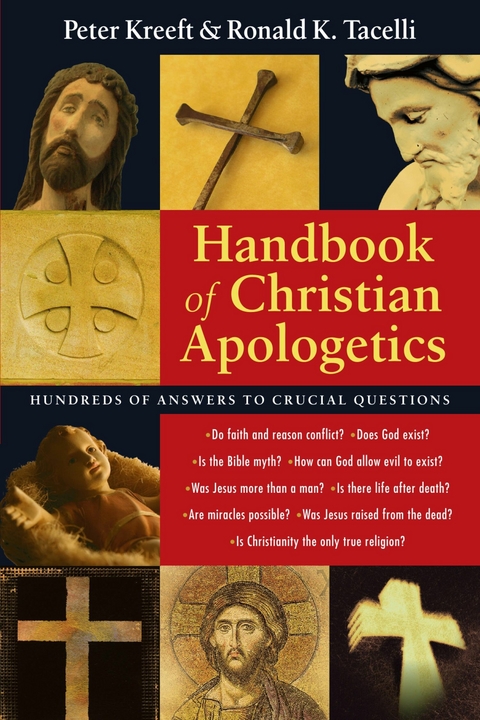
Handbook of Christian Apologetics (eBook)
406 Seiten
IVP Academic (Verlag)
978-1-5140-1462-2 (ISBN)
Ronald K. Tacelli, S.J., is associate professor of philosphy at Boston College and has published articles in the Public Affairs Quarterly and Downside Review.
Peter Kreeft (PhD, Fordham University) is professor of philosophy at Boston College, where he has taught since 1965. A popular lecturer, he has also taught at many other colleges, seminaries, and educational institutions in the eastern United States. Kreeft has written more than fifty books, including The Best Things in Life, The Journey, and Handbook of Christian Apologetics (with Ronald Tacelli). Ronald K. Tacelli, S.J., is associate professor of philosphy at Boston College and has published articles in the Public Affairs Quarterly and Downside Review.
CHAPTER 2
Faith & Reason
IN A SENSE THE MARRIAGE OF FAITH AND REASON IS THE MOST IMPORTANT question in apologetics because it is the overall question. If faith and reason are not wedded partners, if faith and reason are divorced or incompatible, like cats and birds, then apologetics is impossible. For apologetics is the attempt to ally reason to faith, to defend faith with reason’s weapons.
Definitions
It is especially crucial to clarify our definitions of faith and reason, because these terms are often used either vaguely or equivocally. Defining removes vagueness. Distinguishing two possible meanings and confining ourselves to one at a time removes equivocation.
Faith
We must distinguish the act of faith from the object of faith, believing from what is believed.
1. The object of faith means all the things believed. For the Christian, this means everything God has revealed in the Bible; Catholics include all the creeds and universal binding teachings of the church as well. This faith (the object, not the act) is expressed in propositions. Propositions are not expressions of the act of believing but expressions of the content believed. Liturgical and moral acts express the act of believing. However, the propositions are not the ultimate objects of faith, but only the proximate objects of faith. They are manifold, but the ultimate object of faith is one. The ultimate object of faith is not words but God’s Word (singular)—indeed, God himself. The propositions are the map or structure of faith; God is the real existing object of faith. (God is also the author of faith—both the revealer of the objective doctrines believed and the one who inspires the heart to make the free choice to believe them.)
It is equally wrong to stop at propositions and not have your faith reach out to the living God, or to denigrate propositions as dispensable or even harmful to living faith. Without a live relationship to the living God, propositions are pointless, for their point is to point beyond themselves to God. (“A finger is good for pointing to the moon, but woe to him who mistakes the finger for the moon,” according to a wise Zen saying.) But without propositions, we cannot know or tell others what God we believe in and what we believe about God.
2. The act of faith is more than merely an act of belief. We believe many things—for example, that the Bulls will beat the Celtics, that the President is not a crook, that Norway is beautiful—but we are not willing to die for these beliefs, nor can we live them every moment. But religious faith is something to die for and something to live every moment. It is much more than belief, and much stronger, though belief is one of its parts or aspects.
We can distinguish at least four aspects or dimensions of religious faith. Ranked on a hierarchy from less to more important and essential, and less to more interior—that is, as coming from ever more central aspects of the human self—they are (a) emotional faith, (b) intellectual faith, (c) volitional faith and (d) heart faith.
a. Emotional faith is feeling assurance or trust or confidence in a person. This includes hope (which is much stronger than just a wish) and peace (which is much stronger than mere calm).
b. Intellectual faith is belief. This is stronger than emotional faith in that it is more stable and unchanging, like an anchor. My mind can believe while my feelings are shaken. This belief, however, is held tight, unlike a mere opinion. The old definition of intellectual faith was “the act of the intellect, prompted by the will, by which we believe everything God has revealed on the grounds of the authority of the One who revealed it.” It is this aspect of faith that is formulated in propositions and summarized in creeds.
c. Volitional faith is an act of the will, a commitment to obey God’s will. This faith is faithfulness, or fidelity. It manifests itself in behavior, that is, in good works. Just as a hope deeper than a wish is central to emotional faith, and a belief deeper than an opinion is central to intellectual faith, so a love deeper than a feeling is central to volitional faith. For the root of volitional faith—the will—is the faculty or power of the soul that is closest to the prefunctional root and center called the “heart” (d).
The intellect is the soul’s navigator, but the will is its captain. The intellect is its Mr. Spock, the will is its Captain Kirk, and the feelings are its Dr. McCoy. The soul is an “Enterprise,” a real starship. The will can command the intellect to think, but the intellect cannot command the will to will, only inform it, as a navigator informs the captain. Yet the will cannot simply make you believe. It can’t force the intellect to believe what appears to it to be false, or to disbelieve what seems to it to be true. Belief is what happens when you decide to be honest and put your mind in the service of truth. (See Aquinas, Summa Theologiae, I, 82, 3-4 on the relationship between intellect and will.)
d. Faith begins in that obscure mysterious center of our being that Scripture calls the “heart.” Heart in Scripture (and in the church fathers, especially Augustine) does not mean feeling or sentiment or emotion, but the absolute center of the soul, as the physical heart is at the center of the body. The heart is where God the Holy Spirit works in us. This is not specifiable as a kind of interior object, as emotions, intellect and will are, because it is the very self, the I, the subject, the one whose emotions and mind and will they are.
“Keep your heart with all vigilance,” advised Solomon, “for from it flow the springs of life” (Prov 4:23). With the heart we choose our “fundamental option” of yes or no to God, and thereby determine our eternal identity and destiny.
The faith-works controversy that sparked the Protestant Reformation was due largely to an equivocation on the word faith. If we use “faith” as Catholic theology does—see the old Baltimore Catechism definition of faith in section (b) above—and as Paul did in 1 Corinthians 13—that is, if we mean intellectual faith—then faith alone is not sufficient for salvation, for “Even the demons believe—and shudder” (Jas 2:19). Hope, and above all love, need to be added to faith (1 Cor 13:13). But if we use “faith” as Luther did, and as Paul did in Romans and Galatians, that is, as heart-faith, then this is saving faith. It is sufficient for salvation, for it necessarily produces the good works of love just as a good tree necessarily produces good fruit. Protestants and Catholics agree on this. The Pope even told the German Lutheran bishops so over a decade ago, and they were startled and delighted. The two churches issued a public Joint Statement on Justification, a statement of agreement. Protestants and Catholics do not have essentially different religions, different ways of salvation. There are real and important differences, but this most central issue is not one of them.
Reason
Here again we must distinguish the subjective, personal act of reason from the object of reason.
1. The object of reason means all that reason can know. This includes three kinds of things, corresponding to the “three acts of the mind” in classical Aristotelian logic. It means all the truths that can be (a) understood by reason (that is, by human reason alone without faith in divine revelation), (b) discovered by human reason to be true and (c) proved logically, without any premises assumed by faith in divine revelation. (See figure 1.)
a. For instance, we can understand what a star is made of by human reason alone, and this is not part of divine revelation. We can also understand why the universe is so well ordered: human reason tells us that there must be a superhuman intelligence behind its design. This second example is also part of divine revelation, while the first is not. A third case: we cannot understand what God’s plan to save humanity is by human reason alone, only by divine revelation.
b. As to the second “act of the mind”—we can discover that the planet Pluto exists by human reason alone, and this is not part of divine revelation. We can also discover the historical existence of Jesus by human reason alone, by historical research. But this truth is also part of divine revelation, while the first is not. But we cannot discover by reason alone that God loves us so much that he died for us. We can know this only by faith in divine revelation.
c. Finally, we can prove the Pythagorean theorem in geometry by human reason alone, and this is not part of revelation. We can also prove by reason alone that the soul does not die as the body dies, by good philosophical arguments (see chap. 10). This is also part of revelation. But we cannot prove that God is a Trinity; we can only believe it because God revealed it.
2. The act of reason, as distinct from the object of reason, means all the subjective, personal acts of the mind by which we (a) understand, (b) discover or (c) prove any truth. The ancient meaning of reason included...
| Erscheint lt. Verlag | 22.7.2025 |
|---|---|
| Verlagsort | Lisle |
| Sprache | englisch |
| Themenwelt | Religion / Theologie ► Christentum ► Kirchengeschichte |
| Schlagworte | Argument • Belief • Bible • Biblical • Catholic • Catholicism • Cosmology • Divinity of Christ • Doubt • ethics • Evil • Existence • Faith • Heaven • hell • is god real • objective truth • Philosophy • Questioning • reasons to believe • Religion • Salvation • Scripture • Sin • Theology • Worldview |
| ISBN-10 | 1-5140-1462-9 / 1514014629 |
| ISBN-13 | 978-1-5140-1462-2 / 9781514014622 |
| Informationen gemäß Produktsicherheitsverordnung (GPSR) | |
| Haben Sie eine Frage zum Produkt? |
 EPUB (Wasserzeichen)
DRM: Digitales Wasserzeichen
Dieses eBook enthält ein digitales Wasserzeichen und ist damit für Sie personalisiert. Bei einer missbräuchlichen Weitergabe des eBooks an Dritte ist eine Rückverfolgung an die Quelle möglich.
Dateiformat: EPUB (Electronic Publication)
EPUB ist ein offener Standard für eBooks und eignet sich besonders zur Darstellung von Belletristik und Sachbüchern. Der Fließtext wird dynamisch an die Display- und Schriftgröße angepasst. Auch für mobile Lesegeräte ist EPUB daher gut geeignet.
Systemvoraussetzungen:
PC/Mac: Mit einem PC oder Mac können Sie dieses eBook lesen. Sie benötigen dafür die kostenlose Software Adobe Digital Editions.
eReader: Dieses eBook kann mit (fast) allen eBook-Readern gelesen werden. Mit dem amazon-Kindle ist es aber nicht kompatibel.
Smartphone/Tablet: Egal ob Apple oder Android, dieses eBook können Sie lesen. Sie benötigen dafür eine kostenlose App.
Geräteliste und zusätzliche Hinweise
Buying eBooks from abroad
For tax law reasons we can sell eBooks just within Germany and Switzerland. Regrettably we cannot fulfill eBook-orders from other countries.
aus dem Bereich