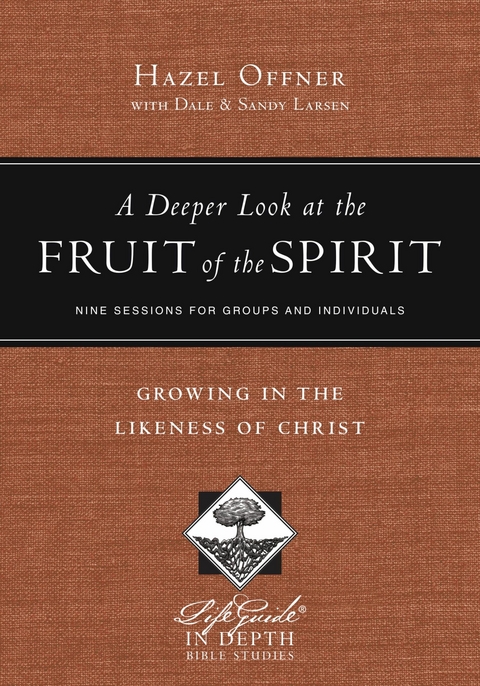
A Deeper Look at the Fruit of the Spirit (eBook)
134 Seiten
IVP Bible Studies (Verlag)
978-1-5140-1484-4 (ISBN)

Hazel Offner has for many years worked with students in the InterVarsity Christian Fellowship chapter at the University of Illinois. She has also helped to lead and promote hundreds of Bible study groups in the Champaign-Urbana area.
Hazel Offner has for many years worked with students in the InterVarsity Christian Fellowship chapter at the University of Illinois. She has also helped to lead and promote hundreds of Bible study groups in the Champaign-Urbana area.
Part 2. Connect
Scripture to Scripture
(On Your Own)
JOHN’S AUTHORITY TO SPEAK ABOUT GOD’S LOVE
We once heard a Christian say, “God in the New Testament is loving, but God in the Old Testament was terrible.” Many people have the same idea. They believe that a God of love is a radical New Testament innovation, introduced by Jesus Christ.
If God was once terrible and is now loving, then somewhere between the Old and New Testaments, his character must have changed. Intellectually we know that can’t be true. God does not change. Still, whether it makes sense or not, many people believe that the God of the Old Testament is a different sort of God from the God in the New Testament: a God who exhibits wrath rather than love.
If anyone could write with authority about love—both the love of God and our love for one another—it was John the apostle, the author of this letter. Tradition has it that he was “the disciple whom Jesus loved” (Jn 13:23) and was one of the three disciples closest to Jesus. John holds that love is so inseparable from the character of God that “everyone who loves has been born of God and knows God. Whoever does not love does not know God, because God is love” (vv. 7-8).
God is love. There could be no stronger declaration that God is a loving God. But has God always been the God of love? Let’s look backward into the Old Testament and examine the evidence there for John’s declaration.
THE LORD MAKES PROMISES
Abraham (then called Abram) came from a family who worshiped various gods (Joshua 24:2). They migrated northwest from modern-day Iraq to the edge of what is now Turkey. There, apparently out of the blue, the Lord spoke to Abraham and told him to pick up and leave and go to a land which the Lord would show him. Abraham obeyed, and after some sidetracks, he and his immediate family arrived in Canaan. (See Genesis 12–14.)
God had promised Abraham a nation of descendants. The problem was that Abraham and his wife, Sarah, were already old and had no children at all. When the Lord once again spoke reassuring words to Abraham, Abraham expressed severe doubts about the situation.
Read Genesis 15.
In Abraham’s circumstances, if you were asked to count the stars and believe that your offspring would be as numerous, what would you think?
Abraham asked how he would know that God’s promise was true. In answer, God made a covenant with Abraham (vv. 9-19). How was the covenant evidence that God loved and cared for Abraham?
OUT OF EGYPT
In fulfillment of what God had told Abraham (Genesis 15:13-14), Abraham’s great-grandson Joseph was taken to Egypt as a slave. He rose to prominence in the kingdom and was eventually joined there by his father, Jacob, and his brothers. When a new Pharaoh arose, the fortunes of the Israelites changed. They lost all status and became forced laborers for the Egyptians.
After four hundred years of slavery in Egypt, the Israelites were freed under the leadership of Moses and Aaron. They went out into the desert of Sinai with the land of Canaan as their ultimate destination. We don’t have to read very far in Deuteronomy before we uncover more about the love of God. At this point in the journey, Moses was looking ahead to the people’s entry into Canaan. He wanted to equip them to live there and flourish under the Lord’s protection.
Read Deuteronomy 7:7-11. Check the statement(s) that correctly describe why God chose Israel as his people.
___ They were the most numerous people group in the land.
___ God knew that they were the least sinful people on earth at that time.
___ God always keeps his promises, and he had promised to redeem them from Egypt.
___ They had proven their love for and loyalty to God.
___ They were the smallest and least significant nation.
___ He loved them.
God “set his affection” on the nation of Israel. Why? Because he loved them and was keeping his promise. He loved them because he loved them. Here is no dispassionate definition of love. It is rather a rationale that defies logic. The origin of God’s love is not in the status or goodness of Israel; it is in the character of God. God loved because he loved, with no other explanation.
Read Deuteronomy 6:4-5 and 10:12-15.
Alongside the arrow pointing from God to the people, write what God had done for the Israelites.
Alongside the arrow pointing from the people to God, write what God asked the Israelites to do.
STEADFAST LOVE
Although Israel failed to do what God wanted, in his faithful love he did not abandon his people. The love of God is most commonly expressed in the Old Testament by the Hebrew word hesed. Variously translated as “steadfast love,” “loving-kindness” or “mercy,” hesed is not a generalized warm feeling. It assumes a deeply involved personal relationship of loyalty and commitment.
Forty years after the exodus from Egypt, a new generation of Israelites finally crossed the Jordan River and entered the promised land of Canaan. Centuries followed in which God continued to show the people his love, while their love for him ebbed and flowed.
In Psalm 136, the persistent love of God forms a refrain against the sweep of Israel’s early history. Read through Psalm 136. What events have demonstrated the faithful love of God?
BETROTHED TO THE LORD FOREVER
After the reign of King David, the nation of Israel split into two kingdoms: a northern kingdom (Israel) and a southern kingdom (Judah). Two series of kings led the nations, sometimes into idolatry and sometimes into repentance and righteousness. When the people fell into idolatry, the Lord sent prophets to try to bring them back to himself.
During the eighth century B.C. the Lord sent the prophet Hosea with a message of judgment and, ultimately, one of deep, steadfast love. Hosea started out with a tough assignment. In a shocking demand, God told Hosea, “Go, marry a promiscuous woman and have children with her, for like an adulterous wife this land is guilty of unfaithfulness to the LORD” (Hosea 1:2). Hosea therefore married an immoral woman named Gomer. She had several children with different men. The marriage of Gomer and Hosea gave a picture of the relationship between Israel and the Lord.
Read Hosea 2–3.
In what ways did Israel’s behavior resemble that of an unfaithful spouse?
After a time of judgment, how did God promise to ultimately respond to the nation of Israel?
Read Hosea 11:1-11. What yearning words and phrases does the Lord use to express his steadfast love?
One scholar notes that Hosea 11:1-4, 7-9 is “the nearest the OT approaches to a declaration that God is love.”1 Yet the book of Hosea does not even begin to say everything about the loving nature of God in the Old Testament. God consistently made his love known in verbal announcements through his prophets and in his protection and discipline of Israel.
Ultimately God showed the full extent of his love, not only for Israel but for the whole world, in Jesus Christ: “For God so loved the world that he gave his one and only Son, that whoever believes in him shall not perish but have eternal life. For God did not send his Son into the world to condemn the world, but to save the world through him” (John 3:16-17).
WHAT ABOUT GOD’S WRATH?
Remember our friend who said, “God in the New Testament is loving, but God in the Old Testament was terrible”? She was thinking of the many Old Testament expressions of God’s fiery judgment against sin.
God’s love and God’s wrath are both obvious in Scripture. Our human minds and hearts struggle to reconcile the two, however.
Yet even in the sternest judgments against his people, God revealed his steadfast love and mercy. When the northern kingdom of Israel and the southern kingdom of Judah were each conquered (at different times) by foreign powers and taken into exile, God made it clear that the conquests happened because the people ignored his warnings and persisted in idolatry, worshiping false gods instead of the one true God. (See 2 Kings 17:7-23 and 2 Chronicles 36:15-21.) In the midst of Judah’s unfaithfulness and idolatry, the prophet Habakkuk prayed to the Lord, “In wrath remember mercy” (Habakkuk 3:2), and the Lord answered his prayer. In the midst of the destruction of Jerusalem by the Babylonians, the Lord sent a promise of mercy through the prophet Jeremiah.
This is the word that came to Jeremiah from the LORD: “This is what the LORD, the God of Israel, says: ‘Write in a book all the words I have spoken to you. The days are coming,’ declares the LORD, ‘when I will bring my people Israel and Judah back from captivity and restore them to the land I gave their ancestors to possess,’ says the LORD.” (Jeremiah 30:1-3)
Later God again reiterated his love through Jeremiah: “The LORD appeared to us in the past, saying: ‘I have loved you with an everlasting love; I have drawn you with...
| Erscheint lt. Verlag | 23.6.2025 |
|---|---|
| Reihe/Serie | LifeGuide in Depth Series |
| Co-Autor | Dale Larsen, Sandy Larsen |
| Verlagsort | Lisle |
| Sprache | englisch |
| Themenwelt | Religion / Theologie ► Christentum ► Kirchengeschichte |
| Schlagworte | Bible • Christ • Cultural • Discipleship • discussion • Exercises • faithfulness • gentleness • goodness • Historical • in depth • inductive • Joy • kindness • Lifeguide • Love • New • Old • Patience • Peace • Scripture • Self-control • small group • Spiritual • Study • Testament • Virtues • Weekly |
| ISBN-10 | 1-5140-1484-X / 151401484X |
| ISBN-13 | 978-1-5140-1484-4 / 9781514014844 |
| Informationen gemäß Produktsicherheitsverordnung (GPSR) | |
| Haben Sie eine Frage zum Produkt? |
 EPUB (Wasserzeichen)
DRM: Digitales Wasserzeichen
Dieses eBook enthält ein digitales Wasserzeichen und ist damit für Sie personalisiert. Bei einer missbräuchlichen Weitergabe des eBooks an Dritte ist eine Rückverfolgung an die Quelle möglich.
Dateiformat: EPUB (Electronic Publication)
EPUB ist ein offener Standard für eBooks und eignet sich besonders zur Darstellung von Belletristik und Sachbüchern. Der Fließtext wird dynamisch an die Display- und Schriftgröße angepasst. Auch für mobile Lesegeräte ist EPUB daher gut geeignet.
Systemvoraussetzungen:
PC/Mac: Mit einem PC oder Mac können Sie dieses eBook lesen. Sie benötigen dafür die kostenlose Software Adobe Digital Editions.
eReader: Dieses eBook kann mit (fast) allen eBook-Readern gelesen werden. Mit dem amazon-Kindle ist es aber nicht kompatibel.
Smartphone/Tablet: Egal ob Apple oder Android, dieses eBook können Sie lesen. Sie benötigen dafür eine kostenlose App.
Geräteliste und zusätzliche Hinweise
Buying eBooks from abroad
For tax law reasons we can sell eBooks just within Germany and Switzerland. Regrettably we cannot fulfill eBook-orders from other countries.
aus dem Bereich