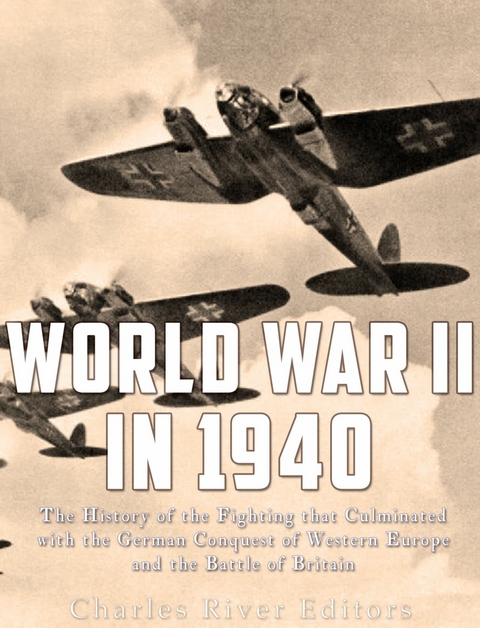
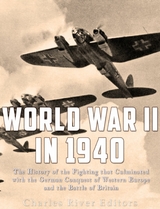
World War II in 1940 (eBook)
137 Seiten
Charles River Editors (Verlag)
978-1-4753-3245-2 (ISBN)
One of the most famous people in the world came to tour the city of Paris for the first time on June 28, 1940. Over the next three hours, he rode through the city's streets, stopping to tour L'Opéra Paris. He rode down the Champs-Élysées toward the Trocadero and the Eiffel Tower, where he had his picture taken. After passing through the Arc de Triomphe, he toured the Pantheon and old medieval churches, though he did not manage to see the Louvre or the Palace of Justice. Heading back to the airport, he told his staff, 'It was the dream of my life to be permitted to see Paris. I cannot say how happy I am to have that dream fulfilled today.' Four years after his tour, Adolf Hitler would order the city's garrison commander, General Dietrich von Choltitz, to destroy Paris, warning his subordinate that the city 'must not fall into the enemy's hand except lying in complete debris.'
Of course, Paris was not destroyed before the Allies liberated it, but it would take more than 4 years for them to wrest control of France from Nazi Germany after they took the country by storm in about a month in 1940. That said, it's widely overlooked today given how history played out that as the power of Nazi Germany grew alarmingly during the 1930s, the French sought means to defend their territory against the rising menace of the Thousand-Year Reich. As architects of the most punitive measures in the Treaty of Versailles following World War I, France was a natural target for Teutonic retribution, so the Maginot Line, a series of interconnected strongpoints and fortifications running along much of France's eastern border, helped allay French fears of invasion.
The popular legend of the Maginot Line portrays the frontier defenses as a useless 'white elephant' project that was prompted by a gross misapprehension of warfare's new realities in the mid-20th century and quickly overwhelmed by the forceful advance of the German blitzkrieg. English idiom today invokes this vision of the Maginot Line as a metaphor for any defensive measure strongly believed in but actually useless. Indeed, usages such as 'Maginot Line mentality,' describing an overly defensive, reactive mindset, perpetuate the legend. As a French author and military liaison with the British, Andre Maurois, wrote about his disillusionment with the defensive line he originally enthusiastically supported: 'We know now that the Maginot line-complex was a dangerous disease of the mind; but I publish this as it was written in January, 1940.'
In reality, however, the actual Maginot Line proved considerably more functional than memory has served. The true flaw in French military strategy during the opening days of World War II lay not in reliance on the Maginot fortifications but in the army's neglect to exploit the military opportunities the Line created. In other words, the border defense performed as envisioned, but the other military arms supported it insufficiently to halt the Germans. The French Army squandered the opportunity not because the Maginot Line existed but because they failed to utilize their own defensive plan properly; the biggest problem was that the Germans simply skirted past the intricate defensive fortifications by invading neutral Belgium and swinging south, thereby avoiding the Maginot Line for the most part.
Thankfully, after the French surrender, the RAF stood toe to toe with the Luftwaffe and ensured Hitler's planned invasion of Britain was permanently put on hold. The Allied victory in the Battle of Britain inflicted a psychological and physical defeat on the Luftwaffe and Nazi regime at large, and as the last standing bastion of democracy in Europe, Britain would provide the toehold for the June 1944 invasion of Europe that liberated the continent. For those reasons alone, the Battle of Britain was one of the decisive turning points of history's deadliest conflict.
One of the most famous people in the world came to tour the city of Paris for the first time on June 28, 1940. Over the next three hours, he rode through the city's streets, stopping to tour L'Opera Paris. He rode down the Champs-Elysees toward the Trocadero and the Eiffel Tower, where he had his picture taken. After passing through the Arc de Triomphe, he toured the Pantheon and old medieval churches, though he did not manage to see the Louvre or the Palace of Justice. Heading back to the airport, he told his staff, "e;It was the dream of my life to be permitted to see Paris. I cannot say how happy I am to have that dream fulfilled today."e; Four years after his tour, Adolf Hitler would order the city's garrison commander, General Dietrich von Choltitz, to destroy Paris, warning his subordinate that the city "e;must not fall into the enemy's hand except lying in complete debris."e;Of course, Paris was not destroyed before the Allies liberated it, but it would take more than 4 years for them to wrest control of France from Nazi Germany after they took the country by storm in about a month in 1940. That said, it s widely overlooked today given how history played out that as the power of Nazi Germany grew alarmingly during the 1930s, the French sought means to defend their territory against the rising menace of the Thousand-Year Reich. As architects of the most punitive measures in the Treaty of Versailles following World War I, France was a natural target for Teutonic retribution, so the Maginot Line, a series of interconnected strongpoints and fortifications running along much of France's eastern border, helped allay French fears of invasion.The popular legend of the Maginot Line portrays the frontier defenses as a useless white elephant project that was prompted by a gross misapprehension of warfare's new realities in the mid-20th century and quickly overwhelmed by the forceful advance of the German blitzkrieg. English idiom today invokes this vision of the Maginot Line as a metaphor for any defensive measure strongly believed in but actually useless. Indeed, usages such as Maginot Line mentality, describing an overly defensive, reactive mindset, perpetuate the legend. As a French author and military liaison with the British, Andre Maurois, wrote about his disillusionment with the defensive line he originally enthusiastically supported: We know now that the Maginot line-complex was a dangerous disease of the mind; but I publish this as it was written in January, 1940. In reality, however, the actual Maginot Line proved considerably more functional than memory has served. The true flaw in French military strategy during the opening days of World War II lay not in reliance on the Maginot fortifications but in the army's neglect to exploit the military opportunities the Line created. In other words, the border defense performed as envisioned, but the other military arms supported it insufficiently to halt the Germans. The French Army squandered the opportunity not because the Maginot Line existed but because they failed to utilize their own defensive plan properly; the biggest problem was that the Germans simply skirted past the intricate defensive fortifications by invading neutral Belgium and swinging south, thereby avoiding the Maginot Line for the most part.Thankfully, after the French surrender, the RAF stood toe to toe with the Luftwaffe and ensured Hitler s planned invasion of Britain was permanently put on hold. The Allied victory in the Battle of Britain inflicted a psychological and physical defeat on the Luftwaffe and Nazi regime at large, and as the last standing bastion of democracy in Europe, Britain would provide the toehold for the June 1944 invasion of Europe that liberated the continent. For those reasons alone, the Battle of Britain was one of the decisive turning points of history s deadliest conflict.
| Erscheint lt. Verlag | 2.5.2025 |
|---|---|
| Sprache | englisch |
| Themenwelt | Geschichte ► Allgemeine Geschichte ► 1918 bis 1945 |
| Schlagworte | Britain • Churchill • Dunkirk • Hitler • Luftwaffe • Nazi • soviet |
| ISBN-10 | 1-4753-3245-9 / 1475332459 |
| ISBN-13 | 978-1-4753-3245-2 / 9781475332452 |
| Informationen gemäß Produktsicherheitsverordnung (GPSR) | |
| Haben Sie eine Frage zum Produkt? |
 EPUB (Ohne DRM)
Digital Rights Management: ohne DRM
Dieses eBook enthält kein DRM oder Kopierschutz. Eine Weitergabe an Dritte ist jedoch rechtlich nicht zulässig, weil Sie beim Kauf nur die Rechte an der persönlichen Nutzung erwerben.
Dateiformat: EPUB (Electronic Publication)
EPUB ist ein offener Standard für eBooks und eignet sich besonders zur Darstellung von Belletristik und Sachbüchern. Der Fließtext wird dynamisch an die Display- und Schriftgröße angepasst. Auch für mobile Lesegeräte ist EPUB daher gut geeignet.
Systemvoraussetzungen:
PC/Mac: Mit einem PC oder Mac können Sie dieses eBook lesen. Sie benötigen dafür die kostenlose Software Adobe Digital Editions.
eReader: Dieses eBook kann mit (fast) allen eBook-Readern gelesen werden. Mit dem amazon-Kindle ist es aber nicht kompatibel.
Smartphone/Tablet: Egal ob Apple oder Android, dieses eBook können Sie lesen. Sie benötigen dafür eine kostenlose App.
Geräteliste und zusätzliche Hinweise
Buying eBooks from abroad
For tax law reasons we can sell eBooks just within Germany and Switzerland. Regrettably we cannot fulfill eBook-orders from other countries.
aus dem Bereich