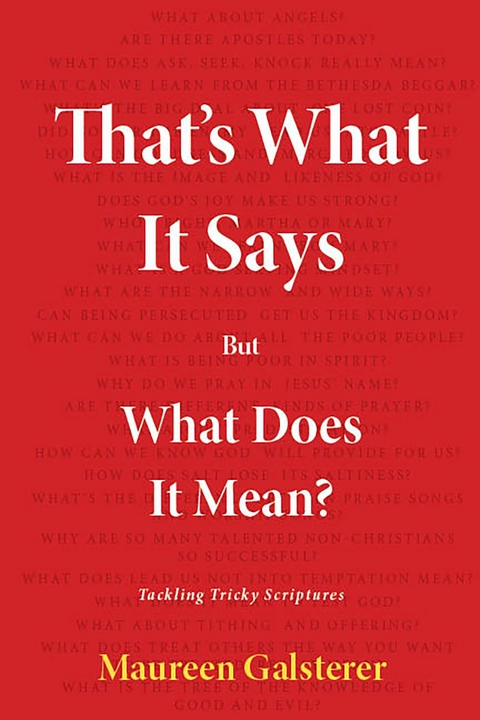
That's What It Says (eBook)
188 Seiten
Bookbaby (Verlag)
979-8-3509-9776-7 (ISBN)
Reverend Maureen Galsterer is a staff minister with Dove Ministries International (DMI) and is currently based at Fresh Start Church (FSC) of Petoskey, Michigan. During a conference in 2012, the founder of DMI said to her 'Mo, you have a way of saying things in a completely different way, of putting a new twist on Kingdom things. The Lord likes that.' That word of prophecy was a wake-up call that God gave Rev. Galsterer a gift, and He expects her to use it to benefit His kingdom. She has worked with DMI and FSC for over 35 years in various positions including as Dean of their Bible School, within their IT Department and their Publishing Department, managing conferences, officiating at weddings, and most importantly: preaching and teaching the Bible. She holds a Ph.D. in Computer Science from Michigan State University and taught that subject at Saginaw Valley State University. Rev. Galsterer knows her true calling is in the ministry, but she congratulates God on letting the universities she attended and taught at prior to her ordination do the heavy lifting of getting her ready to serve Him in in His kingdom as a teacher. She can be reached at rev.dr.galst@gmail.com
The Bible was written over a span of centuries in a mixture of Hebrew, ancient Greek, and Aramic. The first English translation was in 1382 by John Wycliff and his community. It was the first major publication by Johannes Gutenberg in 1455 after the printing press was invented. Over the years, amazing scholars have produced different versions of the original text; from word-for-word translations like the King James and New King James versions, to paraphrased versions which give the meaning in contemporary language like the Message Bible, and everything in between. The goal of each these scholars, just as Jesus was doing in His Sermon on the Mount, is to make God's Word easier to understand, to entice more people to read the Bible and learn from It. In "e;That's What it Says"e;, Reverend Maureen Galsterer collects some of the trickiest and most misunderstood scriptures, looking beyond the surface meaning to show the true heart of God contained within. She references concepts such as the Tree of the Knowledge of Good and Evil, Guardian Angels, What "e;Ask, Seek and Knock"e; Really Means, Does God's Joy Make Us Strong, the Narrow and Wide Ways, Persecution, Being Poor in Spirit, Why We Pray in Jesus' Name, Different Kinds of Prayer, Predestination, How We Know God Will Provide for Us, How Salt Loses It's Saltiness, the Difference Between Praise Songs and Worship Songs, What "e;Lead Us Not Into Temptation"e; Really Means, How We Test God, Should Christians Tithe Today, Biblical Visions and other head-scratchers in this informative exploration of the Bible. The Bible is a love letter from God to us. He truly loves us and wants more than anything to draw us into His inner circle. He has never done anything but uphold our right to choose. Choose what? Choose Him or not, it's that simple.
What About Angels?
A lot of people have opinions about angels, and the Bible teaches about them. We don’t know how many there are, but we suppose there are lots and lots of angels. Both the Old and New Testaments talk about angels: angels of the Lord, an angel of the Lord and The Angel of the Lord.
We should look first at The Angel of the Lord. The Bible doesn’t tell us who this angel is, but it gives us enough information to make an educated guess. This angel is very different from all the others the Bible talks about because this angel talks like God, associates himself with God, and does the works of God. Here are just a few examples.
In Genesis 16:9-10, The Angel of the Lord commands Hagar and makes a claim about Hagar’s descendants to do something only God can do, “Then the angel of the Lord told her, ‘Go back to your mistress and submit to her.’ The angel added, ‘I will increase your descendants so much that they will be too numerous to count.’” Only God could increase her descendants.
In Exodus 3:2-4, The Angel of the Lord appears in a burning bush and reveals He is God, “There the angel of the Lord appeared to him in flames of fire from within a bush. Moses saw that through the bush was on fire it did not burn up. So Moses thought, ‘I will go over and see this strange sight—why the bush does not burn up.’ When the Lord saw that he had gone over to look, God called to him from within the bush, ‘Moses! Moses!’ And Moses said, ‘Here I am.’”
In Judges 6:14-16, The Angel of the Lord is called by God’s special name, YHWH. The ancient Jews developed a tradition of never speaking God’s name because they overemphasized the third commandment they read as, “You shall not misuse the name of the Lord your God, for the Lord will not hold anyone guiltless who misuses his name.” When reading the special name, the Jews spoke the name, “Adonai,” which means Master or Lord. That’s why sometimes the word “Lord” is capitalized in Old Testament scriptures, because it replaces YHWH, “The LORD turned to him and said, ‘Go in the strength you have and save Israel out of Midian’s hand. Am I not sending you?’ ‘Pardon me, my lord,’ Gideon replied, ‘but how can I save Israel? My clan is the weakest in Manasseh, and I am the least in my family.’ The LORD answered, ‘I will be with you and you will strike down all the Midianites, leaving none alive.’”
In Daniel 3:24-25, A fourth person appears in the fiery furnace with Shadrach, Meshach and Abednego, “Then King Nebuchadnezzar leaped to his feet in amazement and asked his advisers, ‘Weren’t there three men that we tied up and threw into the fire?’ They replied, ‘Certainly, Your Majesty.’ He said, ‘Look! I see four men walking around in the fire, unbound and unharmed, and the fourth looks like a son of the gods.’” Nebuchadnezzar identifies that figure as God, though he had no idea who God was at that time. In Daniel 4 he does recognize that God is God and praises Him for His everlasting power and dominion, “Now I, Nebuchadnezzar, praise and exalt and glorify the King of heaven, because everything he does is right and all his ways are just. And those who walk in pride he is able to humble.” (Daniel 4:37)
Who is this Angel? The Angel of the Lord doesn’t appear in the Bible again after the Old Testament. I’ve heard the argument that Matthew puts the article “the” in front of “angel of the Lord” when talking about the angel appearing to Joseph in a dream in Matthew 1:24 but a few verses before Matthew says, “an” angel of the Lord appeared to Joseph, so verse 24 is just referring back to that angel in verse 20, “But after he had considered this, (putting Mary away because she was pregnant and they weren’t even married yet) an angel of the Lord appeared to him in a dream and said, ‘Joseph son of David, do not be afraid to take Mary home as your wife, because what is conceived in her is from the Holy Spirit.’” The angel who appeared to Joseph was not The Angel of the Lord. He brought Joseph a message from God and did nothing any other angel on a mission couldn’t do.
The Angel of the Lord is probably a manifestation of Jesus before His incarnation and birth. Jesus said that He existed before Abraham (John 8:58) so it makes sense that He appeared as a manifestation in the Old Testament because He already was before the world was created but He didn’t have a body yet. Given that the argument over Matthew chapter 1 is settled there’s the fact that Jesus as the Angel of the Lord doesn’t appear at all in the New Testament. Why would Jesus appear as a manifestation of Himself when He was already present in physical form all through the gospels? And why, after He ascended bodily to heaven and He sent His Holy Spirit to be our counselor and comforter, would He need to return in any of the epistles? We have the Holy Spirit with us from the time Jesus ascended into heaven up to now. Jesus doesn’t need to return until He comes again in Revelation.
Let’s look at other angels. These are the ones the Bible calls “angels of the Lord” or “an angel of the Lord.” There are many references to angels in the Bible and they do lots of things. They meet physical needs (Matthew 4, Mark 1). They give strength (Luke 22). They give guidance (Matthew 2, Acts 8, 10). They protect us and deliver us (Psalm 91, Acts 5, 12). They bring messages from God (1 Kings 13:18, Luke 1, Revelation 2,3). They perform feats of strength (Matthew 28, Revelation 20). They worship God (Isaiah 6, Luke 2). They bring God’s judgment (1 Chronicles 21:15, Acts 12, Revelation 7-10; 14-16). They do anything and everything God sends them to do.
All of Psalm 91 is a beautiful poem whose author isn’t known but Psalm 91 is often attributed to Moses or David. This psalm about God’s protection is so well known that even Satan referenced it during Jesus’ temptation, “Then the devil took him to the holy city and had him stand on the highest point of the temple. ‘If you are the Son of God,’ he said, ‘throw yourself down. For it is written: ‘He will command his angels concerning you, and they will lift you up in their hands, so that you will not strike your foot against a stone.’” (Matthew 4:5-6) We can all take heart that just as angels would have protected Jesus, they will protect us! The writer of Hebrews tells us that believers benefit all the time from angels’ ministry.
Hebrews 1:14 Are not all angels ministering spirits sent to serve those who will inherit salvation?
Acts 12 is another famous example of God’s protection detailing Peter’s miraculous escape from prison with the help of an angel.
Acts 12:6-11 The night before Herod was to bring him to trial, Peter was sleeping between two soldiers, bound with two chains, and sentries stood guard at the entrance. 7 Suddenly an angel of the Lord appeared, and a light shone in the cell. He struck Peter on the side and woke him up. “Quick, get up!” he said, and the chains fell off Peter’s wrists. 8 Then the angel said to him, “Put on your clothes and sandals.” And Peter did so. “Wrap your cloak around you and follow me,” the angel told him. 9 Peter followed him out of the prison, but he had no idea that what the angel was doing was really happening; he thought he was seeing a vision. 10 They passed the first and second guards and came to the iron gate leading to the city. It opened for them by itself, and they went through it. When they had walked the length of one street, suddenly the angel left him. 11 Then Peter came to himself and said, “Now I know without a doubt that the Lord has sent his angel and rescued me from Herod’s clutches and from everything the Jewish people were hoping would happen.”
There’s one more thing we must consider about angels. This one has stirred up all kinds of opinions. There are Christian denominations that teach it as a possibility, but none of them has made it one of their doctrines. Other world religions also teach about angels, but we’re only talking about Christianity in this book.
Does Everybody Have a Guardian Angel? We know what angels are, created spirits, and we know that they do a whole list of things on earth. But is a specific angel assigned to every human being to protect and serve? There are only two scriptures that might possibly show this is true if we look at them in the right way. One is in Acts 12 as a continuation of the account of Peter’s escape from prison.
Acts 12:12-15 When this had dawned on him, he went to the house of Mary the mother of John, also called Mark, where many people had gathered and were praying. 13 Peter knocked at the outer entrance, and a servant named Rhoda came to answer the door. 14 When she recognized Peter’s voice, she was so overjoyed she ran back without opening it and exclaimed, “Peter is at the door!” 15 “You’re out of your mind,” they told her. When she kept insisting that it was so, they said, “It must be his angel.”
The Acts account comes in second when people use scripture to prove there are guardian angels. Rabbi Leo Trepp, the last rabbi to lead a congregation in Nazi Germany, tells us that the Jews in Jesus’ time had developed a tradition that people had guardian angels. But Chaya Sarah Silberberg, who serves in the Bais Chabad Torah Center in West Bloomfield, Michigan today tells us that the idea of a personal guardian angel isn’t part of Jewish doctrine. When the disciples attributed Peter’s presence to “his angel” they were voicing a tradition that developed among the Jews in ancient times, but it wasn’t part of their doctrine. The angel showed up, did his job, and left. Is this...
| Erscheint lt. Verlag | 23.7.2025 |
|---|---|
| Sprache | englisch |
| Themenwelt | Geisteswissenschaften ► Religion / Theologie ► Christentum |
| ISBN-13 | 979-8-3509-9776-7 / 9798350997767 |
| Informationen gemäß Produktsicherheitsverordnung (GPSR) | |
| Haben Sie eine Frage zum Produkt? |
 EPUB (Ohne DRM)
Größe: 1,1 MB
Digital Rights Management: ohne DRM
Dieses eBook enthält kein DRM oder Kopierschutz. Eine Weitergabe an Dritte ist jedoch rechtlich nicht zulässig, weil Sie beim Kauf nur die Rechte an der persönlichen Nutzung erwerben.
Dateiformat: EPUB (Electronic Publication)
EPUB ist ein offener Standard für eBooks und eignet sich besonders zur Darstellung von Belletristik und Sachbüchern. Der Fließtext wird dynamisch an die Display- und Schriftgröße angepasst. Auch für mobile Lesegeräte ist EPUB daher gut geeignet.
Systemvoraussetzungen:
PC/Mac: Mit einem PC oder Mac können Sie dieses eBook lesen. Sie benötigen dafür die kostenlose Software Adobe Digital Editions.
eReader: Dieses eBook kann mit (fast) allen eBook-Readern gelesen werden. Mit dem amazon-Kindle ist es aber nicht kompatibel.
Smartphone/Tablet: Egal ob Apple oder Android, dieses eBook können Sie lesen. Sie benötigen dafür eine kostenlose App.
Geräteliste und zusätzliche Hinweise
Buying eBooks from abroad
For tax law reasons we can sell eBooks just within Germany and Switzerland. Regrettably we cannot fulfill eBook-orders from other countries.
aus dem Bereich