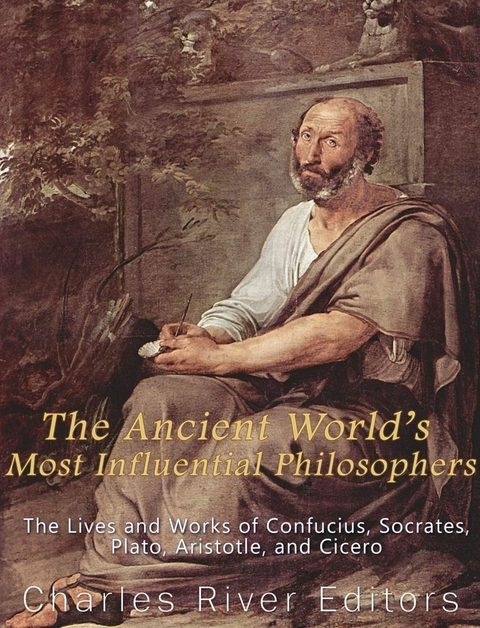
The Ancient World’s Most Influential Philosophers (eBook)
154 Seiten
Charles River Editors (Verlag)
978-1-4753-3239-1 (ISBN)
Many people argue that Confucius is the most influential person of all time, and if having a significant effect on the greatest number of people is the criterion, he may very well be. China is one of the largest and oldest civilizations on earth, and Confucius has been influential there from almost the beginning: the first Chinese dynasty was founded around 1600 BCE and Confucius lived from 551-479 BCE.
Although he is still one of history's most famous philosophers, Confucius was in many respects an unremarkable man, and even his physical features were said to be unattractive. There is little evidence that he thought of himself as a harbinger of any kind, but shortly after his death, writings, sayings, and theories based on his life and ideas spread throughout China and even took hold of the imperial court of one of the most powerful and important dynasties, the Han (206 BCE-220 CE). It was during the Han Dynasty that Confucianism became closely tied to state affairs, and it would remain so until the fall of the last dynasty in 1912. Confucianism was closely tied to state religious and ritual practice, and naturally, it benefited greatly from this relationship and was able to subsequently exert influence on all aspects of society.[1] As a 'state religion', it provided 'religious sanction for policy-making, official sacrifices, court ceremonies, royal marriage, funeral and mourning rights' as well as several major sacrifices to gods and ancestors.[2] Confucianism continues to reverberate to the present day; the Chinese Communist Party still discusses Confucius in their official newspapers and references his thought when they think it will help promote a political or social stance.
In 427 B.C., the Ancient Greek city-state of Athens was flourishing. Approximately 80 years earlier, the Athenians had formed the first self-representative democracy in history, the Peloponnesian War against Sparta had only just started, and Socrates was only beginning to lay the foundation of what would become Western philosophy.
None of Socrates' works survived antiquity, so most of what is known about him came from the writings of his followers, most notably Plato. What is known about Socrates is that he seemed to make a career out of philosophy, and Plato was intent on following in his footsteps. Yet for all of the influence of Socrates' life on his followers, it was Socrates' death around 399 B.C. that truly shaped them. Plato was so embittered by Socrates' trial in Athens that he completely soured on Athenian democracy, and Aristotle would later criticize politicians who relied on rhetoric; when Aristotle's own life was threatened, he fled Greece and allegedly remarked, 'I will not allow the Athenians to sin twice against philosophy.'
Since Socrates wrote nothing down, or at least nothing that survived antiquity, there has been a wealth of scholarship ever since attempting to determine the person to whom the philosophical positions of the various (and genuine) Socratic dialogues of Plato's should be attributed. Even though Aristotle insisted that Socrates only cared about ethics and held no metaphysical theory of the kind that Plato propounded, the attempt to read the ugly but wise Socrates via the Platonic dialogues continued up to the 20th century. The change of tone, style and philosophical topics seemed to be a big argument that Socratic views are to be found in the early Platonic works, whereas later works bear the stamp of Plato's personal views. The Platonic scholar Gregory Vlastos introduced a developmentalist position which has almost become an orthodoxy in Platonic studies, by moving the discussion from the historical Socrates to Plato as a philosopher. According to developmentalism, if the views in the dialogue are not spelled out only to be refuted afterward, then the person they should be attributed to is Plato and not Socrates. These philosophical views developed over time.
| Erscheint lt. Verlag | 1.5.2025 |
|---|---|
| Sprache | englisch |
| Themenwelt | Geschichte ► Allgemeine Geschichte ► Altertum / Antike |
| Schlagworte | Athens • Mythology • Philosophy • Religion • Roman • Rome • Sparta |
| ISBN-10 | 1-4753-3239-4 / 1475332394 |
| ISBN-13 | 978-1-4753-3239-1 / 9781475332391 |
| Informationen gemäß Produktsicherheitsverordnung (GPSR) | |
| Haben Sie eine Frage zum Produkt? |
 EPUB (Ohne DRM)
Digital Rights Management: ohne DRM
Dieses eBook enthält kein DRM oder Kopierschutz. Eine Weitergabe an Dritte ist jedoch rechtlich nicht zulässig, weil Sie beim Kauf nur die Rechte an der persönlichen Nutzung erwerben.
Dateiformat: EPUB (Electronic Publication)
EPUB ist ein offener Standard für eBooks und eignet sich besonders zur Darstellung von Belletristik und Sachbüchern. Der Fließtext wird dynamisch an die Display- und Schriftgröße angepasst. Auch für mobile Lesegeräte ist EPUB daher gut geeignet.
Systemvoraussetzungen:
PC/Mac: Mit einem PC oder Mac können Sie dieses eBook lesen. Sie benötigen dafür die kostenlose Software Adobe Digital Editions.
eReader: Dieses eBook kann mit (fast) allen eBook-Readern gelesen werden. Mit dem amazon-Kindle ist es aber nicht kompatibel.
Smartphone/Tablet: Egal ob Apple oder Android, dieses eBook können Sie lesen. Sie benötigen dafür eine kostenlose App.
Geräteliste und zusätzliche Hinweise
Buying eBooks from abroad
For tax law reasons we can sell eBooks just within Germany and Switzerland. Regrettably we cannot fulfill eBook-orders from other countries.
aus dem Bereich