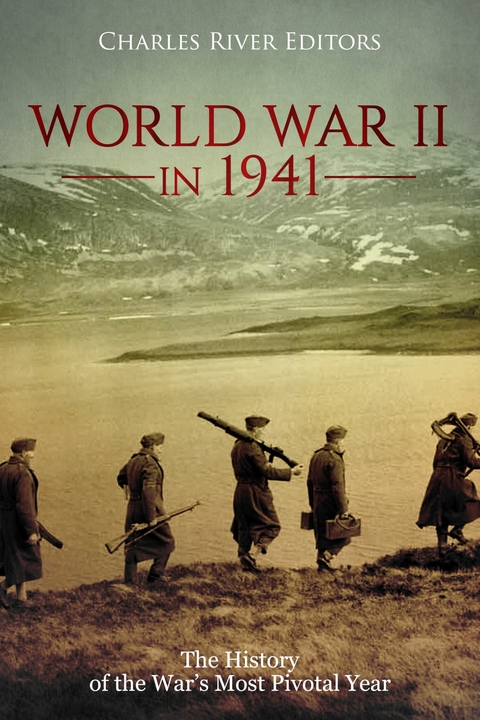
World War II in 1941 (eBook)
245 Seiten
Charles River Editors (Verlag)
978-1-4753-3217-9 (ISBN)
At the beginning of 1941, it was unclear whether the Allies would be able to remain in the war for much longer. British Prime Minister Winston Churchill had already immortalized the men of the Royal Air Force with one of the West's most famous war-time quotes, but the potential of a German invasion of Britain still loomed. With the comfort of hindsight, historians now suggest that the picture was actually more complex than that, but the Battle of Britain, fought throughout the summer and early autumn of 1940, was unquestionably epic in scope. The largest air campaign in history at the time, the vaunted Nazi Luftwaffe sought to smash the Royal Air Force, but thankfully, the RAF stood toe to toe with the Luftwaffe and ensured Hitler's planned invasion was permanently put on hold. The Allied victory in the Battle of Britain inflicted a psychological and physical defeat on the Luftwaffe and Nazi regime at large, and as the last standing bastion of democracy in Europe, Britain would provide the toehold for the June 1944 invasion of Europe that liberated the continent. For those reasons alone, the Battle of Britain was one of the decisive turning points of history's deadliest conflict.
In the warm predawn darkness of June 22, 1941, 3 million men waited along a front hundreds of miles long, stretching from the Baltic coast of Poland to the Balkans. Ahead of them in the darkness lay the Soviet Union, its border guarded by millions of Red Army troops echeloned deep throughout the huge spaces of Russia. This massive gathering of Wehrmacht soldiers from Adolf Hitler's Third Reich and his allied states - notably Hungary and Romania - stood poised to carry out Operation Barbarossa, Hitler's surprise attack against the country of his putative ally, Soviet dictator Joseph Stalin.
Though Germany was technically Russia's ally, Stalin had no delusions that they were friends. Instead, he used this time to build up his forces for what he saw as an inevitable invasion. First, on the heels of the German invasion of Poland in September 1939, Stalin had his troops invade and reclaim the land Russia had lost in World War I. Next he turned his attention to Finland, which was only 100 miles from the newly named Leningrad. He initially tried to negotiate with the Finnish government for some sort of treaty of mutual support. When this failed he simply invaded. While the giant Russian army ultimately won, the fact that little Finland held them off for three months demonstrated how poorly organized the bigger force was.
Stalin knew that if he could delay an invasion through the summer of 1941, he would be safe for another year, but Hitler began to plan to invade Russia by May of 1941. Since military secrets are typically the hardest to keep, Stalin soon began to hear rumors of the invasion, but even when Winston Churchill contacted him in April of 1941 warning him that German troops seemed to be massing on Russia's border, Stalin remained dubious. Stalin felt even more secure in his position when the Germans failed to invade the following May.
What Stalin did not realize was that Hitler had simply overstretched himself in Yugoslavia and only planned to delay the invasion by a few weeks. Hitler aimed to destroy Stalin's Communist regime, but he also hoped to gain access to resources in Russia, particularly oil. Throughout the first half of 1941, Germany dug in to safeguard against an Allied invasion of Western Europe as it began to mobilize millions of troops to invade the Soviet Union. Stalin even refused to believe the report of a German defector who claimed that the troops were massing on the Soviet border at that very moment.
| Erscheint lt. Verlag | 1.5.2025 |
|---|---|
| Sprache | englisch |
| Themenwelt | Geschichte ► Allgemeine Geschichte ► 1918 bis 1945 |
| Schlagworte | Churchill • Dunkirk • Hitler • Nazi • Pearl Harbor • Roosevelt • soviet |
| ISBN-10 | 1-4753-3217-3 / 1475332173 |
| ISBN-13 | 978-1-4753-3217-9 / 9781475332179 |
| Informationen gemäß Produktsicherheitsverordnung (GPSR) | |
| Haben Sie eine Frage zum Produkt? |
 EPUB (Ohne DRM)
Digital Rights Management: ohne DRM
Dieses eBook enthält kein DRM oder Kopierschutz. Eine Weitergabe an Dritte ist jedoch rechtlich nicht zulässig, weil Sie beim Kauf nur die Rechte an der persönlichen Nutzung erwerben.
Dateiformat: EPUB (Electronic Publication)
EPUB ist ein offener Standard für eBooks und eignet sich besonders zur Darstellung von Belletristik und Sachbüchern. Der Fließtext wird dynamisch an die Display- und Schriftgröße angepasst. Auch für mobile Lesegeräte ist EPUB daher gut geeignet.
Systemvoraussetzungen:
PC/Mac: Mit einem PC oder Mac können Sie dieses eBook lesen. Sie benötigen dafür die kostenlose Software Adobe Digital Editions.
eReader: Dieses eBook kann mit (fast) allen eBook-Readern gelesen werden. Mit dem amazon-Kindle ist es aber nicht kompatibel.
Smartphone/Tablet: Egal ob Apple oder Android, dieses eBook können Sie lesen. Sie benötigen dafür eine kostenlose App.
Geräteliste und zusätzliche Hinweise
Buying eBooks from abroad
For tax law reasons we can sell eBooks just within Germany and Switzerland. Regrettably we cannot fulfill eBook-orders from other countries.
aus dem Bereich