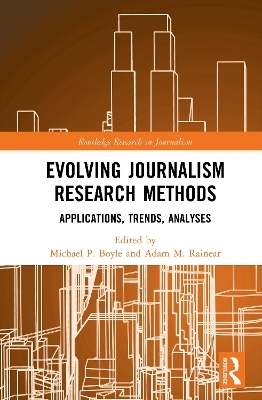
Evolving Journalism Research Methods
Routledge (Verlag)
978-1-032-62148-7 (ISBN)
Divided into five sections, this volume begins by contextualizing key theories and industry debates, from newsroom automation to ethics in research. It addresses sampling and sourcing techniques as well as the broad distinctions between qualitative and quantitative methods, including their relative strengths and weaknesses. Finally, authors consider and problematize techniques for analyzing and reporting data. Throughout the book, case studies illuminate the close relationship between theory and methodology in the research process, bringing into question issues such as source credibility, news framing, and the roles of gender, big data, and Artificial Intelligence.
Featuring diverse contributions from scholars at the cutting-edge of research in this area, this book is key reading for anyone researching journalism or studying industry issues at an advanced level.
Michael P. Boyle is a Professor in the Department of Communication and Media at West Chester University, USA. His research interests focus on news coverage of protest as well as the implications of media use on public opinion and perceptions of media effects. Adam M. Rainear is an Associate Professor in the Department of Communication and Media at West Chester University, USA. His research utilizes technology—such as social media, robotics, and artificial intelligence—to understand how individuals access information and communicate about risks such as weather, climate, and environmental hazards.
List of Contributors
Section I: Theory in a Changing World
Introduction to theory in a changing world
Michael P. Boyle and Adam M. Rainear
Chapter 1: Digital journalism: Theory, practice, and critics
Masduki, Iwan Awaluddin Yusuf, Narayana Mahendra Prastya, Id NDK Ningsih, and Dian Dwi Anisa
Chapter 2: Heuristics and digital horizons: Navigating media effects in journalism
Xialing Lin and Patric R. Spence
Chapter 3: Community structure shapes journalism: From modest model to robust theory
John C. Pollock
Chapter 4: Understanding user and designer perspectives on newsroom automation: Exploring a clash in newsworker and technologist perspectives through comparative analysis
Shangyuan Wu, Pei Qi Chua, and Edson C. Tandoc Jr.
Chapter 5: An exploratory experiment to understand perceptions of medical experts and scientists presented in news media regarding the COVID-19 vaccine
Brett W. Robertson and Adam M. Rainear
Chapter 6: Ethics in research
Kimberly Meltzer
Section II: Sampling and Measurement
Section introduction
Michael P. Boyle and Adam M. Rainear
Chapter 7: Rapport and journalist to subject relationships
Kimberly Meltzer
Chapter 8: Measuring media's ecological effects: Spatial analyses of local media’s role in non-institutional political engagement
Abby Y. Qin
Chapter 9: Qualitative listening in data gathering
Michele Kimball
Chapter 10: Universal Design (UD) practices and accessibility disclosure statements: Best practices in the web-based research
Alicia Mason, Elizabeth A. Spencer, Pan Liu, Kristen M. Livingston, Angela Ashmore, Lauren Shepard, and Tristan A. Spencer
Chapter 11: Gender, caste, language, and terrain in India's Maoist conflict journalism fieldwork
Ashmi Desai
Chapter 12: Exploring question order-effects: Implications for questionnaire design
Mike Schmierbach and Michael P. Boyle
Section III: Qualitative Research Methods
Section introduction
Michael P. Boyle and Adam M. Rainear
Chapter 13: Four research methods for studying journalists' knowledge and expertise
Zvi Reich, Irit Neumann, Oded Jackman, Liri Bloom and Tal Mishaly
Chapter 14: Qualitative analysis in fact-checking methodology research: Semi-structured, in-depth interviews
Victoria Moreno-Gil
Chapter 15: Journalism and autoethnography: An explication and application
James A. Ford and Richard D. Besel
Chapter 16: Focus groups in journalism research: A reappraisal
Martin J. Riedl, Gina M. Masullo, and Tamar Wilner
Chapter 17: Discourses of a shortage: News sharing on social media during the 2022 infant formula crisis
Alison N. Novak
Chapter 18: Interviews and focus groups within journalists in Pakistan's conflict zone: Methodological and ethical challenges
Sayyed Fawad Ali Shah & Shabir Hussain
Chapter 19: Gender sensitive journalism education in Kashmir: An exploratory study
Paromita Pain, Aaliya Ahmed, and Zara Malik Khaled
Section IV: Quantitative Research Methods
Section introduction
Michael P. Boyle and Adam M. Rainear
Chapter 20: Cognitive barriers to select news from distrusted sources: An eye tracking examination of expectancy violation perceptions
Robin Blom
Chapter 21: Effects of collectivism in perceptions of websites and discussion forums: A comparison between national vs. individual-level differences
Maria D. Molina and Mike Schmierbach
Chapter 22: The necessity and sufficiency of intercoder reliability and other contemporary issues in content analyses
Cory L. Armstrong and Fangfang Gao
Chapter 23: Stimulus creation for experiments: A case study using media literacy videos
Anne Oeldorf-Hirsch, Alyssa Appelman, Mike Schmierbach, and Michael P. Boyle
Chapter 24: Latent Dirichlet allocation (LDA) topic modeling and journalism studies: A case study of UK news coverage using Freedom of Information (FOI) requests
Jingrong Tong
Chapter 25: Cancer information overload and message fatigue: The overload-fatigue model and dispositional origins
Jakob D. Jensen, Rachel A. Katz, Helen M. Lillie, Manusheela Pokharel, Dallin R. Adams, and Sean Upshaw
Section V: Analyzing and Reporting Data
Section introduction
Michael P. Boyle and Adam M. Rainear
Chapter 26: Planning, conducting, and presenting visual journalism research: Considerations for visual data collection, analysis, and publication
T.J. Thomson
Chapter 27: Using newsroom reconstruction to understand metacognition in journalism
Patrick R. Johnson
Chapter 28: Exploring news consumption as an independent and dependent variable
L. Meghan Mahoney and Tang Tang
Chapter 29: Applying responsible research and innovation (RRI) as a method in journalism research
Astrid Gynnild and Anja Salzman
Chapter 30: “Flow” as the new unit of analysis: Introducing snowball crawling and named-entity recognition as a methodological toolkit for media research
Steve Guo and Dan Wang
Chapter 31: Who said what? Studying public opinions with big data methods and discourse perspectives
Xianlin Jin and Xin Sheng
Index
| Erscheinungsdatum | 17.10.2025 |
|---|---|
| Reihe/Serie | Routledge Research in Journalism |
| Zusatzinfo | 17 Tables, black and white; 3 Line drawings, black and white; 10 Halftones, black and white; 13 Illustrations, black and white |
| Verlagsort | London |
| Sprache | englisch |
| Maße | 156 x 234 mm |
| Gewicht | 930 g |
| Themenwelt | Geisteswissenschaften ► Geschichte |
| Sozialwissenschaften ► Kommunikation / Medien ► Journalistik | |
| Sozialwissenschaften ► Kommunikation / Medien ► Kommunikationswissenschaft | |
| Sozialwissenschaften ► Kommunikation / Medien ► Medienwissenschaft | |
| ISBN-10 | 1-032-62148-6 / 1032621486 |
| ISBN-13 | 978-1-032-62148-7 / 9781032621487 |
| Zustand | Neuware |
| Informationen gemäß Produktsicherheitsverordnung (GPSR) | |
| Haben Sie eine Frage zum Produkt? |
aus dem Bereich