


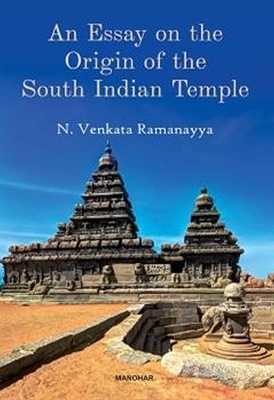
An Essay on the Origin of the South Indian Temple
Seiten
2024
Manohar Publishers and Distributors (Verlag)
978-93-6080-755-9 (ISBN)
Manohar Publishers and Distributors (Verlag)
978-93-6080-755-9 (ISBN)
- Titel nicht im Sortiment
- Artikel merken
Dravidian art is one of the visible features which defines the South Indian form of architecture. Initially, Gramadevata was the South Indian village deity that was revered, as temples were not prevalent during the ancient times, particularly during the pre-Sangam and Sangam periods. Similarly, gravesites and stone rings were also seen as sites of worship. However, in the later period, the proto-Dravidian architectural style was developed under the Todas.
With the emergence of dynasties in the early medieval period, such as Cholas, Pallavas, Cheras, Pandyas, and other ancient South Indian kingdoms, temple architecture began to develop rapidly. The author marks some of the prime features of the South Indian temple architecture, such as the origins and different forms of vimana. This book also covers the intersection between Buddhism and Hinduism, and how Buddhist architecture gave rise to the South Indian temple architecture.
With the emergence of dynasties in the early medieval period, such as Cholas, Pallavas, Cheras, Pandyas, and other ancient South Indian kingdoms, temple architecture began to develop rapidly. The author marks some of the prime features of the South Indian temple architecture, such as the origins and different forms of vimana. This book also covers the intersection between Buddhism and Hinduism, and how Buddhist architecture gave rise to the South Indian temple architecture.
The author N. Venkata Ramanayya was a historian specializing in early and medieval South India. He authored books like Vijayanagara: Origin of the City and the Empire; Velugotivarivamsavali, etc.
I Introduction
II The Sacred Tree
III The Pre-Historic Graves
IV The Stone Ring of the Magic Circle
V The Toda Azabams and the primitive Temple
VI The Primitive Temple and the Temple of the Village Deity
VII The Origin of the Vimana
VIII The Buddhist Origin of the Hindu Temple
IX The Extent of the Buddhist Indebtedness: The Stupa
X The Chaitya
XI The Hindu Temple and the Buddhist Temple
XII The Pallavas and the South Indian Temple
XIII The Dolmen Temple and the Toda Boath
XIV The Vimanas of Different Types
XV The Conclusion
| Erscheint lt. Verlag | 31.7.2024 |
|---|---|
| Zusatzinfo | 19 b&w images |
| Verlagsort | New Delhi |
| Sprache | englisch |
| Maße | 150 x 230 mm |
| Themenwelt | Geisteswissenschaften ► Religion / Theologie ► Hinduismus |
| Technik ► Architektur | |
| ISBN-10 | 93-6080-755-9 / 9360807559 |
| ISBN-13 | 978-93-6080-755-9 / 9789360807559 |
| Zustand | Neuware |
| Informationen gemäß Produktsicherheitsverordnung (GPSR) | |
| Haben Sie eine Frage zum Produkt? |
Mehr entdecken
aus dem Bereich


aus dem Bereich
Spiritual Living for Today Based on India's Thousand Names of …
Buch | Softcover (2025)
Nilgiri Press (Verlag)
CHF 35,90
Unearthing and Enacting the Feelings of Nine Himalayan Hindu …
Buch | Hardcover (2025)
De Gruyter (Verlag)
CHF 142,00


