


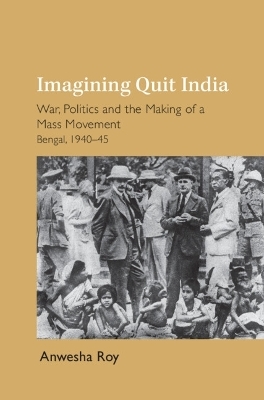
Imagining Quit India
War, Politics and the Making of a Mass Movement, Bengal 1940–45
Seiten
2025
Cambridge University Press (Verlag)
978-1-009-65044-1 (ISBN)
Cambridge University Press (Verlag)
978-1-009-65044-1 (ISBN)
The book explores an untold story of the Second World War – just how revolutionary and emotional the experience of the War was in eastern India, and how, in the midst of this global conflict, far from being a confident leader, the movement highlighted British imperial anxieties of a post-war political order.
This book traces an emotional and revolutionary history of the Second World War, through the prism of the Quit India Movement in Bengal. While this last mass-movement of colonial India echoed at an all-India level, Bengal was exceptional in the 1940s due to its geostrategic position after Japan's entry and Calcutta's industrial base. Rooted in the domestic and international context of War, the author explores three interconnected themes – that the Quit India movement in Bengal was not so much the product of 'war of ideas', but was imagined and sustained by a complex synthesis of both Gandhian and revolutionary ideas of political 'action', the violent response by the colonial state in India reveals complex undercurrents of imperial anxieties of a post-war political order where it was fast losing out to the resurgent USA and the conflict between legal and moral ideas of political responsibility displayed by imperial Britain and Gandhi.
This book traces an emotional and revolutionary history of the Second World War, through the prism of the Quit India Movement in Bengal. While this last mass-movement of colonial India echoed at an all-India level, Bengal was exceptional in the 1940s due to its geostrategic position after Japan's entry and Calcutta's industrial base. Rooted in the domestic and international context of War, the author explores three interconnected themes – that the Quit India movement in Bengal was not so much the product of 'war of ideas', but was imagined and sustained by a complex synthesis of both Gandhian and revolutionary ideas of political 'action', the violent response by the colonial state in India reveals complex undercurrents of imperial anxieties of a post-war political order where it was fast losing out to the resurgent USA and the conflict between legal and moral ideas of political responsibility displayed by imperial Britain and Gandhi.
Anwesha Roy is a Lecturer in Modern History at the University of Sheffield. She has published widely on modern Indian history and is the author of Making Peace, Making Riots: Communalism and Communal Violence, Bengal 1940-1947 (CUP, 2018). She is a Fellow of the Royal Historical Society and the Royal Asiatic Society.
Maps and Figures; Acknowledgements; Abbreviations; Glossary; Introduction; 1. British Bole Baap Re Baap: The Second World War, Rumours and Revolutionary Parties; 2. A Cacophony of (Ir)responsibilities – The Politics of 'Responsibility' around the Movement; 3. The Quit India Movement in Bengal 1942-45; Concluding Remarks;Afterword; Appendix; Bibliography; Index.
| Erscheinungsdatum | 25.11.2025 |
|---|---|
| Zusatzinfo | Worked examples or Exercises |
| Verlagsort | Cambridge |
| Sprache | englisch |
| Gewicht | 418 g |
| Themenwelt | Geschichte ► Allgemeine Geschichte ► Neuzeit (bis 1918) |
| Geschichte ► Allgemeine Geschichte ► 1918 bis 1945 | |
| ISBN-10 | 1-009-65044-0 / 1009650440 |
| ISBN-13 | 978-1-009-65044-1 / 9781009650441 |
| Zustand | Neuware |
| Informationen gemäß Produktsicherheitsverordnung (GPSR) | |
| Haben Sie eine Frage zum Produkt? |
Mehr entdecken
aus dem Bereich

aus dem Bereich
Geschichte einer wilden Handlung
Buch | Hardcover (2024)
C.H.Beck (Verlag)
CHF 47,60


