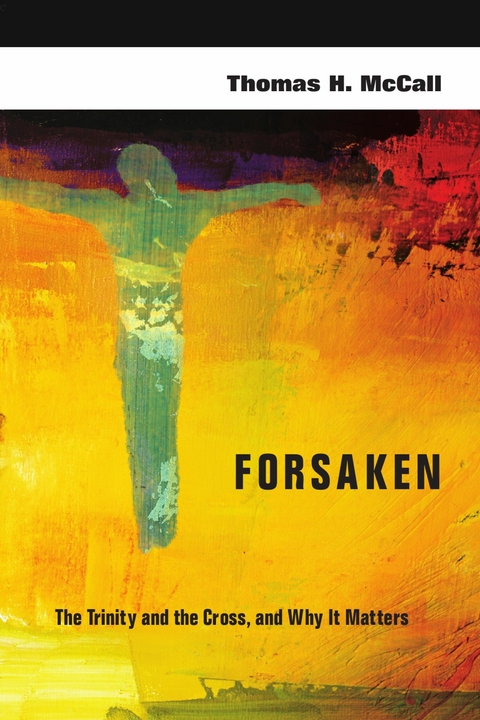
Forsaken (eBook)
171 Seiten
IVP Academic (Verlag)
978-1-5140-1476-9 (ISBN)
Thomas H. McCall (PhD, Calvin Seminary) is professor of biblical and systematic theology and director of the Carl F. H. Henry Center for Theological Understanding at Trinity Evangelical Divinity School in Deerfield, Illinois. He is the author of Which Trinity? Whose Monotheism? and Forsaken: The Trinity and the Cross, and Why It Matters.
Thomas H. McCall (PhD, Calvin Seminary) is professor of biblical and systematic theology and director of the Carl F. H. Henry Center for Theological Understanding at Trinity Evangelical Divinity School in Deerfield, Illinois. He is the author of Which Trinity? Whose Monotheism? and Forsaken: The Trinity and the Cross, and Why It Matters.
2
Did the Death of Jesus Make It
Possible for God to Love Me?
Righteous Wrath, Holy Love and the Heart of the Triune God
The Trinity is not broken; God is one in being and act. The unity of God’s operation in creation and redemption is grounded in the internal unity of the triune life. The Bible speaks in clear and compelling ways about the beautiful, holy love shared between the three divine persons, and it tells us that this love is the same love that God extends to the world. God loves the world—and God does so because God is love within the triune life. But the Bible also speaks in uncomfortably clear terms about the “wrath of God.” Just what are we to make of the biblical witness to the wrath of God? Is it opposed to his love? Is it a “dark side” to God that is inconsistent with his holiness or with his mercy? Or is the fact that God’s wrath is directed against all rebellion—and, more personally, against all rebels—somehow “good news”?
RIGHTEOUS WRATH AND HOLY LOVE
Again, Scripture speaks—repeatedly and powerfully—of both the wrath and love of God. Even a brief review of some of the biblical witness shows both the prevalence and power of God’s self-revelation. But, as we shall see, the biblical witness does not set love and wrath in opposition to one another.
The wrath of God. Paul tells us that he is “not ashamed of the gospel, because it is the power of God that brings salvation to everyone who believes: first to the Jew, then to the Gentile” (Rom 1:16). He is not ashamed because a “righteousness from God” (received “by faith”) is revealed (Rom 1:17). And then Paul immediately tells us that “the wrath of God is being revealed from heaven against all the godlessness and wickedness of people, who suppress the truth by their wickedness” (Rom 1:18). Paul here says that the wrath of God is being revealed. He says that it is being revealed “from heaven.” And notably, he says that it is being revealed against both the “wickedness” (adikia) and the “godlessness” (asebeia) of humanity.
Divine wrath is directed against “wickedness”; it is opposed to the evil affections and behaviors of human sinners as they violate each other and pillage God’s creation. It also stands in diametric opposition to “godlessness,” for it is directly pointed at all creaturely rejections of their Creator and Sustainer. This double-pronged focus is well-attested in both the Old and New Testaments.1 The Old Testament has unmistakable warnings for those who deny justice to the oppressed. “This is what the LORD says: Do what is just and right. Rescue from the hand of the oppressor the one who has been robbed. Do no wrong or violence to the foreigner, the fatherless or the widow, and do not shed innocent blood in this place” (Jer 22:3). God’s command is clear.
Administer justice every morning;
rescue from the hand of the oppressor
the one who has been robbed. (Jer 21:12)
And the warning is just as clear.
Or my wrath will break out and burn like fire
because of the evil you have done. (Jer 21:12)
In the Old Testament, sins against fellow human creatures, including oppression and injustice as well as all manner of social ills and sexual abuses, are closely tied to and indeed follow from sin against God (e.g., Ex 22:16-24). Idolatry is quickly followed by debauchery, oppression and violence (e.g., Ezek 22:1-29). Godlessness—expressed most commonly and most openly in the practice of idolatry but also present in all those who do not follow God wholeheartedly as well as those who do not speak truthfully of him—deserves God’s wrath and threatens those who either practice or condone it (e.g., Ex 32:1-10; Num. 25:3; 32:10-14; Job 42:7). Thus we have repeated and forceful warnings not to “forget” the Lord, who rescued Israel, and the commands to
fear the LORD your God, and serve him only and take your oaths in his name. Do not follow other gods, the gods of the peoples around you; for the LORD your God, who is among you, is a jealous God and his anger will burn against you, and he will destroy you from the face of the land. Do not put the LORD your God to the test as you did at Massah. Be sure to keep the commands of the LORD your God and the stipulations and decrees he has given you. Do what is right and good in the LORD’s sight, so that it may go well with you. (Deut 6:13-18)
Idolatry, nothing less than rebellion against God, brings nothing but wrath and judgment (e.g., Josh 22:16-18; 23:16), for God opposes our opposition to his purposes and will.
God in his wrath opposes the sins of Israel, both before (e.g., Num 32:14) and during the divided kingdom (e.g., 2 Chron 28:11-13) as well as after the exile (e.g., Neh 13:18). God exercises his wrath against the sinful nations as well (e.g., Ezek 25:14, 17). Accordingly, God uses Israel to chastise and discipline her pagan neighbors,2 but he also uses those same pagan neighbors to discipline Israel (e.g., Is 10:5-19; Ezek 21:1-24; Hab 1:5-11).3 Everywhere it is clear that the people who sin do so against God’s good and just intentions for his creation, and they do so in direct opposition to God’s desires for them. “Now your impurity is lewdness. Because I tried to cleanse you but you would not be cleansed from your impurity, you will not be clean again until my wrath against you has subsided” (Ezek 24:13).
The consequences of sin are both breathtaking and frightening. As D. A. Carson notes,
The wrath of God manifests itself in sword, hunger, and plague (Ezek. 6:11-14), in wasting diseases “until you perish” (Deut. 28:22), devastation (Jer. 25:37-38), scattering (Lam. 4:16), and depopulation (Jer. 50:13). God treads the nations in his winepress (Isa. 63:1-6); alternatively, God gives them the cup of his fury to drink (Isa. 51:17; cf. 63:1-2; Joel 3:13). Under the wrath of God, members of the covenant community may be “cut off” from their people (e.g., Exod. 30:33, 38; Lev. 7:20; Num. 9:13; 19:20).4
Carson is correct when he says that the biblical witness to the wrath of God against sin is “humbling and frightening.”5
The wrath of God is sometimes depicted in intensely personal terms in the Old Testament. We know well the frequent portrayals of God as King and Judge in Scripture. But he also reveals himself as a Father, which throws the personal nature of our relationship with him—and of his wrath toward us as sinners—into sharper relief (e.g., Ex 4:22; Ps 103:13). Seen in this light, God’s wrath is not detached and impersonal; nor is it the polar opposite to his love and mercy. It is not the selfish frustration or temper of someone who is self-obsessed and irate with anyone who gets in the way of his own self-actualization or self-fulfillment. Instead, it is the wrath of someone who loves deeply and powerfully—it is the wrath that says, “What are you doing to yourself? How dare you do such a thing?” As Leon Morris says, the wrath of God in the Old Testament is “the wrath of a loving father who yearns for his children to come to him.”6
But God also gives us self-portraits in the Old Testament that show an even more personally intense side of divine wrath, for he portrays his relationship to his people in explicitly nuptial terms—as that of a spouse who is faithful to one who is unfaithful.7 God likens his people to those who have committed adultery by prostituting themselves and sleeping with the enemy (e.g., the Egyptians, the Assyrians and the Chaldeans in Ezek 23:1-49, with the Philistines and Babylonians included in Ezek 16:23-29). Yahweh lays charge against his people in uncomfortably straightforward and direct terms.
But you trusted in your beauty and used your fame to become a prostitute. You lavished your favors on anyone who passed by and your beauty became his. You took some of your garments. . . . You also took the fine jewelry I gave you, the jewelry made of my gold and silver, and you made for yourself idols and engaged in prostitution with them. And you took your embroidered clothes to put on them. . . . Also the food I provided for you. . . .
And you took your sons and daughters whom you bore to me and sacrificed them as food to the idols. Was your prostitution not enough? You slaughtered my children and sacrificed them to idols. (Ezek 16:15-21)
The Lord points out that this prostitution is so twisted that “you give gifts to all your lovers, bribing them to come to you from everywhere for your illicit favors” (Ezek 16:33). We see God’s wrath here to be “jealous anger” (Ezek 16:38), and it results in judgment, as God says that he will “deliver you into the hands of your lovers” who will destroy you and leave you “stark naked” (Ezek 16:39-41). Divine wrath as portrayed in the Old Testament is both real and personal.
Carson observes that a common misconception is that the New Testament is less concerned with divine wrath than the Old Testament; for while there might be a “residue of wrath” in the New Testament, in general “a gentleness takes over and softens the darker period: God’s love is now richer than his wrath. After all, Jesus taught his disciples to love their enemies and turn the other cheek.”8 Carson rejects this misconception: “Nothing could be...
| Erscheint lt. Verlag | 12.6.2025 |
|---|---|
| Verlagsort | Lisle |
| Sprache | englisch |
| Themenwelt | Geisteswissenschaften ► Religion / Theologie ► Christentum |
| Schlagworte | abandoned • Bible • Christ • Christian • Crucifixion • Death • doctrin • Father • Gospel • Historical • Holy Spirit • Interpretation • Jesus • New Testament • NT • Orthodox • Resurrection • Scripture • Son • Study • Survey • Textual • Theological • Three in One • Trinitarian |
| ISBN-10 | 1-5140-1476-9 / 1514014769 |
| ISBN-13 | 978-1-5140-1476-9 / 9781514014769 |
| Informationen gemäß Produktsicherheitsverordnung (GPSR) | |
| Haben Sie eine Frage zum Produkt? |
 EPUB (Wasserzeichen)
DRM: Digitales Wasserzeichen
Dieses eBook enthält ein digitales Wasserzeichen und ist damit für Sie personalisiert. Bei einer missbräuchlichen Weitergabe des eBooks an Dritte ist eine Rückverfolgung an die Quelle möglich.
Dateiformat: EPUB (Electronic Publication)
EPUB ist ein offener Standard für eBooks und eignet sich besonders zur Darstellung von Belletristik und Sachbüchern. Der Fließtext wird dynamisch an die Display- und Schriftgröße angepasst. Auch für mobile Lesegeräte ist EPUB daher gut geeignet.
Systemvoraussetzungen:
PC/Mac: Mit einem PC oder Mac können Sie dieses eBook lesen. Sie benötigen dafür die kostenlose Software Adobe Digital Editions.
eReader: Dieses eBook kann mit (fast) allen eBook-Readern gelesen werden. Mit dem amazon-Kindle ist es aber nicht kompatibel.
Smartphone/Tablet: Egal ob Apple oder Android, dieses eBook können Sie lesen. Sie benötigen dafür eine kostenlose App.
Geräteliste und zusätzliche Hinweise
Buying eBooks from abroad
For tax law reasons we can sell eBooks just within Germany and Switzerland. Regrettably we cannot fulfill eBook-orders from other countries.
aus dem Bereich