Gems and the New Science
University of Chicago Press (Verlag)
978-0-226-64460-8 (ISBN)
- Noch nicht erschienen (ca. Februar 2026)
- Versandkostenfrei
- Auch auf Rechnung
- Artikel merken
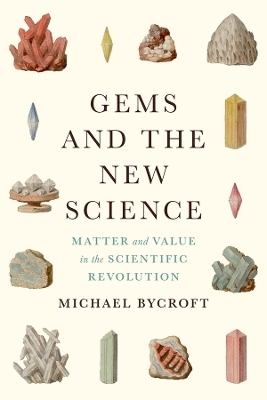
In Gems and the New Science, Michael Bycroft argues that gems were connected to major developments in the “new science” between the sixteenth and nineteenth centuries. As he explains, precious and semiprecious stones were at the center of dramatic shifts in natural knowledge in early modern Europe. They were used to investigate luminescence, electricity, combustion, chemical composition, and more. They were collected by naturalists; measured by mathematicians; and rubbed, burned, and dissolved by experimental philosophers. This led to the demise of the traditional way of classifying gems—which grouped them by transparency, color, and locality—and the turn to density, refraction, chemistry, and crystallography as more reliable guides for sorting these substances.
The science of gems shows that material evaluation was as important as material production in the history of science. It also shows the value of seeing science as the product of the interaction between different material worlds. The book begins by bringing these insights to bear on five themes of the Scientific Revolution. Each of the subsequent chapters deals with a major episode in early modern science, from the expansion of natural history in the sixteenth century to the emergence of applied science early in the nineteenth century. This important work is not only the first book-length history of the science of gems but also a fresh interpretation of the Scientific Revolution and an argument for using a new form of materialism to understand the evolution of science.
Michael Bycroft is associate professor in the history of science and technology at the University of Warwick. He is the coeditor of Gems in the Early Modern World: Materials, Knowledge, and Global Trade, 1450–1800.
List of Abbreviations
Note on Terminology
Introduction
Gems
Matter
Value
The Scientific Revolution
Matter and Value in the Scientific Revolution
Seven New Sciences
Alternative Histories of Gem Science
1. Gem Classification and Renaissance Natural History
From Luxuries to Virtues
Trade and the Orient
Tools and Hardness
Oriental Hardness
Classification Without Systematics
2. Gems and Technical Writing in the Age of Louis XIV
Manuals
Inventories
Travel Narratives
Maps
Letters
The Mutual Influence of the Crafts
3. Gem Collecting and Experimental Philosophy
A Virtual Collection
The Jewel House
Strange Proofs
Trials of Goodness
4. Gems and the French Origins of Experimental Physics
Material-Driven Experimentation
Assaying Gems
Physics as Gem Collecting
Electricity as a Science of Materials
The Varieties of Matter
5. Precision and Preciousness in Enlightenment Mineralogy
From Lapidaries to Mineralogies
Color and Nuance
Refraction and Structure
Density and Variety
Crystals and Correlation
Gems and the Quantifying Spirit
6. Gems, the Crafts, and Chemical Composition
Metals and Porcelain
Diamond and Porcelain
Drugs and Glass
Gems and Metals
Compositionism About What?
7. The End of Gems and the Origins of Gemology
Books
Collections
Tests
Expertise
Value-Free Evaluation
Conclusion
A Brief History of Garnet
From Materialism to Transmaterialism
From Production to Evaluation
Gems Beyond the Scientific Revolution
Acknowledgments
Appendix 1. Diamonds Used in the Argument of Boyle’s Gems
Appendix 2. Gem Specimens from the Regent’s Survey, 1714–1719
Appendix 3. Gems in Dufay’s Experiments
Appendix 4. Comparative Table of Enlightenment Gem Taxonomies
Appendix 5. Refraction Data from Buffon and Rochon
Bibliography
Index
| Erscheint lt. Verlag | 24.2.2026 |
|---|---|
| Reihe/Serie | Synthesis |
| Zusatzinfo | 10 color plates, 35 halftones, 8 tables |
| Sprache | englisch |
| Maße | 152 x 229 mm |
| Gewicht | 454 g |
| Themenwelt | Geisteswissenschaften ► Geschichte |
| Naturwissenschaften ► Chemie | |
| Naturwissenschaften ► Geowissenschaften ► Geologie | |
| ISBN-10 | 0-226-64460-X / 022664460X |
| ISBN-13 | 978-0-226-64460-8 / 9780226644608 |
| Zustand | Neuware |
| Informationen gemäß Produktsicherheitsverordnung (GPSR) | |
| Haben Sie eine Frage zum Produkt? |
aus dem Bereich