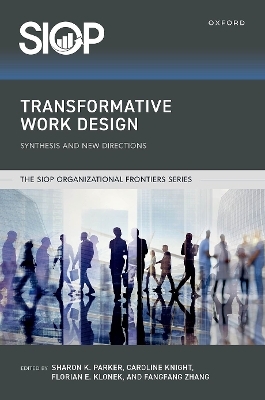
Transformative Work Design
Oxford University Press Inc (Verlag)
978-0-19-769256-1 (ISBN)
The book also covers key methodologies for studying work design and explores new areas of research. For instance, authors explore how work design can shape identity and personality development, moving beyond the usual focus on wellbeing and performance outcomes. Additionally, the book shifts the traditional emphasis from understanding the outcomes of work design to unpacking the antecedents of work design. Chapters explore how various individual, team, organizational, and global factors shape the way people's work is designed, laying the foundation for understanding how to successfully redesign work.
Picking up this perspective, several chapters focus on how to change work design. By discussing 'top down' work redesigns, such as self-managing teams, and 'bottom up' approaches like playful work design and job crafting, pathways to creating better work are identified. A final section highlights critical issues raised by large-scale technological and demographic shifts, such as remote working trends, population aging, and rapid digitalization.
Sharon K. Parker, ARC Laureate Fellow, is a John Curtin Distinguished Professor at Curtin University, Director of the Centre for Transformative Work Design at Curtin University, a Fellow of the Australian Academy of Social Science and in 2019 she was named among the world's most influential scientists and social scientists in the Web of Science Highly Cited Researchers list. Caroline Knight is a Senior Lecturer in The University of Queensland Business School. Caroline's research focuses on understanding how we can design work which is optimally healthy for individuals and organisations. Her focus is on work design, remote and hybrid work, work redesign interventions, and well-being. Florian Erik Klonek is a Senior Lecturer at Deakin University. He is interested in understanding effective social interactions and processes in the context of groupwork, teams and leadership. Fangfang Zhang is a Research Fellow at the Centre for Transformative Work Design at Curtin University. She is also a CEPAR (Centre of Excellence in Population Ageing Research) Research Fellow located at the Centre for Transformative Work Design.
Chapter 1: Transformative Work Design: An Integrative Framework
Chapter 2: The Evolution of Work Design Theory and Research
Chapter 3: Multilevel Work Design: Integrating Work Characteristics Across Individual, Team, and Organizational Levels of Analysis
Chapter 4: Job-Design and Well-Being: A Review of the Empirical Evidence
Chapter 5: Work Design and Performance
Chapter 6: Work Design and Identity: Taking Stock of What We Know and Charting Pathways for Future Research
Chapter 7: What You Do Makes Who You Are: The Role of Work Design in Personality Change
Chapter 8: Methodology in Work Design Research: The Past, Present, and (Longitudinal) Future
Chapter 9: Global and National Factors Shaping Work Design
Chapter 10: Occupational, Organisational, Managerial and Work Group Factors
Chapter 11: Developmental Challenge
Chapter 12: How and Why do Top-Down Work Redesign Interventions Impact Wellbeing and Performance?
Chapter 13: Implementing and Sustaining Work Redesign
Chapter 14: Capturing the magic: A PAARTH to Participatory Work Design
Chapter 15: Understanding the outcomes of work transformations: Evaluation of organizational interventions
Chapter 16: Job Crafting Theory and Perspectives
Chapter 17: Job Crafting Interventions
Chapter 18: It Pays to Play: Playful Work Design
Chapter 19: Artificial Intelligence: How it Changes the Landscape for Work Design Research and Practice
Chapter 20: Reimagining Work Design in Contemporary Employment: The Disruptive Rise of the Gig Economy
Chapter 21: The Perils of Algorithmic Management for Work Design
Chapter 22: Understanding Why, When, and How Virtual Work Works Through the Lens of a Work Design Perspective
Chapter 23: Designing Work to Retain an Ageing Workforce
Chapter 24: Text Analysis Using Artificial Intelligence as a Tool for Job Analysis and Job Design
Chapter 25: Where is the Future of Work Design Research Heading? A Roadmap for Key Topics to Be Investigated
| Erscheinungsdatum | 30.05.2025 |
|---|---|
| Reihe/Serie | The SIOP Organizational Frontiers Series |
| Verlagsort | New York |
| Sprache | englisch |
| Maße | 158 x 234 mm |
| Gewicht | 989 g |
| Themenwelt | Geisteswissenschaften ► Psychologie ► Arbeits- und Organisationspsychologie |
| ISBN-10 | 0-19-769256-7 / 0197692567 |
| ISBN-13 | 978-0-19-769256-1 / 9780197692561 |
| Zustand | Neuware |
| Informationen gemäß Produktsicherheitsverordnung (GPSR) | |
| Haben Sie eine Frage zum Produkt? |
aus dem Bereich