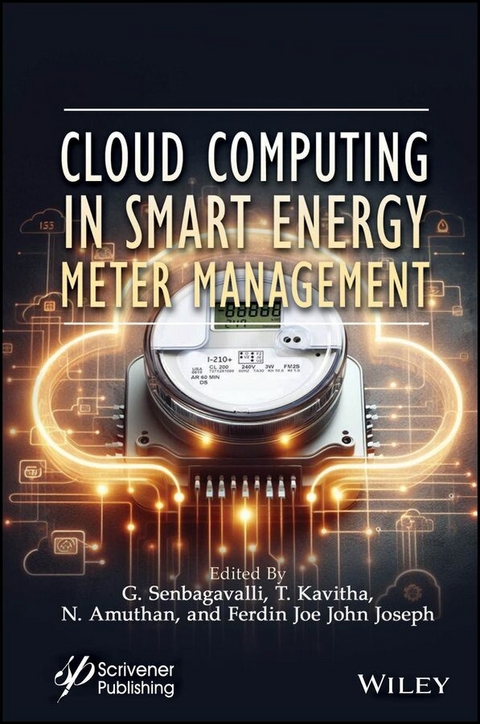
Cloud Computing in Smart Energy Meter Management (eBook)
783 Seiten
Wiley-Scrivener (Verlag)
978-1-394-19374-5 (ISBN)
Cloud Computing in Smart Energy Meter Management equips you with essential insights and practical solutions for effectively managing smart meter data through cutting-edge technologies like artificial intelligence and cloud computing, making it an invaluable resource for anyone looking to enhance their understanding of modern energy management.
Cloud Computing in Smart Energy Meter Management presents a structured review of the current research on smart energy meters with artificial intelligence and cloud computing solutions. This book will help provide solutions for processing and analyzing the massive amounts of data involved in smart meters through cloud computing. Readers will learn about data storage, processing, and dynamic pricing of smart energy data in the cloud, as well as smart metering concepts dealing with the flow of power consumption from consumer to utility center. It offers an in-depth explanation of advanced metering infrastructure (AMI) which includes meter installation, meter advising, commissioning, integration, master data synchronization, billing, customer interface, complaints, and resolution. In smart cities, components in household energy meters are fitted with sensors and can interconnect with the Internet of Things to measure power consumption with an automated meter reading. This book also acts as a new resource describing new technologies involved in the integration of smart metering with existing cellular networks. Cloud Computing in Smart Energy Meter Management provides knowledge on the vital role played by artificial intelligence and cloud computing in smart energy meter reading with precise evaluations.
G. Senbagavalli, PhD, is an associate professor in the Department of Electronics and Communication Engineering, AMC Engineering College, Bengaluru, India with over 18 years of experience in teaching and research. She has published three patents, two book chapters, and 15 papers in national and international conferences and journals. She is also a lifetime member of the International Society for Technology in Education and the Institution of Electronics and Telecommunications Engineers. Her research interests include image and video processing, computer vision, machine learning, and VLSI Design.
T. Kavitha, PhD, is a professor in the Department of Electronics and Communication Engineering, AMC Engineering College, Bengaluru, India with over twenty years of experience in teaching and research. She has published five patents, two book chapters, 15 papers in international journals, and over 30 papers in national and international conferences. She is also a lifetime member of the International Society for Technology in Education and the Institution of Engineers (India). Her research interests include wireless networks, wireless sensor networks, information security, Internet of Things, deep learning, and machine learning.
N. Amuthan, PhD, is a professor at AMC Engineering College, Bengaluru, India with over 22 years of teaching experience. He has over 26 publications in reputed national and international conferences, workshops, and journals and serves as a reviewer for various national and international journals. He is also a member of numerous national and international committees and societies. His research interests include power electronics, energy conservation, auditing, renewable energy sources, and implementation of the cloud for integration at the national level.
Ferdin Joe John Joseph, PhD, is an assistant professor in the Department of Information Technology at the Thai Nichi Institute of Technology, Bangkok with over a decade of teaching experience. He has several publications in international journals and conferences and has been designated as a Most Valuable Professional with Alibaba Cloud. His areas of research include deep learning, Internet of Things, and Cloud AI.
Cloud Computing in Smart Energy Meter Management equips you with essential insights and practical solutions for effectively managing smart meter data through cutting-edge technologies like artificial intelligence and cloud computing, making it an invaluable resource for anyone looking to enhance their understanding of modern energy management. Cloud Computing in Smart Energy Meter Management presents a structured review of the current research on smart energy meters with artificial intelligence and cloud computing solutions. This book will help provide solutions for processing and analyzing the massive amounts of data involved in smart meters through cloud computing. Readers will learn about data storage, processing, and dynamic pricing of smart energy data in the cloud, as well as smart metering concepts dealing with the flow of power consumption from consumer to utility center. It offers an in-depth explanation of advanced metering infrastructure (AMI) which includes meter installation, meter advising, commissioning, integration, master data synchronization, billing, customer interface, complaints, and resolution. In smart cities, components in household energy meters are fitted with sensors and can interconnect with the Internet of Things to measure power consumption with an automated meter reading. This book also acts as a new resource describing new technologies involved in the integration of smart metering with existing cellular networks. Cloud Computing in Smart Energy Meter Management provides knowledge on the vital role played by artificial intelligence and cloud computing in smart energy meter reading with precise evaluations.
1
Fundamentals of Smart Meter
G. Senbagavalli1*, T. Kavitha2 and S.T. Bibin Shalini3
1AMC Engineering College, Visvesvaraya Technological University, Bangalore, Karnataka, India
2New Horizon College of Engineering, Visvesvaraya Technological University, Bangalore, Karnataka, India
3Kuwait University, Sabah Al Salem University City, Safat State, Kuwait
Abstract
A cloud-based smart metering infrastructure supports the management of smart meter readings, the automation of future distribution grids, and their intelligent monitoring and control. Smart metering’s cloud-based software architecture aims to create cutting-edge services for managing the smart grid. Lately, several countries have started to use state-of-the-art smart meters and advanced metering infrastructures (AMI) to boost the energy industry’s efficiency in the distribution sector. A cloud-based system provides the necessary interfaces to distribution grid services and simultaneously allows communication with smart meters. Many apps may be built on top of the cloud to provide communication with smart meters.
Keywords: Cloud architecture, cloud services, smart metering infrastructure
1.1 Introduction
The advantages of smart meters for the environment will be highlighted via the COVID-19 environmental theme. Smart meters’ role is to lower the carbon footprint. The importance of AMI in outage management systems and service restoration is driven by persistent power quality concerns. Energy theft losses highlight the necessity of effective AMI. Both the development of smart grids and smart cities are two significant themes that might create new business prospects for AMI. The importance of smart cities in emergencies is highlighted by COVID-19. Smart grids are an important component of energy infrastructure in smart cities and a source of income for AMI. The increasing global interest in demand response (DR) has brought attention to AMI as a crucial enabler. Big data and data analytics are essential for maximizing AMI. Internet of Things (IoT), blockchain, and AI play important roles in improving AMI efficiency, and cloud computing transforms the market for smart meters. Consumers desire multiple tariffs and prepaid smart solutions. Government policy for deploying micro-grid solutions. Market rivalry and demand for IT solutions increase as a result of the privatization of power sectors [1]. Electro-mechanical meters gave way to static or electronic meters throughout time, and advanced metering infrastructure (AMI) gave way to automated meter reading (AMR). IT systems, including the distribution management, outage management system, geographic information system (GIS), enterprise ERP, billing system, and customer information system require links to be established with AMI. Also, load connect, load disconnect, and load verification in demand response programs are carried out through smart meters with interested customers and under the necessary rules [2].
On request from HES, upon event trigger (such as interference detection or supply failure, etc.) or by a schedule, AMI systems monitor, gather, and calculate data, assess energy consumption, regulate, and interact with metering equipment. Rate metering and monitoring based on energy can be enabled for time of day (TOD), critical peak pricing (CPP), and real-time pricing (RTP). Usage by using two-way communication to give the user information about consumption patterns and alarm messages, advanced metering infrastructure (AMI) consists of energy consumption meters (smart meters), a database service called the MDMS (meter data management system), and a head-end system (HES) between utilities and customers through two-way communication channels. AMI includes load disconnect switch in smart meters as a control element in the utility [2]. At the customer interconnection points, there is a smart meter that delivers not only revenue information but also power and power-quality information for all devices [3].
Smart meters are sensors that measure many characteristics, including how much electricity is spent. The major methods of communication are power line carrier (PLC), RF mesh (6 LoPAN), and occasionally GPRS through SIM modules. An RF mesh “canopy” is set up in many cities around the world so that different smart devices, such as smart street lighting systems, smart electricity meters, switched capacitor banks, and ring main units, can reliably, securely, and with two-way communication, communicate to their respective Head End Systems. The Head End or IoT Platform must be notified right away of any spontaneously reported irregularities from field devices (such as tampering or supply outages), and remedial signals like disconnecting meters or dispatching local staff must be set up [4, 22]. Numerous worldwide standard-setting organizations, including ETSI, NIST, IETF, CEN, IEEE, CENELEC, IEC, DLMS UA, ITU, and others, remain working together to develop standards for smart meters and grids.
Do Smart Meters Consume Energy Generated at Home That Is Renewable?
Traditional meters are only equipped to record consumption; therefore, they cannot account for any energy that a family generates. With a smart meter, you can determine how much energy you generate in your house, whether you already have solar panels or are intending to add them. If there is an excess that you might sell back to the grid, the smart meter will also determine whether or not there is one. However, because this is a rare demand, providers have been sluggish to put systems in place to accommodate it [5].
1.2 Advanced Metering Infrastructure (AMI)
1.2.1 Foundational Elements of AMI
AMI is made up of several hardware and software parts, each contributing to the measurement of energy use and the transmission of data about energy usage to utility providers and consumers as shown in Figure 1.1. The main technological elements of AMI are as follows [6]:
Smart meters are advanced metering devices with the ability to gather data on energy usage over time and transmit it to the utility via fixed communication networks. They can also receive data from the utility, such as pricing signals, and transmit it to the consumer.
Advanced communication networks that permit two-way communication make it possible for smart meters to provide information to utility companies and vice versa.
Data concentrator units (DCUs) and the control center hardware are used in the meter data acquisition system to collect meter data through a messagelinkage and deliver it through MDMS.
Figure 1.1 Advanced metering infrastructure (AMI).
The host system receives, stores, and analyzes metering data in the meter data management system (MDMS).
Every meter and adapter has a power line carrier (PLC) module or a GSM/ GPRS module that, for GSM/GPRS communication, connects directly to the central system or via a concentrator for PLC communication [7].
The primary duties of master meters are as follows [7]:
- Periodically record the power usage figures and store these values in profiles
- Report any electricity outages
- Keeping track of electrical status and alarm data
- Offer printable tariff switching tables
- Offer a disconnector that allows the customer’s premises to be disconnected and reconnected locally or remotely
- Support the smart meter’s in-house display with recent usage information
- Act as a conduit for messages to be sent starting the efficacy of the smart meter
- Afford a message interface (or interfaces) for communicating with the in-house display, operating the disconnector remotely, and reading the power and slave meter consumption figures remotely.
The meter completely schedules the recording of the measurement data (electricity) into profiles. The profiles are kept locally in the non-volatile memorial by the cadence. The PLC communication between the data concentrator and the PLC module is based on industry-standard protocols (IEC61334). When PLC is not effective (technically or economically), GSM/GPRS communication (IEC 62056 series) is used as a substitute. To ensure optimum dependability, the concentrator keeps a duplicate of the most recent sections of the energy values profile, the daily values profile, and the event logs in its buffer. Each meter node has such a buffer. The concentrator automatically retrieves the missing values of the respective meters during excellent communication circumstances if there are misplaced ideals in the buffer (due to momentary communication issues for data), the CS rarely needs to get in touch with the meter directly and regularly since, whenever it connects the concentrator, it has access to all the pertinent data [7].
1.2.2 Benefits of AMI
Benefits to system operation are mainly related to decreased meter readings and related management and administrative assistance, enhanced utility asset management, quicker energy theft detection [24], and simpler outage management.
Benefits for client amenities are mostly concerned with providing customers with a variety of TOD tariff alternatives, detecting meter failures early, improving billing accuracy, expediting the restoration of service, flexible billing cycles, and creating customer energy profiles to target energy efficiency/demand response programs.
Benefits to the utility’s bottom line include lower apparatus and apparatus maintenance costs, lower support...
| Erscheint lt. Verlag | 17.4.2025 |
|---|---|
| Sprache | englisch |
| Themenwelt | Geisteswissenschaften ► Geschichte |
| Naturwissenschaften ► Physik / Astronomie | |
| Technik ► Elektrotechnik / Energietechnik | |
| Schlagworte | advanced Metering Infrastructure (AMI) • Artificial Intelligence • Billing • Cloud Computing • Data Management • Internet of Things (IoT) • Remote Monitoring Cloud (RMC) • Smart Energy Meter • Smart Meter • Smart Meter Prepaid System • Smart Meter Security |
| ISBN-10 | 1-394-19374-2 / 1394193742 |
| ISBN-13 | 978-1-394-19374-5 / 9781394193745 |
| Informationen gemäß Produktsicherheitsverordnung (GPSR) | |
| Haben Sie eine Frage zum Produkt? |
 EPUB (Adobe DRM)
Kopierschutz: Adobe-DRM
Adobe-DRM ist ein Kopierschutz, der das eBook vor Mißbrauch schützen soll. Dabei wird das eBook bereits beim Download auf Ihre persönliche Adobe-ID autorisiert. Lesen können Sie das eBook dann nur auf den Geräten, welche ebenfalls auf Ihre Adobe-ID registriert sind.
Details zum Adobe-DRM
Dateiformat: EPUB (Electronic Publication)
EPUB ist ein offener Standard für eBooks und eignet sich besonders zur Darstellung von Belletristik und Sachbüchern. Der Fließtext wird dynamisch an die Display- und Schriftgröße angepasst. Auch für mobile Lesegeräte ist EPUB daher gut geeignet.
Systemvoraussetzungen:
PC/Mac: Mit einem PC oder Mac können Sie dieses eBook lesen. Sie benötigen eine
eReader: Dieses eBook kann mit (fast) allen eBook-Readern gelesen werden. Mit dem amazon-Kindle ist es aber nicht kompatibel.
Smartphone/Tablet: Egal ob Apple oder Android, dieses eBook können Sie lesen. Sie benötigen eine
Geräteliste und zusätzliche Hinweise
Buying eBooks from abroad
For tax law reasons we can sell eBooks just within Germany and Switzerland. Regrettably we cannot fulfill eBook-orders from other countries.
aus dem Bereich