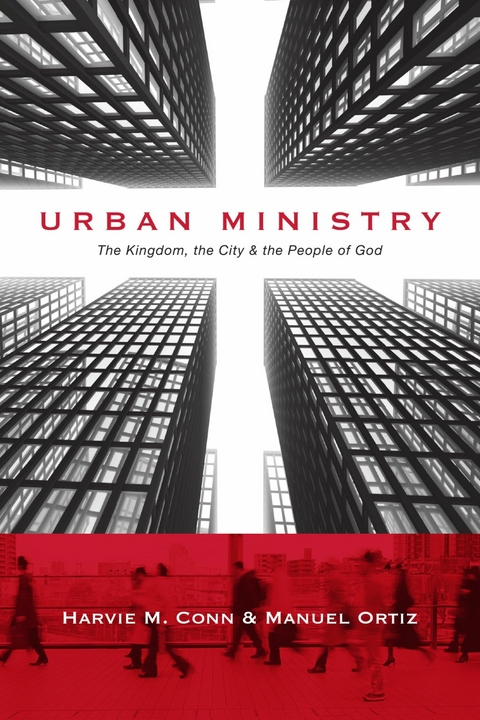
Urban Ministry (eBook)
527 Seiten
IVP Academic (Verlag)
978-1-5140-1469-1 (ISBN)
Manuel Ortiz (1938-2017) was professor of ministry and urban mission and director of the urban program at Westminster Theological Seminary. His books include The Hispanic Challenge: Opportunities Confronting the Church, One New People: Models for Developing a Multiethnic Church, and Urban Ministry: The Kingdom, the City and the People of God (coauthored with Harvie Conn). Ortiz was passionate about integrating urban ministry, education, and the gospel, and he spoke and consulted around the nation. For fourteen years he ministered to Hispanics in Chicago, founding five urban congregations, two elementary schools, and an extension school for theological education. He was also the founder and senior pastor of Spirit and Truth Fellowship (Christian Reformed Church), a multiethnic congregation in Philadelphia, and the codirector of the CRC Philadelphia Initiative for Church Planting.
Manuel Ortiz (1938–2017) was professor of ministry and urban mission and director of the urban program at Westminster Theological Seminary. His books include The Hispanic Challenge: Opportunities Confronting the Church, One New People: Models for Developing a Multiethnic Church, and Urban Ministry: The Kingdom, the City and the People of God (coauthored with Harvie Conn). Ortiz was passionate about integrating urban ministry, education, and the gospel, and he spoke and consulted around the nation. For fourteen years he ministered to Hispanics in Chicago, founding five urban congregations, two elementary schools, and an extension school for theological education. He was also the founder and senior pastor of Spirit and Truth Fellowship (Christian Reformed Church), a multiethnic congregation in Philadelphia, and the codirector of the CRC Philadelphia Initiative for Church Planting. Harvie M. Conn was emeritus professor of missions at Westminster Theological Seminary in Philadelphia, Pennsylvania, before his death in 1999. He was for ten years editor of Urban Mission. He also wrote Evangelism: Doing Justice and Preaching Grace and Eternal Word and Changing Worlds.
1
From the Present to the Past
GRAFFITI MESSAGES ON THE TERMINAL WALL of Tegucigalpa’s airport in the mid-1980s introduce the intention of this chapter. “Poor Honduras—oppressed and occupied,” reads one plaintive, angry line. Below it, a second line in dialogue with the first, scrawled by another hand: “You s.o.b. communist: go back to Cuba.” And under that, a third and last word by yet another writer: “Christ is the answer!” (Berg and Pretiz 1992:13-14).
That third line needs some filling out. How can Christ be the answer to the glory and misery, the order and chaos, the sanctity and sin of our vast cities? If Christ is the urban answer, what are the questions?
If we pluck phrases and adjectives at random from the literature, the verbal impressions become strong: religious “syncretism,” “people who know only despair,” “a population deprived of security and stability,” “an outcast subculture,” a working class caught in a cycle of “insecurity, instability, and low wages,” “a ruling class of some lineage and power,” children as “the victims of economic depression.” How did our cities get this way? Can we find clues from the cities’ past? parallels? connections?
Moving to the urban present requires at least four stopovers along the way. This chapter will review the first two great urban waves—urban empires and feudal and commercial cities—but let’s begin before the territorial state borders of nation and empire, past the boundaries of Rome and Athens, in the hazy world of the city-state.
Shrine City-States
In this world people take their name not from their identity as a people (e.g., Israel) but from their connection with an isolated urban nucleus of political power (e.g., Sumer, Ur). In this world there are no national capitals. There is only one city with its hinterland surroundings. And that city and its monarchy are the state (Buccellati 1967:12-15).
In keeping with the Genesis narrative, the beginnings of these city-states are found in the Tigris-Euphrates river valleys of Mesopotamia (Gen 4:17, 22; 11:1-9). Here, before 4000 B.C., on sites like Al Ubaid in modern Iraq, people built temples on city terraces surrounded by dwellings. Here other cities emerged about the same time—Ur, Eridu and Uruk (probably the Erech of Gen 10:10). Here around 3500 B.C. the Sumerians migrated, drawn by the twin magnets of sea trade and metal, to usher in the bronze age (Moholy-Nagy 1968:37-38).
From these beginnings came years of urban development and struggle. The city-states of Sumer and Akkad battled for dominance. Lagash, Umma, Eshnumma, Kish and Ur, each in its turn, sought to gain hegemony over others. The new city-states of Knossos and Mallia developed on Crete. In the Nile Valley grew centers like Heliopolis, Thebes and Akhetaten (Tell el Amarna). By 1400 B.C., over two millennia later, urbanization was languishing. The cities in the very regions where urban life first appeared went into eclipse. They would not flourish again until the fourth century B.C.—and then with a new shape.
What social, technological and physical conditions created these early city-states? That is a question still widely argued by archaeologists and social scientists. Much of the debate appears to us to be too heavily dependent on evolutionary assumptions of social and cultural development (Adams 1966; Childe 1950:3-17; Kempinski 1983:235-41; Redman 1982:375-82). The biblical record, by comparison, associates the appearance of the city with the first family on earth (Gen 4:17).
Power and the city-state. What links today’s Lima or Jakarta to the early city-states? Certainly not size. Defining these city-states by size is relatively problematic. There was, to be sure, a concentration of people in one place. But the concentrations were small by modern standards. “The walls of ancient Babylon, for example, embraced an area of very roughly 3.2 square miles, and ‘Ur with its canals, harbors, and temples, occupied some 220 acres; the walls of Erech encompassed an area of just two square miles.’ This suggests that the famous Ur could hardly have boasted more than 5,000 inhabitants and Erech hardly more than 25,000” (Davis 1960:430-31).
Where then do we go to find the link between Lima and Akkad? And what enables the archaeologist, as he or she searches among the oldest remains of settlements, to differentiate between small sites considered to have been cities and others labeled villages? The answer may be power.
Signs of it are in evidence everywhere. Craft production and the distribution of trade goods, the presence of monumental buildings like temples and palaces, marks of creativity and innovation, and the fortresslike walls of Jericho all point to a place of radiating power and expanding influence.
Whether small or large the city-state was the anvil of civilization, the center of power, a physical metaphor of human society itself. In the city converged piety and trade, security and politics. Its walls marked it as protector, its shrines and temples its place as the center of the world.
Religion and power. At the heart of power’s expression in the city-state was its religious role, a prologue to the later religiosity of the world’s Limas. Ancient Eridu and Ur, Sumer and Uruk were marked by elaborate temple structures raised on platforms or mounds, the forerunners of the later ziggurats. The temple was central to the life of these cities.
In these urban centers “every feature . . . revealed the belief that man was created for no other purpose than to magnify and serve his gods. That was the city’s ultimate reason for existence” (Mumford 1961:74-75). Citizenship was defined in terms of service to the gods. Family, agriculture and economy were bound together by their religious commitment to the local gods in a seamless experience of everyday life.
Idolatry was not simply an isolated worship of deity. It was the foundation of community, “the shared conviction that the land and all humankind, indeed nature itself, were the property of the gods” (Lapidus 1986:265). Each city was ruled by a king seen as the representative of the city’s tutelary deity. His voice was the voice of the gods, his whim the whim of the gods (Frankfort 1978). Temple priests were judges and politicians; society was sharply divided between the temple elite and the masses who executed the will of the gods. A stratified class system appeared to divide the social hierarchy. Standing at the pinnacle “were small numbers of princely families who seem to have been vigorously extending their control of land by purchase” (Adams 1966:109). At the bottom of the hierarchy? A concentration of slaves. As in Lima, society was polarized.
The First Great Urban Wave: Urban Empires
Mesopotamia’s urban model would have its wider influence. From its cultural cradle ancient cities like Mohenjo-Daro and Harappa would appear in the Indus Valley of present-day Pakistan, Anyang and Zhengzhou in the Huang-Ho valley of China. Egypt bore its Memphis and its Thebes. But the urban achievement of the Indus Valley proved abortive. And in Egypt cities sprang out of the idea of a unified territory, not vice versa (Hammond 1972:57-76). In fact, the first great city-building wave would come not from Mesopotamia at all but from Greece.
The history of Mesopotamia’s city-states would still make contributions to the new urban drive. Emerging from these early city-states was a new twist to urban power that would shape a new direction—the expansion of the city past local borders through conquest. The urban empire was born, and the shrine city became also the imperial city.
Sargon of Akkad (born about 2400 B.C.) was one of the earliest to add this geographical dimension to armed conflict between the cities. And others followed. Asshur, the city named after its god (Gen 10:22), became Assyria the empire, Babel Babylon.
Invested with the divine authority of the city gods, the city kings grew in pride and greed (Dan 4:30) that could not be contained by one city’s borders. The city’s trade routes, its monopolizing control of resources, its manpower demands became structural routes along which spread sin’s quest for power (Jas 4:1-2). The dark side of colonialism that would one day engulf Latin America, Africa and Asia had been born.
Hellenism and the Greco-Roman Empire. Alexander the Great saw the imperial city as a tool for the colonization of his conquered world. By 323 B.C. that world included the Persian empire and stretched from Macedonia on the Balkan peninsula across Asia Minor, Mesopotamia and Persia into India. At strategic points Alexander built Greek cities to serve as administrative centers. Through these cities a new cultural vision began to penetrate the world of the East: “urbanization became the means of hellenization” (Meeks 1983:11). For six and a half centuries from Alexander to Constantine, through Greek and Roman empires, the cities were founded and refounded. Political, sociocultural and religious changes were to reshape them and be shaped by them in return.
In the ancient Near East the formation of far-flung empires was already reducing the integrating religious power of king and temple. With their growing institutionalization, “the temples, cities, and city-states ceased to be territorial governments, municipalities, communalities of worshippers, or communities of economic exchange” (Lapidus 1986:281). Cities began to lose their totalitarian roles as...
| Erscheint lt. Verlag | 6.6.2025 |
|---|---|
| Verlagsort | Lisle |
| Sprache | englisch |
| Themenwelt | Geisteswissenschaften ► Religion / Theologie ► Christentum |
| Schlagworte | Bible • Biblical • centralization • Christian • Church • Colonialism • Downtown • Exploitation • government corruption • History • Immigration • Industrial • Migration • ministry • New • NT • Old Testament • OT • Pastor • Pastoral Resources • Poor • Poverty • Racism • Social Justice • theocratic |
| ISBN-10 | 1-5140-1469-6 / 1514014696 |
| ISBN-13 | 978-1-5140-1469-1 / 9781514014691 |
| Informationen gemäß Produktsicherheitsverordnung (GPSR) | |
| Haben Sie eine Frage zum Produkt? |
 EPUB (Wasserzeichen)
DRM: Digitales Wasserzeichen
Dieses eBook enthält ein digitales Wasserzeichen und ist damit für Sie personalisiert. Bei einer missbräuchlichen Weitergabe des eBooks an Dritte ist eine Rückverfolgung an die Quelle möglich.
Dateiformat: EPUB (Electronic Publication)
EPUB ist ein offener Standard für eBooks und eignet sich besonders zur Darstellung von Belletristik und Sachbüchern. Der Fließtext wird dynamisch an die Display- und Schriftgröße angepasst. Auch für mobile Lesegeräte ist EPUB daher gut geeignet.
Systemvoraussetzungen:
PC/Mac: Mit einem PC oder Mac können Sie dieses eBook lesen. Sie benötigen dafür die kostenlose Software Adobe Digital Editions.
eReader: Dieses eBook kann mit (fast) allen eBook-Readern gelesen werden. Mit dem amazon-Kindle ist es aber nicht kompatibel.
Smartphone/Tablet: Egal ob Apple oder Android, dieses eBook können Sie lesen. Sie benötigen dafür eine kostenlose App.
Geräteliste und zusätzliche Hinweise
Buying eBooks from abroad
For tax law reasons we can sell eBooks just within Germany and Switzerland. Regrettably we cannot fulfill eBook-orders from other countries.
aus dem Bereich