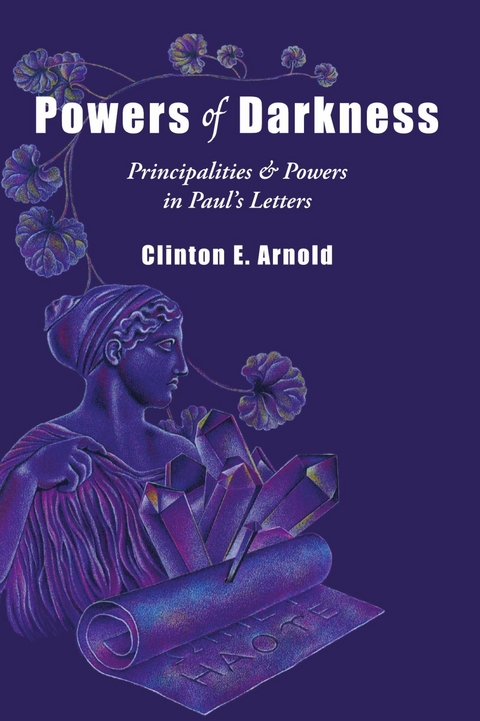
Powers of Darkness (eBook)
244 Seiten
IVP Academic (Verlag)
978-1-5140-1471-4 (ISBN)
Clinton Arnold earned his PhD at the University of Aberdeen in Scotland and has done post-doctoral work at Eberhard-Karls-Universität Tübingen in Germany. He is currently research professor of New Testament at the Talbot School of Theology in La Mirada, California.
Clinton Arnold earned his PhD at the University of Aberdeen in Scotland and has done post-doctoral work at Eberhard-Karls-Universität Tübingen in Germany. He is currently research professor of New Testament at the Talbot School of Theology in La Mirada, California.
Introduction
In 1992 Salem, Massachusetts, commemorated the 300th anniversary of the city’s infamous witch trials. More than 400 persons were accused of being witches in the inquisition. Of these, 150 were jailed, 14 women and 5 men were hung, and one supposed witch was crushed to death under several tons of rock.
Today, as visitors tour an 1845 stone church converted into Salem’s Witch Museum, the museum narrator greets them with, “Welcome to the Witch Museum. Do you believe in witches? Millions of our ancestors did.”
Many people today find it incredible that our forebears gave credence to these ideas. How could anyone possibly believe that “witches” have actual supernatural powers, that spell-casting can work, and that evil spirits wreak all kinds of terror in peoples’ lives? For most, these beliefs were rendered obsolete with the rise of the scientific age and the spread of educational opportunity for everyone.
Now, three centuries after the witch trials, no threat of a similar inquisition is looming, and I hope that that threat never will loom. But there is an upsurge of interest in witchcraft and the occult throughout the West. Note, for instance, the following advertisement that appeared in a recent tabloid:
I will cast a spell for you. I can cast a spell to make one love another, or cause a person to change his mind about a relationship, or bring two people together. I can do all these things because I have the combined powers of my mother who was a sorceress and my father, one of the most powerful warlocks who passed on his secrets to me moments before he moved on to a different world. My magical powers are beyond your imagination. I can cast a spell in your behalf regarding a relationship, your financial situation, future events, or whatever is important to you. I have the power and I use the power.1
This announcement is typical of a number of occultic advertisements that appear regularly in tabloids throughout the United States.
This burgeoning interest in the occult is not a local fad but a trend in Western society. The growing fascination in the occult of the sixties became what the eminent history of religions scholar Mircea Eliade termed an “occult explosion” in the seventies.2 He notes, “As a historian of religions, I cannot fail to be impressed by the amazing popularity of witchcraft in modern Western culture and its subcultures. . . . The contemporary interest in witchcraft is only part and parcel of a larger trend, namely the vogue of the occult and the esoteric from astrology and pseudospiritualist movements to Hermetism, alchemy, Zen, Yoga, Tantrism, and other Oriental gnoses and techniques.”3 Then came the New Age movement, a definite “explosion” in its own right during the eighties and continuing vigorously into the nineties.4 The movement received a strong impetus from the publicity it received from a number of entertainment celebrities who popularized its teachings. The religious vocabulary of the West expanded with a barrage of neologisms such as “channeling” (getting in contact with a spiritual entity), “spirit guide” (a spiritual entity who provides information), “cosmic consciousness” (the perception that all in the universe is “one”) and “astral flight” (soul travel during meditation or the night).
It is difficult to gauge the size of this growing “movement” since it is loosely organized. Its current popularity can best be seen by perusing the shelves of any bookstore. Increasing space is given to the literally thousands of New Age publications. Businesses and corporations are hosting more and more “human potential” seminars based on New Age principles.5 The New Age concept of channeling has grown increasingly popular, especially in Southern California. A Los Angeles Times poll revealed that more women in West Los Angeles are consulting channelers than psychologists or counselors.6 In a recent cover story, entitled “New Age Harmonies,” Time magazine summarized the surprisingly rapid acceptance and popularity of the movement in many sectors of Western society.7
The New Age movement is characterized by a monistic world view that has much in common with classic Hinduism. Monism is the belief that the entire universe is a living unified whole. God permeates the entire universe, and in a sense every person is a part of God. God and humanity are therefore one. What is needed, according to this view, is a change in our consciousness to heighten our level of awareness into our essential unity with the divine. The New Age movement also has a lively belief in the realm of spirits and thus practices forms of divination and magic (under the euphemism “channeling”). For this reason some evangelical analysts have described the heart of the New Age religion as occultism.8
Given this rise in occultism, expressed also in the form of the New Age movement, we need to ask if the church is alert and ready to face this fresh challenge? Is the church prepared to effectively handle the spiritual problems that will surface in ministering to people who have opened their lives to the direct and immediate influence of the realm of Satan?
There are some encouraging signs. Many evangelical seminaries and Christian colleges are offering courses in spiritual warfare (or the equivalent) and, almost invariably, these courses have turned out to be the most popular courses among the students.9 Quite a number of books and articles have also appeared, treating topics on spiritual warfare, demon possession, counseling the demonized, and the New Age movement. Regrettably, the Christian community has not been well served with material dealing with a biblical perspective on demons, principalities and powers, and the nature of the church’s conflict with the powers of evil. I hope that this book can be a helpful first installment on developing a biblical perspective on the powers of darkness.
But is this topic relevant for everyone? Certainly not everyone in the church has had contact with professing Satanists or witches, with New Age advocates, or with those deeply involved in the occult. Furthermore, this topic is rather frightening. Why spend time exploring the varied dimensions of evil, especially in terms of demons and evil spirits? Would it not be better to avoid this topic altogether and spend the time meditating on the positive aspects of our Christian life?
I believe this topic is important for all Christians because it touches us in a profound way, regardless of whether we have had any involvement in the occult. The Bible teaches not only that evil spirits exist, but also that they are actively hostile to all Christians; their perverse instigations adversely affect our day-to-day life and the lives of those around us. The Bible consequently provides us with vital information, information designed to give Christians an appropriate perspective on these malicious forces and how to deal with their activity against us.
My personal interest in this theme originated during the course of my doctoral studies. Nestled in my office high in a tower of the sixteenth-century King’s College of the University of Aberdeen (Scotland), I banged away on a keyboard, researching and writing on the biblical concept of power. I was not far into my research before I realized that it was nigh well impossible to study the power of God without studying the opposing sphere of power, the kingdom of Satan. The end result was a dissertation entitled, “The Power of God and the Powers of Evil in Ephesians,” a study of this theme in one New Testament letter.
Not only in Paul’s letter to the Ephesians, but also throughout the New Testament, Christ is portrayed in terms of a struggle with the powers of darkness. Jesus confronted the demonic in his earthly ministry, dealt a decisive blow to the kingdom of evil on the cross, continues to wage war against the hosts of Satan through the church, and will finally vanquish Satan and his forces once and for all after his Second Coming. Christ’s conflict with the powers of evil surfaces as a major theme in New Testament theology. Surprisingly, this theme has been terribly neglected in the exegetical and theological study of the New Testament. Why? I am not certain. It may be due partly to the Western post-Enlightenment world view that has interpreted the New Testament references to evil spirits as outmoded primitive myth.
The grip of our common Western world view provides yet another reason for this book. In contrast to people in Africa, Korea, China, and other parts of the non-Western world, we have grown up disbelieving in the realm of spirits, demons and angels. Most Westerners, if asked, “Do you believe in evil spirits?” would say no. This is also true of many Christians in the West, although we display some double-mindedness on the issue. Many Christians would affirm a belief in demons because they are mentioned in the Bible (and perhaps because some missionaries have come home with tales about dealing with the demonic). In actual fact, however, the spirit realm may have no more a part of a given Christian’s world view than it does of that person’s non-Christian neighbor. It is tough to break the all-pervasive influence of one’s culture. If the realm of spirits and angels is a dominant part of the biblical world view, it should thus be a dominant part of a Christian world view in our age.
In the following pages I hope to show precisely what role evil spiritual powers had in the world view of one of Christianity’s most brilliant and inspired thinkers, the apostle Paul. Comprising about...
| Erscheint lt. Verlag | 12.6.2025 |
|---|---|
| Verlagsort | Lisle |
| Sprache | englisch |
| Themenwelt | Geisteswissenschaften ► Religion / Theologie ► Christentum |
| Schlagworte | Angels • Apostle • Belief • believers • Bible • Biblical • Christ • Christian • Demons • Devil • Divination • epistles • evil forces • exegetical • Jesus • Magic • New Testament • Pastor • Professor • Satan • Scripture • Sorcery • Spirits • Spiritual Warefare • Teachings • Theology • Witches |
| ISBN-10 | 1-5140-1471-8 / 1514014718 |
| ISBN-13 | 978-1-5140-1471-4 / 9781514014714 |
| Informationen gemäß Produktsicherheitsverordnung (GPSR) | |
| Haben Sie eine Frage zum Produkt? |
 EPUB (Wasserzeichen)
DRM: Digitales Wasserzeichen
Dieses eBook enthält ein digitales Wasserzeichen und ist damit für Sie personalisiert. Bei einer missbräuchlichen Weitergabe des eBooks an Dritte ist eine Rückverfolgung an die Quelle möglich.
Dateiformat: EPUB (Electronic Publication)
EPUB ist ein offener Standard für eBooks und eignet sich besonders zur Darstellung von Belletristik und Sachbüchern. Der Fließtext wird dynamisch an die Display- und Schriftgröße angepasst. Auch für mobile Lesegeräte ist EPUB daher gut geeignet.
Systemvoraussetzungen:
PC/Mac: Mit einem PC oder Mac können Sie dieses eBook lesen. Sie benötigen dafür die kostenlose Software Adobe Digital Editions.
eReader: Dieses eBook kann mit (fast) allen eBook-Readern gelesen werden. Mit dem amazon-Kindle ist es aber nicht kompatibel.
Smartphone/Tablet: Egal ob Apple oder Android, dieses eBook können Sie lesen. Sie benötigen dafür eine kostenlose App.
Geräteliste und zusätzliche Hinweise
Buying eBooks from abroad
For tax law reasons we can sell eBooks just within Germany and Switzerland. Regrettably we cannot fulfill eBook-orders from other countries.
aus dem Bereich