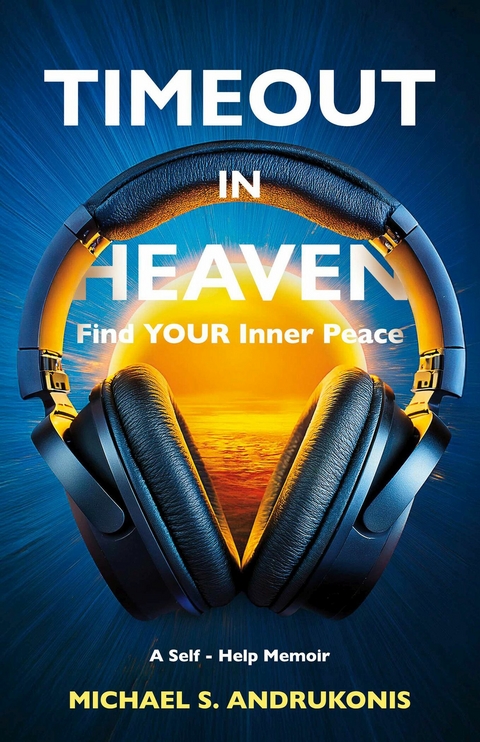
Timeout in Heaven (eBook)
160 Seiten
Bookbaby (Verlag)
979-8-3509-9317-2 (ISBN)
Michael S. Andrukonis holds a Bachelor of Arts degree in Art and Secondary Education. After a brief stint in teaching at the high school level, he meandered between various other jobs becoming an entrepreneur, self-starter, thinker, and author. He enjoys writing, playing volleyball, and working out. He currently lives with his wife in East Longmeadow Massachusetts. He is a proud father of two outstanding sons and loves being a grandparent - hello sweet Caroline!
Overwhelmed with depression, ADHD, anxiety, and PTSD? Follow one man's journey from tumultuous upbringing in Communist Poland, lost and confused in America, to finally changing the script to "e;Timeout in Heaven."e; This self-developed relaxation and mind-altering technique brings readers to a place of serene presence and creative problem-solving thoughts. Follow the script, then personalize it.
Part One: Struggle
Scene: 1: That’s Me in the Corner
It’s a moonlit, star-studded evening. The two cast long staggered shadows on wooden picket fences and patches of snow. One pedaling, the other running behind - must keep pace. A belt strapped around his neck, tied to a whip that in turn is tied under the bicycle seat constrained his motion.
The still of the night is interrupted by the pedaler’s intermittent cursing, loudly swearing - as the other weeps, stuttering indistinguishable pleas. The worst awaits! The other – the other is my older brother.
I squat behind neighbor’s fence, peeking between the slats, horrified as the two pass by. What should I do? Nothing! I would have been rounded up and severely punished. This, as other scenes, are internalized, branded in my skull, as vivid as back in 1963.
I was born in the Eastern part of Poland, a town called Radun, in 1953. During the second World War, Poland endured devastating invasions and human suffering. It was controlled by the Nazis in the West and the Soviet Union in the East. Poland’s government was exiled to Paris and later to London.
The Russians occupied Radun in 1939. In 1941, the Nazis invaded Russia and occupied this area until 1944, when the Russian Red Army took back control. Both powers intended to eradicate Poland’s culture and control its people.
After the war at the Conference in Yalta, ( a Russian resort town in Crimea), between Churchill, Roosevelt, and Stalin, it was decided that the Soviet Union would annex an enormous section of Eastern Poland, which included Radun. In exchange, Poland received a much smaller land mass in Eastern Germany.
At Yalta, that murderous, ruthless, and cunning Stalin pulled off a major public relations stunt, presenting himself as a zesty, vigorous world leader negotiating with a couple of gentlemanly feeble old bags.
The famous photo of all three sittings helped Roosevelt’s image, as he had suffered from paralysis as a result of polio. Stalin, however, was the ultimate winner. He was the shortest of the three, standing at about five-foot five inches tall, and afflicted by Napolean Complex. On his home turf and strong-willed, he controlled the narrative, appearing as the one in command as the other two’s time had passed.
It was a moot point that the Polish borders were redrawn, as the entire country, among several others in the region, were under Stalin’s iron fist.
Polish nationals living in Radun were enticed by the fledgling Polish government to move west to newly acquired land of Eastern Germany to escape the direct reach of Stalin’s ruthless rule. Free land and housing were promised, and many took this opportunity.
In the Soviet Union, all private farms had been nationalized by Stalin. In Poland, however, small private farms were tolerated, another inducement to move. But the Russians were very selective as to who was allowed to leave, mainly for political reasons.
In 1957, my family left for better opportunity. With only a few belongings, people were loaded like cattle in train boxcars and sent on a fifteen-hour journey into the unknown. The perimeters of these boxcars were lined with hay, which served as sleeping areas. Privacy did not exist. Teary-faced mothers clinging to hope of a better life for their kids, as fathers’ glazed empty faces stared into abyss. Only hope was on their side.
You were treated not as humans but cargo to be transported from here to there.
A low-cut oil drum placed in one corner of the car served as a toilet. Atop it, a removable wooden cover with a hole in the middle served as toilet seat. It was shielded by a shabby blanket hanging from one corner to another, providing questionable privacy. This drum was periodically taken out and replaced with another. At regular intervals, the train stopped to empty human waste and such.
It was a miserable journey. At times, the pungent odor seemed unbearable. People coughing, farting, babies crying—no way out, just enduring, hoping for a better life. Food was not available; you had to bring your own. We had a couple loaves of bread, rolls, homemade butter, marmalade, and jugs of milk.
We ended up in a village called Ochla on a small, self-sustaining farm. Vestiges of German life were ever-present, from cobblestone roads to architecture. The name itself is German.
Most of this town was cleared of German nationals who were relocated to within new boarders of Germany. Some stubbornly stayed behind, insisting it’s their home. Who can blame them since it is their generational homestead. They, like the rest of us, happened to be victims of this harsh reality, of being caught in the crosshairs of political decisions.
The remaining locals viewed the new arrivals as invaders disrupting their way of life. They were the “Aryans,” a superior race which viewed us as inferior, diluting their lineage. Likewise, the new residents viewed the Germans with disdain, not to be trusted. They massacred countless Poles. Marriage between the Poles and the Germans were frowned upon, especially by the older ones who suffered the ravishes of war. We had to co-exist.
Ten of us were crammed in four small, drafty rooms, along with our beloved flea-infested dog, Filus, and a family of mice.
No curb appeal here. From the road, a potholed clayish dirt driveway led to an ugly concrete structure laden with irregular cracks and moss. The grayish tile roof needed continuous repair. The overall structure appeared deserted, overtaken by nature.
The house was to the left of the driveway, next to a stone well and a garden. In the center of the yard was a hay barn. That’s where the chickens hung out. Behind the barn was a sizable grassy field adorned with a small stream.
To the right of the yard was a pigsty. This sketchy structure seemed on the verge of collapse. Next to it was a makeshift outhouse which, along with the pigsty, exuded a nasty odor. A barn for cows and horses completed the array of buildings.
The low, cracked plaster ceiling and cement floor inside the kitchen set the mood of simple peasant living. Drab mildewed cement walls solidified its appearance. This utilitarian space had a large, wobbly table, creaky chairs, and a wood-burning combination stove and heater.
In the summer, next to the ceiling light a sticky, gruesome fly ribbon hung from the kitchen ceiling. At night when the light was turned on, this ribbon exposed the hellish slow death of the flies. The exhaustive flickering and buzzing of wings in the futile attempt to free themselves from their eventual demise was a nightly scene.
In the morning, there was an eerie silence. By the evening, a new batch of flies was lured to the light and ribbon strip—the death dance resumed. After a week or so, the strip was replaced.
If you happened to be on the tall side, watch out, as you must navigate around this sticky fly death trap.
Stepping into the hallway, to the right was an imposing masonry heater. It took most of this area and spanned up to the ceiling. It contained various meandering chambers lined with terra cotta tiles. This design held heat longer and served as a sort of catalytic combustor, re-burning energy-filled particles in the smoke.
Even if the fire was out, these chambers retained latent heat, keeping the house warm. It was a combination heater, burning both wood and coal. The fire was usually started with wood and then switched over to coal for more sustained heat.
During the cold winters, this was the place to huddle. It was Filus’s favorite spot.
To the left of the hallway was the biggest room, where my three brothers and I slept, all four in the same bed. We slept with two skulls at one end, two at the other—farting, sneezing, snoring, tossing, and turning; well, that’s how it was.
My sisters shared another room and bed on the right side of the hallway. Next to them was the room occupied by my parents. The fourth, a closet-sized room, is where my grandmother and grandfather on my mother’s side slept. Ten of us were crammed into four rooms. The boys’ room, being the biggest, also served as a makeshift living room.
Life was a continuous struggle, oppressive and miserable. There was no indoor plumbing. Want to use the bathroom? No problem. A three-minute walk across the yard did the trick. Winters were bitterly cold. Parking one’s fanny on the makeshift wooden toilet wasn’t desirable.
Summers were worse. Approaching the outhouse overwhelmed the sinuses. And the pigsty next to it? Well, it might as well keep the pungent odor in the same area. Before opening the outhouse door, one needed a deep breath and to try to hold it until the business was finished.
Flies, beetles, maggots, and other crawling creatures completed the morbid scene. There was no luxury of reading the newspaper.
Want to have a drink of water? Take a stroll to the well, and don’t forget to boil it. This was an ordeal. Stoke up the wood burning stove for that precious drink. Of course, you must wait until the water cooled off. Water wells were never tested for contaminations and parasites. It was simpler to have a glass of milk.
Electric outlets were two hundred and thirty volts, roughly doble that of the United States. The room light switches were not on the wall but on the bulb socket with an on–off push switch. This hung from the ceiling and was not well insulated. Once I reached up to turn on the light and was struck by a bolt of piercing current which pulsated up my arm and throughout my body. It was very brief, but it felt like I was sticking my...
| Erscheint lt. Verlag | 17.4.2025 |
|---|---|
| Sprache | englisch |
| Themenwelt | Geisteswissenschaften ► Psychologie |
| ISBN-13 | 979-8-3509-9317-2 / 9798350993172 |
| Informationen gemäß Produktsicherheitsverordnung (GPSR) | |
| Haben Sie eine Frage zum Produkt? |
 EPUB (Ohne DRM)
Größe: 2,9 MB
Digital Rights Management: ohne DRM
Dieses eBook enthält kein DRM oder Kopierschutz. Eine Weitergabe an Dritte ist jedoch rechtlich nicht zulässig, weil Sie beim Kauf nur die Rechte an der persönlichen Nutzung erwerben.
Dateiformat: EPUB (Electronic Publication)
EPUB ist ein offener Standard für eBooks und eignet sich besonders zur Darstellung von Belletristik und Sachbüchern. Der Fließtext wird dynamisch an die Display- und Schriftgröße angepasst. Auch für mobile Lesegeräte ist EPUB daher gut geeignet.
Systemvoraussetzungen:
PC/Mac: Mit einem PC oder Mac können Sie dieses eBook lesen. Sie benötigen dafür die kostenlose Software Adobe Digital Editions.
eReader: Dieses eBook kann mit (fast) allen eBook-Readern gelesen werden. Mit dem amazon-Kindle ist es aber nicht kompatibel.
Smartphone/Tablet: Egal ob Apple oder Android, dieses eBook können Sie lesen. Sie benötigen dafür eine kostenlose App.
Geräteliste und zusätzliche Hinweise
Buying eBooks from abroad
For tax law reasons we can sell eBooks just within Germany and Switzerland. Regrettably we cannot fulfill eBook-orders from other countries.
aus dem Bereich