


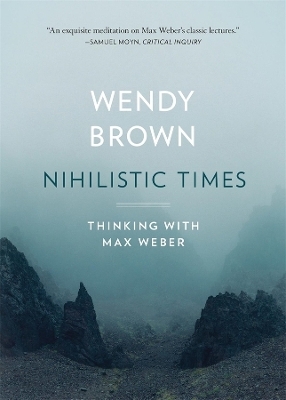
Nihilistic Times
Thinking with Max Weber
Seiten
2025
Harvard University Press (Verlag)
978-0-674-30160-3 (ISBN)
Harvard University Press (Verlag)
978-0-674-30160-3 (ISBN)
Wendy Brown diagnoses a late-modern nihilism that trivializes values—including truth itself—and reduces politics to narcissism and power-mongering. Rereading Max Weber, who saw a similar predicament in his own time, Brown seeks to reground political action in responsibility and reorient classrooms to the critical thinking citizens need today.
A Seminary Co-op Notable Book
“What makes Brown’s book especially well worth reading is her impressive ability to show how key themes in Weber’s scholarship—including his emphasis on the defining characteristics of modernity . . . speak to our own time.” —Inside Higher Ed
“Presses us to think more carefully and imaginatively about the relationships among human freedom, human value, and something beyond purely human concerns, be it truth, God, or Gaia.” —Commonweal
“Worth reading…A timely reminder of the nihilistic air we breathe.” —Law & Liberty
“Elegantly and concisely written…this insightful, thought-provoking book illuminates some objective culture factors contributing to the social division and degradation of public life in many democracies today.” —Critical Theology
How has politics become a playpen for vain demagogues? Why has the university become an ideological war zone? What has happened to Truth? Wendy Brown places nihilism at the center of these predicaments. Emerging from the retreat of God and tradition in the face of science and reason, nihilism removes the foundation on which values, including that of truth, stand. It hyperpoliticizes knowledge and renders the profound trivial, the future unimportant, and corruption banal.
In search of remedies, Brown turns to Max Weber’s Vocation Lectures. Weber famously decries the effects of nihilism on scholarly and political life and proposes to keep the two separate, restricting academic work to the pursuit of facts and the political realm to the legislation of values. Without accepting Weber’s arch oppositions, Brown acknowledges the distinctions they mark as she charts reparative strategies for our own times. She calls for retrieving knowledge from hyperpoliticization without expunging values from research or teaching, and she challenges the left to make good on its commitments to critical thinking and democratization.
A Seminary Co-op Notable Book
“What makes Brown’s book especially well worth reading is her impressive ability to show how key themes in Weber’s scholarship—including his emphasis on the defining characteristics of modernity . . . speak to our own time.” —Inside Higher Ed
“Presses us to think more carefully and imaginatively about the relationships among human freedom, human value, and something beyond purely human concerns, be it truth, God, or Gaia.” —Commonweal
“Worth reading…A timely reminder of the nihilistic air we breathe.” —Law & Liberty
“Elegantly and concisely written…this insightful, thought-provoking book illuminates some objective culture factors contributing to the social division and degradation of public life in many democracies today.” —Critical Theology
How has politics become a playpen for vain demagogues? Why has the university become an ideological war zone? What has happened to Truth? Wendy Brown places nihilism at the center of these predicaments. Emerging from the retreat of God and tradition in the face of science and reason, nihilism removes the foundation on which values, including that of truth, stand. It hyperpoliticizes knowledge and renders the profound trivial, the future unimportant, and corruption banal.
In search of remedies, Brown turns to Max Weber’s Vocation Lectures. Weber famously decries the effects of nihilism on scholarly and political life and proposes to keep the two separate, restricting academic work to the pursuit of facts and the political realm to the legislation of values. Without accepting Weber’s arch oppositions, Brown acknowledges the distinctions they mark as she charts reparative strategies for our own times. She calls for retrieving knowledge from hyperpoliticization without expunging values from research or teaching, and she challenges the left to make good on its commitments to critical thinking and democratization.
Wendy Brown is UPS Foundation Professor in the School of Social Science at the Institute for Advanced Study and was for many years Class of 1936 First Professor of Political Science at the University of California, Berkeley. Her books, which have been translated into more than twenty languages, include In the Ruins of Neoliberalism, States of Injury, Undoing the Demos, and Walled States, Waning Sovereignty.
| Erscheinungsdatum | 23.10.2025 |
|---|---|
| Reihe/Serie | The Tanner Lectures on Human Values |
| Verlagsort | Cambridge, Mass |
| Sprache | englisch |
| Maße | 127 x 178 mm |
| Themenwelt | Geisteswissenschaften ► Philosophie |
| Sozialwissenschaften ► Politik / Verwaltung ► Politische Theorie | |
| Sozialwissenschaften ► Soziologie ► Allgemeines / Lexika | |
| ISBN-10 | 0-674-30160-9 / 0674301609 |
| ISBN-13 | 978-0-674-30160-3 / 9780674301603 |
| Zustand | Neuware |
| Informationen gemäß Produktsicherheitsverordnung (GPSR) | |
| Haben Sie eine Frage zum Produkt? |
Mehr entdecken
aus dem Bereich


aus dem Bereich
Leben und letzte Reise eines Revolutionärs
Buch | Hardcover (2025)
C.H.Beck (Verlag)
CHF 36,40
Weltherrschaft und Menschheitsethos
Buch | Hardcover (2025)
Suhrkamp (Verlag)
CHF 67,20
Buch | Softcover (2025)
Matthes & Seitz Berlin (Verlag)
CHF 16,80


