


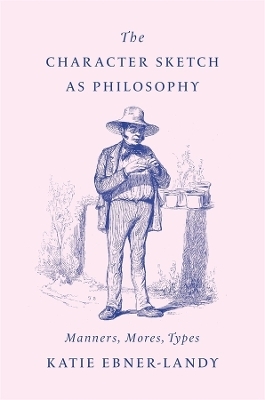
The Character Sketch as Philosophy
Manners, Mores, Types
Seiten
2025
Harvard University Press (Verlag)
978-0-674-29412-7 (ISBN)
Harvard University Press (Verlag)
978-0-674-29412-7 (ISBN)
Katie Ebner-Landy shows that early modern Europeans, inspired by the ancient philosopher Theophrastus, embraced the character sketch as a source of moral and political education. Yet Enlightenment thinkers spurned this genre in favor of elaborating principles, thereby helping to drive a wedge between philosophy and literature.
An insightful exploration of the moral and political power of the character sketch in early modern Europe—and the implications for our own relationship to this genre today.
In the fourth century BCE, the philosopher Theophrastus, a student of Aristotle, composed thirty character sketches depicting ordinary Athenian vices: idle chatter, bad timing, cowardice, shamelessness, and superstition, among others. Centuries later, this enigmatic text—known as the Characters—was feverishly translated and imitated by early modern Europeans convinced of its moral and political importance. Tracing this resurgence of the Theophrastan tradition, Katie Ebner-Landy sheds new light on the role of the character sketch as a philosophical tool.
Ebner-Landy shows that the original Characters is best understood as a work of political philosophy, designed to urge Athenians toward civic virtue. It is this quality that made the text so resonant in early modern Europe, where the character sketch again served as a means of encouraging ethical behavior and cultivating political knowledge. During the English Civil War, for example, the character sketch was used to diagnose new political types such as the Roundhead and the Cavalier. By the era of the Enlightenment, however, moral philosophy’s long association with the character sketch began to break down. A different approach to philosophy took hold, one that spurned literary descriptions of manners, mores, and types and instead emphasized the principles underlying knowledge itself. This shift, in turn, helped to drive a broader separation between literature and philosophy.
A revealing intellectual history, The Character Sketch as Philosophy also encourages us to consider what literary description might contribute to ethics and political thought today—and to think critically about the kinds of character sketches on which we still rely, from the snob to the mansplainer.
An insightful exploration of the moral and political power of the character sketch in early modern Europe—and the implications for our own relationship to this genre today.
In the fourth century BCE, the philosopher Theophrastus, a student of Aristotle, composed thirty character sketches depicting ordinary Athenian vices: idle chatter, bad timing, cowardice, shamelessness, and superstition, among others. Centuries later, this enigmatic text—known as the Characters—was feverishly translated and imitated by early modern Europeans convinced of its moral and political importance. Tracing this resurgence of the Theophrastan tradition, Katie Ebner-Landy sheds new light on the role of the character sketch as a philosophical tool.
Ebner-Landy shows that the original Characters is best understood as a work of political philosophy, designed to urge Athenians toward civic virtue. It is this quality that made the text so resonant in early modern Europe, where the character sketch again served as a means of encouraging ethical behavior and cultivating political knowledge. During the English Civil War, for example, the character sketch was used to diagnose new political types such as the Roundhead and the Cavalier. By the era of the Enlightenment, however, moral philosophy’s long association with the character sketch began to break down. A different approach to philosophy took hold, one that spurned literary descriptions of manners, mores, and types and instead emphasized the principles underlying knowledge itself. This shift, in turn, helped to drive a broader separation between literature and philosophy.
A revealing intellectual history, The Character Sketch as Philosophy also encourages us to consider what literary description might contribute to ethics and political thought today—and to think critically about the kinds of character sketches on which we still rely, from the snob to the mansplainer.
Katie Ebner-Landy is Assistant Professor of Aesthetics in the Department of Philosophy and Religious Studies at Utrecht University. She has been a Junior Fellow at the Harvard Society of Fellows, and her articles have appeared in The Guardian, Le Monde, and the New Yorker.
| Erscheinungsdatum | 17.10.2025 |
|---|---|
| Zusatzinfo | 18 photos |
| Verlagsort | Cambridge, Mass |
| Sprache | englisch |
| Maße | 156 x 235 mm |
| Themenwelt | Geschichte ► Allgemeine Geschichte ► Neuzeit (bis 1918) |
| Geisteswissenschaften ► Geschichte ► Regional- / Ländergeschichte | |
| Geisteswissenschaften ► Philosophie ► Ethik | |
| Geisteswissenschaften ► Sprach- / Literaturwissenschaft ► Anglistik / Amerikanistik | |
| Geisteswissenschaften ► Sprach- / Literaturwissenschaft ► Literaturwissenschaft | |
| ISBN-10 | 0-674-29412-2 / 0674294122 |
| ISBN-13 | 978-0-674-29412-7 / 9780674294127 |
| Zustand | Neuware |
| Informationen gemäß Produktsicherheitsverordnung (GPSR) | |
| Haben Sie eine Frage zum Produkt? |
Mehr entdecken
aus dem Bereich

aus dem Bereich
Geschichte einer wilden Handlung
Buch | Hardcover (2024)
C.H.Beck (Verlag)
CHF 47,60


