


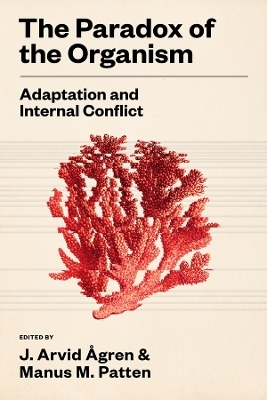
The Paradox of the Organism
Adaptation and Internal Conflict
Seiten
2025
Harvard University Press (Verlag)
978-0-674-29638-1 (ISBN)
Harvard University Press (Verlag)
978-0-674-29638-1 (ISBN)
The unity of the organism—an assembly of organs, tissues, cells, and genes working toward a common goal—has long been taken for granted. The essays in this collection pierce the organismal veil to consider how an organism persists, even as internal conflict, from cancer cells to selfish genes, threatens its integrity and survival.
Leading evolutionary theorists and philosophers come together to understand how organisms persist, even as they’re riddled with internal conflict, from cancer cells to selfish genes.
How does a vast menagerie of organs, tissues, cells, and genes coalesce to form a unified organism? For centuries, biologists and philosophers have taken this astonishing feat for granted, treating it as a matter of divine will or evolutionary inevitability. Yet unity is hardly assured. From cancer cells to selfish genes, the body is riven by internal conflicts.
The Paradox of the Organism grapples with this puzzle. As the essays in this collection show, profound questions arise when we pierce the organismal veil and consider the self-replicating elements within. Is an organism really a cohesive agent that adapts to the ecosystem it inhabits? Or is an organism itself an ecosystem, within which individual components are engaged in a continuous arms race?
The answers have immediate implications: for understanding miscarriage, treating cancer, improving psychological health, and preserving biodiversity. Challenging fundamental precepts of evolutionary theory, The Paradox of the Organism offers an incisive account of life’s extraordinary success.
Leading evolutionary theorists and philosophers come together to understand how organisms persist, even as they’re riddled with internal conflict, from cancer cells to selfish genes.
How does a vast menagerie of organs, tissues, cells, and genes coalesce to form a unified organism? For centuries, biologists and philosophers have taken this astonishing feat for granted, treating it as a matter of divine will or evolutionary inevitability. Yet unity is hardly assured. From cancer cells to selfish genes, the body is riven by internal conflicts.
The Paradox of the Organism grapples with this puzzle. As the essays in this collection show, profound questions arise when we pierce the organismal veil and consider the self-replicating elements within. Is an organism really a cohesive agent that adapts to the ecosystem it inhabits? Or is an organism itself an ecosystem, within which individual components are engaged in a continuous arms race?
The answers have immediate implications: for understanding miscarriage, treating cancer, improving psychological health, and preserving biodiversity. Challenging fundamental precepts of evolutionary theory, The Paradox of the Organism offers an incisive account of life’s extraordinary success.
J. Arvid Ågren is Research Associate at the Lerner Research Institute of the Cleveland Clinic and Affiliated Researcher at the Evolutionary Biology Centre at Uppsala University. He is the author of The Gene’s-Eye View of Evolution. Manus M. Patten is an evolutionary biologist whose research explores the consequences of conflict, both for organisms and for evolutionary theory. He is Teaching Professor in Biology at Georgetown University.
| Erscheinungsdatum | 11.12.2025 |
|---|---|
| Zusatzinfo | 18 illus., 3 tables |
| Verlagsort | Cambridge, Mass |
| Sprache | englisch |
| Maße | 156 x 235 mm |
| Themenwelt | Geisteswissenschaften ► Philosophie |
| Naturwissenschaften ► Biologie ► Genetik / Molekularbiologie | |
| Naturwissenschaften ► Biologie ► Ökologie / Naturschutz | |
| ISBN-10 | 0-674-29638-9 / 0674296389 |
| ISBN-13 | 978-0-674-29638-1 / 9780674296381 |
| Zustand | Neuware |
| Informationen gemäß Produktsicherheitsverordnung (GPSR) | |
| Haben Sie eine Frage zum Produkt? |
Mehr entdecken
aus dem Bereich

aus dem Bereich
Theorien, Modelle, Methoden
Buch | Softcover (2024)
Springer Fachmedien (Verlag)
CHF 34,90
50 Meilensteine der Genetik
Buch | Hardcover (2022)
Librero b.v. (Verlag)
CHF 13,90


