


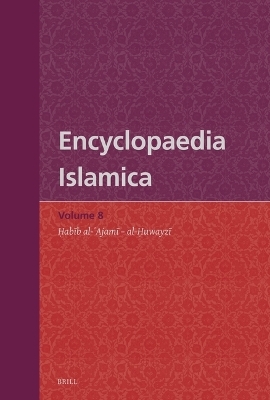
Encyclopaedia Islamica Volume 8
Ḥabīb al-ʿAjamī – al-Ḥuwayzī
Seiten
2025
Brill (Verlag)
978-90-04-54127-6 (ISBN)
Brill (Verlag)
978-90-04-54127-6 (ISBN)
The 16 volume Encyclopaedia Islamica is due to become one of the major comprehensive reference works on Islam and the Muslim world. A unique feature is the attention given to aspects of Islamic heritage—particularly Shiʿism—which makes it complementary to other encyclopaedias.
This volume of Encyclopaedia Islamica is the eighth of a projected 16-volume set, largely consisting of an abridged and edited translation of the Persian Dāʾirat al-Maʿārif-i Buzurg-i Islāmī, one of the most comprehensive sources on Islam and the Muslim world, to which a number of original articles, written specifically for the English edition, have been added. One of the unique features of this work of reference lies in the attention it gives to Shiʿi Islam and its rich and diverse heritage, which makes it complementary to other encyclopaedias. In addition to providing entries on important themes, subjects and personages in Islam generally, it offers the Western reader an opportunity to appreciate the various dimensions of Shiʿi Islam, the Persian contributions to Islamic civilisation, and the spiritual dimensions of the Islamic tradition.
This volume of Encyclopaedia Islamica, covering Ḥabīb al-ʿAjamī to al-Ḥuwayzī, contains a range of articles of an original and analytically significant nature, with special attention given to Shiʿism and Sufism. There are biographies of seminal figures in Islamic history, including the Prophet’s grandsons, Imams al-Ḥasan and al-Ḥusayn, as well as the great Persian lyric poet, Ḥāfiẓ; the Ithnāʿasharī scholar, al-ʿAllāma al-Ḥillī; the founder of the Nizārī Ismaili state in Persia, Ḥasan-i Ṣabbāḥ; and arguably the most renowned mystic in the entire history of Sufism, Ḥusayn b. Manṣūr al-Ḥallāj. Regarding the esoteric traditions, there are also articles on Hujwīrī, author of Kashf al-maḥjūb, the first Sufi manual in Persian; the early ascetic, al-Ḥasan al-Baṣrī; the ‘sage of Herat’, Khwājah ʿAbd Allāh Anṣārī Harawī; and the Malay Sufi master, Ḥamza Fanṣūrī. Core Islamic disciplines are also addressed, including the foundations of Islamic history, scholarship, religious practice and theology, in articles on subjects such as Ḥadīth, Ḥawza ʿIlmiyya, Ḥajj, Ḥaqīqa, and Ḥayra. As with previous volumes, the articles demonstrate above all the richness of the Shiʿi traditions in Islam.
This volume of Encyclopaedia Islamica is the eighth of a projected 16-volume set, largely consisting of an abridged and edited translation of the Persian Dāʾirat al-Maʿārif-i Buzurg-i Islāmī, one of the most comprehensive sources on Islam and the Muslim world, to which a number of original articles, written specifically for the English edition, have been added. One of the unique features of this work of reference lies in the attention it gives to Shiʿi Islam and its rich and diverse heritage, which makes it complementary to other encyclopaedias. In addition to providing entries on important themes, subjects and personages in Islam generally, it offers the Western reader an opportunity to appreciate the various dimensions of Shiʿi Islam, the Persian contributions to Islamic civilisation, and the spiritual dimensions of the Islamic tradition.
This volume of Encyclopaedia Islamica, covering Ḥabīb al-ʿAjamī to al-Ḥuwayzī, contains a range of articles of an original and analytically significant nature, with special attention given to Shiʿism and Sufism. There are biographies of seminal figures in Islamic history, including the Prophet’s grandsons, Imams al-Ḥasan and al-Ḥusayn, as well as the great Persian lyric poet, Ḥāfiẓ; the Ithnāʿasharī scholar, al-ʿAllāma al-Ḥillī; the founder of the Nizārī Ismaili state in Persia, Ḥasan-i Ṣabbāḥ; and arguably the most renowned mystic in the entire history of Sufism, Ḥusayn b. Manṣūr al-Ḥallāj. Regarding the esoteric traditions, there are also articles on Hujwīrī, author of Kashf al-maḥjūb, the first Sufi manual in Persian; the early ascetic, al-Ḥasan al-Baṣrī; the ‘sage of Herat’, Khwājah ʿAbd Allāh Anṣārī Harawī; and the Malay Sufi master, Ḥamza Fanṣūrī. Core Islamic disciplines are also addressed, including the foundations of Islamic history, scholarship, religious practice and theology, in articles on subjects such as Ḥadīth, Ḥawza ʿIlmiyya, Ḥajj, Ḥaqīqa, and Ḥayra. As with previous volumes, the articles demonstrate above all the richness of the Shiʿi traditions in Islam.
Wilferd Madelung has made significant contributions to scholarship on mediaeval Islamic movements, including Twelver Shi‘ism, Zaydism and Ismailism. He is a former Laudian Professor of Arabic at the University of Oxford and Senior Research Fellow with The Institute of Ismaili Studies. Farhad Daftary is Associate Director of the Institute of Ismaili Studies. He is an authority on Mediaeval Islam and Ismaili studies, consulting Editor of Encyclopaedia Iranica, and sits on the Advisory Board of the Encyclopaedia of Islam (3rd edition).
| Erscheinungsdatum | 20.05.2025 |
|---|---|
| Reihe/Serie | Encyclopaedia Islamica ; 8 |
| Verlagsort | Leiden |
| Sprache | englisch; persisch |
| Maße | 180 x 265 mm |
| Gewicht | 1125 g |
| Themenwelt | Geisteswissenschaften ► Religion / Theologie ► Islam |
| ISBN-10 | 90-04-54127-6 / 9004541276 |
| ISBN-13 | 978-90-04-54127-6 / 9789004541276 |
| Zustand | Neuware |
| Informationen gemäß Produktsicherheitsverordnung (GPSR) | |
| Haben Sie eine Frage zum Produkt? |
Mehr entdecken
aus dem Bereich

aus dem Bereich


