


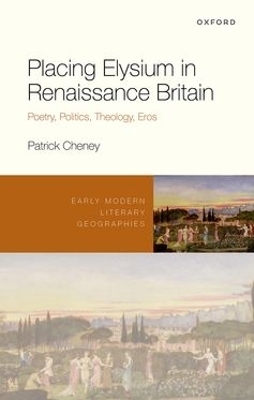
Placing Elysium in Renaissance Britain
Poetry, Politics, Theology, Eros
Seiten
2025
Oxford University Press (Verlag)
978-0-19-887120-0 (ISBN)
Oxford University Press (Verlag)
978-0-19-887120-0 (ISBN)
Cheney explores the literary trope of Elysium from ancient Greek poetry to the English Renaissance, with attention to its place in cartography and the geographies of the sixteenth century, and with emphasis upon the social, political, and imaginative ideas with which it became associated, including religion, nationalism, and utopianism.
Placing Elysium in Renaissance Britain: Poetry, Politics, Theology, Eros is the first study of Elysium as a place in English Renaissance culture. The absence of such a study in the fields of literature and geography is surprising: from its captivating origin in the oceanic margins of Homer's Odyssey to its presence in the Eden of Milton's Paradise Lost, Elysium is a destination to be desired: it is the land of the blessed. As such, Elysium becomes a geographical site for an author's most valued space. In Britannia, Camden provides leadership for this project by citing Plutarch as locating the blessed place in Britain. Following Camden, Spenser centralizes the idea of Britain as Elysium. Subsequently, English authors make the Elysian place the site of a liberating sublimity as the height of artistic renown. This authorial template becomes the site for literary inflections in the realms of politics, theology, and eros. However, Kyd and Marlowe darken the Spenserian project, recalling Virgil's geographical positioning of Elysium next to Hell. In turn, Drayton, Chapman, and Marston champion the Spenserian idea of Britain as Elysium. As this conversation suggests, English authors make Elysium the central place of the 'Renaissance' period concept, and they do so in the nation-building genre of epic. In The Muses Elizium, Drayton crowns the Spenserian tradition by making the blessed place the monomyth of national poetry. At the centre of the monomyth is the cherished ideal of Renaissance culture: the Elysian capacity of the human to become divine.
Placing Elysium in Renaissance Britain: Poetry, Politics, Theology, Eros is the first study of Elysium as a place in English Renaissance culture. The absence of such a study in the fields of literature and geography is surprising: from its captivating origin in the oceanic margins of Homer's Odyssey to its presence in the Eden of Milton's Paradise Lost, Elysium is a destination to be desired: it is the land of the blessed. As such, Elysium becomes a geographical site for an author's most valued space. In Britannia, Camden provides leadership for this project by citing Plutarch as locating the blessed place in Britain. Following Camden, Spenser centralizes the idea of Britain as Elysium. Subsequently, English authors make the Elysian place the site of a liberating sublimity as the height of artistic renown. This authorial template becomes the site for literary inflections in the realms of politics, theology, and eros. However, Kyd and Marlowe darken the Spenserian project, recalling Virgil's geographical positioning of Elysium next to Hell. In turn, Drayton, Chapman, and Marston champion the Spenserian idea of Britain as Elysium. As this conversation suggests, English authors make Elysium the central place of the 'Renaissance' period concept, and they do so in the nation-building genre of epic. In The Muses Elizium, Drayton crowns the Spenserian tradition by making the blessed place the monomyth of national poetry. At the centre of the monomyth is the cherished ideal of Renaissance culture: the Elysian capacity of the human to become divine.
Patrick Cheney is Edwin Erle Sparks Professor of English and Comparative Literature at Penn State University. He has published twenty-one books: seven monographs, two editions, ten collections of essays, and two Oxford Histories. He serves as General Editor of the fourteen-volume Oxford History of Poetry in English, and is a General Editor of the six-volume Oxford Edition of the Collected Works of Edmund Spenser. Additionally, Cheney has published over 90 essays. He has been a Christensen Fellow at St. Catherine's College, Oxford; a Visiting Fellow at All Souls College, Oxford; and a Visiting Research Fellow at Merton College, Oxford.
| Erscheinungsdatum | 30.09.2025 |
|---|---|
| Reihe/Serie | Early Modern Literary Geographies |
| Zusatzinfo | 5 colour images; 2 b&w line drawings |
| Verlagsort | Oxford |
| Sprache | englisch |
| Maße | 147 x 223 mm |
| Gewicht | 608 g |
| Themenwelt | Geschichte ► Allgemeine Geschichte ► Neuzeit (bis 1918) |
| Geisteswissenschaften ► Sprach- / Literaturwissenschaft ► Anglistik / Amerikanistik | |
| Geisteswissenschaften ► Sprach- / Literaturwissenschaft ► Literaturgeschichte | |
| Geisteswissenschaften ► Sprach- / Literaturwissenschaft ► Literaturwissenschaft | |
| ISBN-10 | 0-19-887120-1 / 0198871201 |
| ISBN-13 | 978-0-19-887120-0 / 9780198871200 |
| Zustand | Neuware |
| Informationen gemäß Produktsicherheitsverordnung (GPSR) | |
| Haben Sie eine Frage zum Produkt? |
Mehr entdecken
aus dem Bereich
aus dem Bereich
Geschichte einer wilden Handlung
Buch | Hardcover (2024)
C.H.Beck (Verlag)
CHF 47,60


