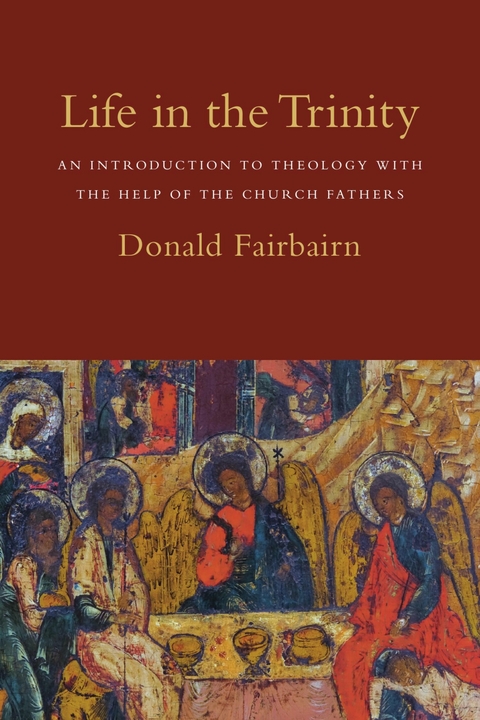
Life in the Trinity (eBook)
248 Seiten
IVP Academic (Verlag)
978-1-5140-1467-7 (ISBN)
Donald Fairbairn is the Robert E. Cooley Professor of Early Christianity at Gordon-Conwell Theological Seminary and a part-time professor at Evangelische Theologische Faculteit in Leuven, Belgium. He received his PhD in patristics from the University of Cambridge in England, and his books include Grace and Christology in the Early Church (Oxford University Press) and Eastern Orthodoxy Through Western Eyes (Westminster John Knox Press).
Donald Fairbairn is the Robert E. Cooley Professor of Early Christianity at Gordon-Conwell Theological Seminary and a part-time professor at Evangelische Theologische Faculteit in Leuven, Belgium. He received his PhD in patristics from the University of Cambridge in England, and his books include Grace and Christology in the Early Church (Oxford University Press) and Eastern Orthodoxy Through Western Eyes (Westminster John Knox Press).
Preface
This book seeks to integrate the various truths of Christianity around a single theme that has been articulated clearly by some of the greatest theologians of the early church but that has often been underemphasized in modern Western theology books. This theme is the relationship between God the Father and God the Son, a relationship in which believers share as we are united to God by the Holy Spirit. The conviction of many of the church fathers1 was that all of Christian life was meant to be a reflection of and a participation in that central relationship between the Father and the Son.
This book is designed as a textbook for courses in Christian theology, and I envision four major situations in which it can be most useful. First, for introductory-level, one-semester theology courses, this book can serve as a standalone textbook, or perhaps as the main textbook with a few other sources (ancient and modern) assigned for supplemental reading. Second, it can be useful for pastors, general Christian readers and lay study groups. Third, for more advanced, multisemester theology courses, this book can serve as a supplement to longer, more comprehensive theology books and can provide a perspective that such books may lack. And fourth, for courses in historical theology, this book can give an overall framework that should make primary sources from the early church more comprehensible. In order to make the book useful for these different audiences, I have arranged it with three levels of material, and I would like to explain this arrangement briefly.
For the benefit of pastors, general readers and students who have little background in formal theology, I have sought to keep the main argument in the text uncluttered by nonbiblical quotations, references to modern theological debates, and other similarly technical material. My argument throughout the book is based on my analysis of crucial biblical passages, especially from the Gospel of John, which occupies a vital place in the New Testament but which has been perhaps slightly underused in Protestant theological study because of Protestantism’s profound focus on Paul’s writings. We will read John’s Gospel and the rest of Scripture as I have learned to read them from the church fathers, paying attention to the passages to which they have directed my attention. But in the text of the book itself, we will listen primarily to the biblical writers, not to later theologians commenting on Scripture.
In addition to the text, the book contains sidebars that offer brief quotations from the church fathers themselves. There is a fair bit of variety in the writings of the early church, but amid this variety, there is one strand of thought that I believe to be particularly biblical and fruitful. Of the church fathers who exemplify this strand of thought, there are four on whom I will focus the most. These are Irenaeus of Lyons (a second-century Greek speaker who lived in what is today southern France), Athanasius of Alexandria (a fourth-century Egyptian who ministered in Greek and Coptic), Augustine of Hippo (a Latin speaker who lived in North Africa in the fourth and fifth centuries) and Cyril of Alexandria (a Greek speaker who followed in Athanasius’s footsteps in Egypt during the early fifth century). Accordingly, in the sidebars, I quote these theologians often and a number of others less frequently, thus enabling readers to gain some exposure to the way patristic writers expressed their ideas. There is also an appendix giving guidance for those who wish to read further in the writings of these four church fathers.
In keeping with the relatively nontechnical nature of the book, it contains few footnotes, and the footnotes that are included offer further biblical citations related to the ideas of the text or explain patristic treatments of those ideas. The footnotes do not compare the church fathers’ ideas with today’s theological debates or with current interpretations of the passages I am considering. Modern commentaries and theological textbooks are readily accessible and usually easy to navigate, so students and other readers who are interested in comparing patristic and modern interpretation should be able to find appropriate modern discussions of the issues without any guidance from me. Although the notes do not direct readers to those modern sources, comparing patristic and modern ideas can be quite fruitful for theological study. Teachers may wish to use this book and its notes as a jumping-off point by assigning students to compare what the church fathers write about particular topics with the way modern scholars articulate the same ideas, or how patristic and modern commentators interpret the same biblical passages.
The presentation of the material in three levels—text, sidebars and footnotes—is designed to keep the book as uncluttered as possible and make its main ideas accessible to all, while also giving students and other interested readers some additional material to consider. People with no prior knowledge of the early church should be able to understand and follow the argument of this book using only the text and a Bible to look up the passages discussed in the text. I hope that this relative simplicity will commend the book for use in introductory theology classes and even lay studies.
However, the very simplicity and brevity that make a book like this useful for beginning theologians might seem to make it superfluous for more advanced students. After all, if students are going to read a thick volume like Millard Erickson’s Christian Theology, Wayne Grudem’s Systematic Theology or Alister McGrath’s Christian Theology: An Introduction (or even a multivolume work like Thomas Oden’s Systematic Theology or Donald Bloesch’s Christian Foundations), it might seem that a short book like this one would have little or nothing new to offer. However, I believe this book can complement more comprehensive theology textbooks in three important ways and thus can benefit more advanced students and the professors who teach them.
First, this book can enable readers to see the whole forest, not just a succession of individual trees. The more comprehensive and detailed a textbook is, the harder it is for readers to see how the many topics fit together. In spite of the intentions of the author, the reader of such a comprehensive book might be left with the impression that theology is a set of facts whose connection to each other and to ordinary Christian life is indecipherable. A very comprehensive book might leave students thinking only in terms of doctrines—individual teachings of the faith—when in fact one is supposed to recognize doctrine (singular), the unified teaching of Christianity. Because of this pitfall associated with longer systematic theology textbooks, there is also a need for books of more modest length that, because they do not go into as many details, are able to give readers a clearer picture of Christian doctrine as a whole. This is intended to be one such book, and as such, it can be valuable even to students who are already reading the longer theology textbooks.
A second way in which this book can complement more comprehensive Western systematic theology textbooks is that it listens to a different set of voices than those books usually do. This book will interact with Scripture and with the ways the early church understood it, without much reference to the way more recent Christian theologians have understood it.2 Such lack of interaction with contemporary discussions is a weakness in some ways, but it may be a strength as well. Omitting direct references to current discussions can enable us to attend to voices from the early church. We need to hear those voices precisely because they are different from our own: they do not merely reinforce what we already think the Bible means but rather challenge us with another way of understanding it and with a different conception of what its central message is, of what lies at the heart of the Christian faith. I do not believe that these new voices contradict our own articulation of the faith, but rather they can complement our understanding of Scripture and make it more complete.
A third way this book can complement a longer, more comprehensive theology textbook is that it uses a different set of integrative themes than is typical in Western theology. If the sheer number of theological topics discussed in a comprehensive textbook can make it hard for the reader to see the forest through the trees, then it is obviously important for any textbook to help readers see the whole forest clearly by articulating a small number of themes around which it organizes the rest of the topics. These themes then become the scarlet thread that enables one to navigate the labyrinth of Christian theology and to hold the various truths of the faith together. For evangelical theologians, the integrating themes are usually the classic distinctives of the Reformation such as sola Scriptura (the Bible alone as the authority), sola Christo (salvation through Christ alone) and sola fide (justification by faith alone).
I fully affirm these and other Reformation distinctives, but nevertheless, this book does not use these as its integrating themes. I am convinced that we need to understand these Reformation ideas as part of a broader context of scriptural teaching, a context that we often underemphasize or even omit. To give an obvious example, the centerpiece of many evangelical systematic theologies is the doctrine of justification by faith. This is without a doubt one of the...
| Erscheint lt. Verlag | 29.5.2025 |
|---|---|
| Verlagsort | Lisle |
| Sprache | englisch |
| Themenwelt | Geisteswissenschaften ► Religion / Theologie ► Christentum |
| Schlagworte | Biblical • Christ • Christian • Doctrine • Early • evangelical • faithful • Father • Gospel • Historical • holy pirit • Integrated • Intro • Jesus • Patristics • Professor • Redemption • Relationship • Roots • Salvation • school • Son • Soteriology • Student • Survey • Trinitarian • undergrad |
| ISBN-10 | 1-5140-1467-X / 151401467X |
| ISBN-13 | 978-1-5140-1467-7 / 9781514014677 |
| Informationen gemäß Produktsicherheitsverordnung (GPSR) | |
| Haben Sie eine Frage zum Produkt? |
 EPUB (Wasserzeichen)
DRM: Digitales Wasserzeichen
Dieses eBook enthält ein digitales Wasserzeichen und ist damit für Sie personalisiert. Bei einer missbräuchlichen Weitergabe des eBooks an Dritte ist eine Rückverfolgung an die Quelle möglich.
Dateiformat: EPUB (Electronic Publication)
EPUB ist ein offener Standard für eBooks und eignet sich besonders zur Darstellung von Belletristik und Sachbüchern. Der Fließtext wird dynamisch an die Display- und Schriftgröße angepasst. Auch für mobile Lesegeräte ist EPUB daher gut geeignet.
Systemvoraussetzungen:
PC/Mac: Mit einem PC oder Mac können Sie dieses eBook lesen. Sie benötigen dafür die kostenlose Software Adobe Digital Editions.
eReader: Dieses eBook kann mit (fast) allen eBook-Readern gelesen werden. Mit dem amazon-Kindle ist es aber nicht kompatibel.
Smartphone/Tablet: Egal ob Apple oder Android, dieses eBook können Sie lesen. Sie benötigen dafür eine kostenlose App.
Geräteliste und zusätzliche Hinweise
Buying eBooks from abroad
For tax law reasons we can sell eBooks just within Germany and Switzerland. Regrettably we cannot fulfill eBook-orders from other countries.
aus dem Bereich