


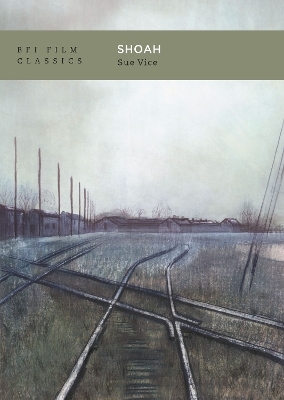
Shoah
Seiten
2026
|
2nd edition
BFI Publishing (Verlag)
978-1-83902-988-2 (ISBN)
BFI Publishing (Verlag)
978-1-83902-988-2 (ISBN)
- Noch nicht erschienen (ca. Januar 2026)
- Portofrei ab CHF 40
- Auch auf Rechnung
- Artikel merken
A new edition of the BFI Film Classic on Claude Lanzmann's epic documentary Shoah (1985).
Sue Vice's study explores Claude Lanzmann's epic 1985 film Shoah both as cinema and as an example of Holocaust representation. Shoah, the distillation of more than 350 hours of footage gathered over eleven years, tells the story of the Holocaust through interviews with survivors of the extermination camps, bystanders who watched or participated in mass murder, and some of the perpetrators of genocide. Eschewing staple documentary elements of archival footage or narrating voiceover, the film is composed entirely of eyewitness interviews contrasted with footage of landscape in the present, and the chilling imagery of travelling trains. Shoah's effect is to represent the past, but only as it exists in the present - in Lanzmann's words, a "fiction of the real", and not a simple documentary.
In a series of close readings of some of the film's interviews, Sue Vice follows Lanzmann's declaration that "Shoah is a fight against generalities", in emphasising the importance of detail in both dialogue and filmic technique. Through these analyses, Vice explores the background to the film, the difficulties in its financing and production, and the long process of editing that led to Lanzmann's realisation that "the subject of my film is death itself; death and not survival."
In her afterword to this new edition, Sue Vice considers developments such as the online availability of the complete ‘Shoah Collection’, Lanzmann’s archive at the United States Holocaust Memorial Museum, and Shoah's continuing influence on films that witness genocides and the Holocaust, including Joshua Oppenheimer's The Look of Silence (2014), and Jonathan Glazer's The Zone of Interest (2023).
Sue Vice's study explores Claude Lanzmann's epic 1985 film Shoah both as cinema and as an example of Holocaust representation. Shoah, the distillation of more than 350 hours of footage gathered over eleven years, tells the story of the Holocaust through interviews with survivors of the extermination camps, bystanders who watched or participated in mass murder, and some of the perpetrators of genocide. Eschewing staple documentary elements of archival footage or narrating voiceover, the film is composed entirely of eyewitness interviews contrasted with footage of landscape in the present, and the chilling imagery of travelling trains. Shoah's effect is to represent the past, but only as it exists in the present - in Lanzmann's words, a "fiction of the real", and not a simple documentary.
In a series of close readings of some of the film's interviews, Sue Vice follows Lanzmann's declaration that "Shoah is a fight against generalities", in emphasising the importance of detail in both dialogue and filmic technique. Through these analyses, Vice explores the background to the film, the difficulties in its financing and production, and the long process of editing that led to Lanzmann's realisation that "the subject of my film is death itself; death and not survival."
In her afterword to this new edition, Sue Vice considers developments such as the online availability of the complete ‘Shoah Collection’, Lanzmann’s archive at the United States Holocaust Memorial Museum, and Shoah's continuing influence on films that witness genocides and the Holocaust, including Joshua Oppenheimer's The Look of Silence (2014), and Jonathan Glazer's The Zone of Interest (2023).
Sue Vice is Professor of English Literature at the University of Sheffield, UK, where her interests lie in the areas of contemporary literature, film and Holocaust studies. Her latest book is Claude Lanzmann’s ‘Shoah’ Outtakes: Holocaust Rescue and Resistance (Bloomsbury Academic, 2021) and she is currently writing a study of Holocaust representation in popular British and Irish fiction.
Acknowledgments
Introduction
1. Lanzmann as Film-maker
2. Documentary or 'fiction of the real'?
3. Archive Footage
4. 'Reincarnating the Past'
5. Mise en scene
6. Lanzmann as Interviewer
7. Poland: The Ethics of Filming
8. Testimony
Appendix: Overview of Shoah
Afterword to the 2026 Edition
Notes
Credits
Bibliography
| Erscheint lt. Verlag | 8.1.2026 |
|---|---|
| Reihe/Serie | BFI Film Classics |
| Sprache | englisch |
| Maße | 134 x 188 mm |
| Gewicht | 168 g |
| Themenwelt | Kunst / Musik / Theater ► Film / TV |
| Geschichte ► Allgemeine Geschichte ► 1918 bis 1945 | |
| ISBN-10 | 1-83902-988-9 / 1839029889 |
| ISBN-13 | 978-1-83902-988-2 / 9781839029882 |
| Zustand | Neuware |
| Informationen gemäß Produktsicherheitsverordnung (GPSR) | |
| Haben Sie eine Frage zum Produkt? |
Mehr entdecken
aus dem Bereich

aus dem Bereich
Deutschland 1933 bis 1945
Buch | Hardcover (2025)
S. Fischer (Verlag)
CHF 47,60
ein Psychologe erlebt das Konzentrationslager
Buch | Hardcover (2024)
Kösel (Verlag)
CHF 30,80


