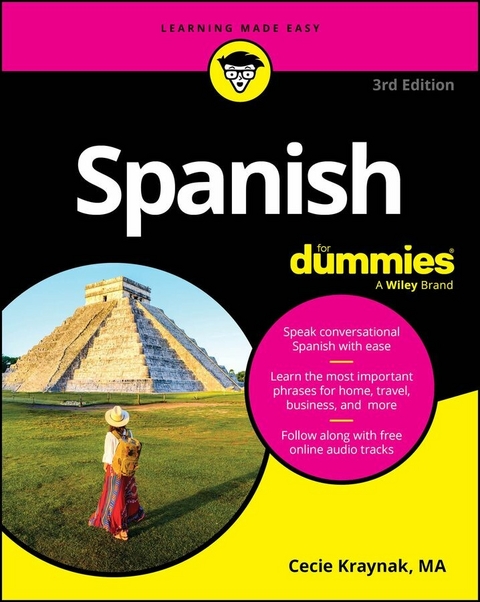
Spanish For Dummies (eBook)
520 Seiten
For Dummies (Verlag)
978-1-394-32133-9 (ISBN)
Learn to speak Latin American Spanish with confidence-the easy way
Spanish For Dummies gets you started with the Spanish language, even if you've never learned a language before. The trusted Dummies language learning method is quick and practical, so you'll know what to say and do when traveling to a Spanish-speaking country or interacting with Spanish speakers in your community. You'll learn the basics of Spanish grammar and pronunciation, and then you'll explore common phrases you'll need in everyday situations. Get ready to study, work, or travel abroad-or integrate Spanish into your everyday life. This essential resource helps you make small talk, understand common expressions, navigate business settings, ask for directions, go to the doctor, and beyond.
- Learn how Latin American Spanish works-grammar, pronunciation, and important constructions
- Build your vocabulary and learn common expressions you'll hear while abroad
- Brush up your conversation skills with authentic dialogues, plus follow along with online audio
- Get practice reading, writing, and speaking Spanish, so you're ready to communicate effectively
With Spanish For Dummies, students, travelers, and business professionals can gain the confidence to converse in Spanish.
Cecie Kraynak, MA, has more than 30 years' experience teaching Spanish. She studied abroad at the University of the Americas in Cholula, Mexico, and the Universidad Complutense in Madrid, Spain. She has authored and contributed to several Spanish titles in the For Dummies series and spends as much time as possible traveling to Spanish-speaking countries.
Learn to speak Latin American Spanish with confidence the easy way Spanish For Dummies gets you started with the Spanish language, even if you've never learned a language before. The trusted Dummies language learning method is quick and practical, so you'll know what to say and do when traveling to a Spanish-speaking country or interacting with Spanish speakers in your community. You'll learn the basics of Spanish grammar and pronunciation, and then you'll explore common phrases you'll need in everyday situations. Get ready to study, work, or travel abroad or integrate Spanish into your everyday life. This essential resource helps you make small talk, understand common expressions, navigate business settings, ask for directions, go to the doctor, and beyond. Learn how Latin American Spanish works grammar, pronunciation, and important constructions Build your vocabulary and learn common expressions you'll hear while abroad Brush up your conversation skills with authentic dialogues, plus follow along with online audio Get practice reading, writing, and speaking Spanish, so you're ready to communicate effectively With Spanish For Dummies, students, travelers, and business professionals can gain the confidence to converse in Spanish.
Introduction
As society becomes more international in nature, knowing how to say at least a few words and phrases in other languages becomes increasingly useful. Global business environments often necessitate overseas travel or at least the ability to communicate via e-mail and over the phone. You just may have friends and neighbors who speak other languages, or you may want to get in touch with your heritage by learning a little bit of the language that your ancestors spoke.
Whatever your reason for wanting to acquire some Spanish, Spanish For Dummies, 3rd Edition, can help you with the skills you need for basic conversational communication in Spanish. I’m not promising fluency here, but if you want to greet someone, purchase a ticket, or order off a menu in Spanish, you need look no further than Spanish For Dummies!
Spanish is one of the great European languages, rich in heritage from its more than nine centuries of existence. This is the language that comes from the region of Spain that English-speakers call Castile. As Christopher Columbus and other Spanish explorers came to the New World, Spanish became the language of the majority of the peoples from Florida to Tierra del Fuego. When you go to places like Argentina, Bolivia, Chile, Colombia, Costa Rica, Cuba, Ecuador, Guatemala, Honduras, Mexico, Nicaragua, Panama, Paraguay, Peru, Puerto Rico, Uruguay, or Venezuela, you speak in or are spoken to in Spanish. If you visit cities like Asuncion, Bogota, Buenos Aires, Caracas, Lima, Mexico City, Montevideo, Quito, San Juan, or Santiago de Chile, and many, many others, the people predominantly speak Spanish. And when you speak their language or even attempt to communicate with them in their native tongue, you add a richer dimension to your experience. Some folks say that language can be a barrier. And I believe that by removing this barrier, you open a world of possibilities.
So you have several good reasons to embrace this beautiful language. You may want to understand the culture and the people. You may also want your Spanish-speaking friends and neighbors at home to understand you, in their own language. So even if your Spanish isn’t perfect, you’ll be appreciated and encouraged in your attempts to immerse yourself in the Spanish-speaking world.
About This Book
Spanish For Dummies can help you reach moments of true understanding in a different language. Use the text as a language and cultural guide for those moments when you really need to know how and why things are done. Note: This book concentrates on Latin American Spanish, meaning the Spanish spoken in Mexico, Central America, and South America.
This book also isn’t a class that you have to drag yourself to twice a week for a specified period of time. You can use the book however you want to, whether your goal is to know some words and phrases to help you get around when you visit Mexico and the countries of Central or South America, travel to Spain, or simply want to be able to say, “Hello, how are you?” to your Spanish-speaking neighbor. Go through this book at your own pace, reading as much or as little at a time as you like. You don’t have to trudge through the chapters in order, either; just read the sections that interest you.
Conventions Used in This Book
To make this book easy for you to navigate, I’ve set some conventions:
- Spanish terms are set in boldface to make them stand out. They’re accompanied by pronunciations, set in normal type with stressed syllables in italics (see the following bullet), and English translations, also set in italics. (Exception: The “Words to Know” tables underline stressed syllables and don’t specially format Spanish words or the translations.)
- Within the pronunciation brackets, I separate all the words that have more than one syllable with a hyphen, like this: (kah-sah).
- Verb conjugations (in charts that show you the forms of a verb) are given in tables in this order: the I form, the you (singular, familiar) form, the he/she/you (singular, formal) form, the we form, and the they/you (plural, formal) form. Pronunciations follow in the second column. Here’s an example:
| Conjugation | Pronunciation |
|---|
| yo llevo | yoh yeh-bvoh |
| tú llevas | tooh yeh-bvahs |
| él, ella, usted lleva | ehl, eh-yah, oohs-tehd yeh-bvah |
| nosotros, nosotras llevamos | noh-soh-trohs, noh-soh-trahs yeh-bvah-mohs |
| ellos, ellas, ustedes llevan | eh-yohs, eh-yahs, oohs-teh-dehs yeh-bvahn |
Language learning is a peculiar beast, so this book includes a few elements that other For Dummies books don’t. Following are the new elements you encounter:
- Talkin’ the Talk dialogues: The best way to pick up a language is to see and hear how it’s used in conversation, so I include dialogues throughout the book. The dialogues come under the heading “Talkin’ the Talk” and show you the Spanish words, the pronunciation, and the English translation.
- Words to Know tables: Memorizing key words and phrases is also important in language learning, so I collect the important words that appear in a Talkin’ the Talk dialogue and write them on a chalkboard with the heading “Words to Know.”
- Fun & Games practice activities: If you don’t have actual Spanish-speakers to practice your new language skills on (and even if you do), you can use the Fun & Games activities to reinforce what you learn. These word games are fun ways to challenge yourself and gauge your progress. You can find the answers to each exercise in Appendix C.
- Mini-dictionaries: Because words are the building blocks of any language I provide Spanish-to English and English-to Spanish mini dictionaries in Appendix A in the back of the book. These mini-dictionaries provide many common vocabulary words that you may want to use in your conversations or that you have a question about.
- Verb tables: In every language you use different forms of a verb to show who or what is doing the action and when they are doing it. I cover this briefly in Chapter 2 and include additional verb tables with the present, past, and future tenses in Appendix B.
Although the English translations that I provide for the Spanish terms may not be exactly literal, I want you to know the gist of what’s being said, not just the words that are being said. For example, you can translate the Spanish phrase de nada (deh nah-dah) literally as of nothing, but the phrase really means you’re welcome (as in, think nothing of it). This book gives the you’re welcome translation.
Foolish Assumptions
To write this book, I had to make some assumptions about who you are and what you want from a book called Spanish For Dummies. Here are the assumptions that I’ve made about you:
- You know no Spanish — or if you took Spanish back in school, you don’t remember a word of it.
- You’re primarily interested in communicating verbally in Spanish, not in reading or writing Spanish, though this book can help with that, too.
- You’re not looking for a book that will make you fluent in Spanish; you just want to know some words, phrases, and sentence constructions so that you can communicate basic information in Spanish.
- You don’t want to have to memorize long lists of vocabulary words or a bunch of boring grammar rules, but you do want some guidance on grammar to deepen your understanding and use of the language.
- You want to have fun and learn a little bit of Spanish at the same time.
If these statements apply to you, you’ve found the right book!
Icons Used in This Book
You may be looking for particular information while reading this book. To make certain types of information easier for you to find, I’ve placed the following icons in the left-hand margins throughout the book:
Pay close attention to the information marked with this icon; it’s something so important that you should commit it to memory.
This icon highlights tips that can make learning Spanish easier.
Languages are full of quirks that may trip you up if you’re not prepared for them. This icon points to discussions of these weird grammar rules.
If you’re looking for information and advice about culture and travel, look for these icons. They draw your attention to interesting tidbits about the countries in which Spanish is spoken.
The audio tracks included with this book give you the opportunity to listen to real Spanish speakers so that you can get a better understanding of what Spanish sounds like. This icon marks the Talkin’ the Talk dialogues that you can find available as audio tracks online.
I like to think that you’ll read every word in this book, but I also know that you’re eager to start immersing yourself in...
| Erscheint lt. Verlag | 2.4.2025 |
|---|---|
| Sprache | englisch |
| Themenwelt | Schulbuch / Wörterbuch ► Wörterbuch / Fremdsprachen |
| Geisteswissenschaften ► Sprach- / Literaturwissenschaft ► Sprachwissenschaft | |
| Technik | |
| Schlagworte | beginner Spanish • common Spanish phrases • conversational spanish • learn spanish • Spanish • Spanish 101 • spanish book • spanish conversation • Spanish Grammar • spanish grammar book • Spanish language • Spanish language learning • Spanish phrase book • travel Spanish |
| ISBN-10 | 1-394-32133-3 / 1394321333 |
| ISBN-13 | 978-1-394-32133-9 / 9781394321339 |
| Informationen gemäß Produktsicherheitsverordnung (GPSR) | |
| Haben Sie eine Frage zum Produkt? |
 EPUB (Adobe DRM)
Kopierschutz: Adobe-DRM
Adobe-DRM ist ein Kopierschutz, der das eBook vor Mißbrauch schützen soll. Dabei wird das eBook bereits beim Download auf Ihre persönliche Adobe-ID autorisiert. Lesen können Sie das eBook dann nur auf den Geräten, welche ebenfalls auf Ihre Adobe-ID registriert sind.
Details zum Adobe-DRM
Dateiformat: EPUB (Electronic Publication)
EPUB ist ein offener Standard für eBooks und eignet sich besonders zur Darstellung von Belletristik und Sachbüchern. Der Fließtext wird dynamisch an die Display- und Schriftgröße angepasst. Auch für mobile Lesegeräte ist EPUB daher gut geeignet.
Systemvoraussetzungen:
PC/Mac: Mit einem PC oder Mac können Sie dieses eBook lesen. Sie benötigen eine
eReader: Dieses eBook kann mit (fast) allen eBook-Readern gelesen werden. Mit dem amazon-Kindle ist es aber nicht kompatibel.
Smartphone/Tablet: Egal ob Apple oder Android, dieses eBook können Sie lesen. Sie benötigen eine
Geräteliste und zusätzliche Hinweise
Buying eBooks from abroad
For tax law reasons we can sell eBooks just within Germany and Switzerland. Regrettably we cannot fulfill eBook-orders from other countries.
aus dem Bereich