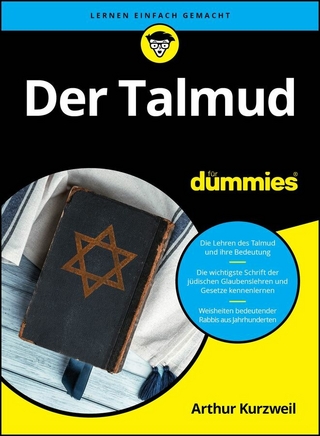
The Talmud For Dummies (eBook)
325 Seiten
For Dummies (Verlag)
978-1-394-33213-7 (ISBN)

Unlock the wisdom, guidance, and spiritual insight of the Talmud
The Talmud For Dummies introduces you to the Jewish guidebook on life and overall cornerstone text of Judaism, the Talmud. This easy-to-understand book makes the Talmud's 63 volumes approachable, so you can deepen your understanding of Jewish teachings. You'll learn about what the Talmud is, get guidance on how to approach Talmud study, and find direction on how to apply the wisdom of the Talmud in your personal and spiritual life.
- Read the fascinating history of the Talmud and the key figures who shaped it
- Get advice on how to study the Talmud and uncover its spiritual teachings
- Apply Talmudic wisdom to everyday life, including marriage, divorce, kosher practices, prayers, and even humor
- Become well versed in the law of Rabbinic Judaism
The Talmud For Dummies is your go-to resource for anyone who wants to study the Talmud, including complete beginners and those looking to brush up their knowledge. Discover the timeless teachings of this profound and influential book with The Talmud For Dummies at your side.
Arthur Kurzweil is a teacher of Talmud and Kabbalah. He is the recipient of the Distinguished Humanitarian Award from the Melton Center for Jewish Studies at The Ohio State University for his unique contributions to Jewish education, as well as a Lifetime Achievement Award from the International Association of Jewish Genealogical Societies. Arthur is the author of several books including The Torah For Dummies, Kabbalah For Dummies, and On the Road with Rabbi Steinsaltz.
Unlock the wisdom, guidance, and spiritual insight of the Talmud The Talmud For Dummies introduces you to the Jewish guidebook on life and overall cornerstone text of Judaism, the Talmud. This easy-to-understand book makes the Talmud's 63 volumes approachable, so you can deepen your understanding of Jewish teachings. You'll learn about what the Talmud is, get guidance on how to approach Talmud study, and find direction on how to apply the wisdom of the Talmud in your personal and spiritual life. Read the fascinating history of the Talmud and the key figures who shaped it Get advice on how to study the Talmud and uncover its spiritual teachings Apply Talmudic wisdom to everyday life, including marriage, divorce, kosher practices, prayers, and even humor Become well versed in the law of Rabbinic Judaism The Talmud For Dummies is your go-to resource for anyone who wants to study the Talmud, including complete beginners and those looking to brush up their knowledge. Discover the timeless teachings of this profound and influential book with The Talmud For Dummies at your side.
Introduction
Maybe you heard someone say, “The Talmud says …” and you wonder just what the Talmud is. Well, the Talmud isn’t so easy to define. The word itself literally means learning, but the text by that name has a more complex true definition. The best way to understand what it is, as I explain in this book, is to jump right into it and swim around a little.
Think of studying the Talmud kind of like kissing. You can read about kissing, you can watch people kiss, you can understand the physiology of how to kiss, but if you want to learn about kissing, the best thing to do is to experience some kissing!
The phrase “the Sea of Talmud” has been used for many centuries to describe the Talmud, and the metaphor of a sea is apt. The Talmud, like a sea
- Has no real beginning. Just jump in.
- Is deep and vast. (The Talmud consists of 63 books, 517 chapters, 2,711 double-sided pages, and 1,860,131 words.)
- Needs an experienced captain to navigate through its waters.
- Can be dangerous; you might drown in it.
The Talmud presents a number of challenges to the reader:
- Written in a mixture of Hebrew and Aramaic
- Contains no vowels, just consonants
- Has incredibly complex text
- Jumps from subject to subject without warning
- Contains a lot of text that may seem irrelevant to modern life
- Much more interested in questions than in answers
Discouraged already? Please don’t be. Translations of the Talmud into modern English use punctuation, and you can find commentaries that go word by word, phrase by phrase, to help even the absolute beginner navigate the Sea of Talmud. And I’m here to act as your guide while we explore the Talmud together.
Talmudic scholars say that the Talmud is written in the language of thought. In the same way that your thoughts can be all over the place almost simultaneously, the Talmud goes from topic to topic by free association.
Someone seeking spiritual enlightenment often has trouble with the Talmud. Why? Because the Talmud has a unique quality that probably no other religious text has: It requires the student to object to it! That’s right. In fact, if you’re not arguing with the text, you’re probably not really studying the Talmud correctly. Although the Talmud is a sacred book of the Jewish people, it encourages — no, it demands — that you question it.
The Inuit, indigenous people native to the Artic and Subarctic regions of North America, have a lot of words for snow in all its varieties. Although people often exaggerate exactly how many words they have, you can understand why they might have more words for snow than people who live in the tropics, for example. Exposure to and constant contact with something makes all its variations clear.
Well, the Talmud doesn’t have too many words for snow, but it has a lot of different words for questions. In fact, the sages who first recorded the Talmud built it on questions. While you study the Talmud, if you don’t ask questions, you can’t really participate in the process of Talmud study. The student of Talmud must eagerly question and re-examine accepted views.
The Talmud was originally compiled over 2,000 years ago, but it serves as the repository of thousands of years of Jewish wisdom.
Another unique aspect of the Talmud is that it treats both familiar topics and imaginary topics with the same degree of seriousness. In other words, to test an idea, the Talmud often invents an impossible situation in order to see the implications of the idea. For example, even though no flying machines existed when the Talmud was compiled, the Talmud doesn’t hesitate to say, “Well, what if we had a flying machine? What would that mean?”
The Talmud is filled with wisdom on almost every subject that you can imagine, but the text of the Talmud is more interested in the discussions that lead to the piece of wisdom, rather than merely the conclusion. When a Jewish child comes home from school, the appropriate question their parent asks isn’t, “What did you learn today?” Instead, they ask, “Did you ask a good question today?”
The writers and compilers of the Talmud never imagined a final, written work, but rather an open-ended text in which new questions and points of view are constantly asked. Talmudic scholars consider it a great achievement when a student of the Talmud comes up with an angle that no one had considered before.
About This Book
The Talmud is Judaism’s most important spiritual text, after the Bible. In fact, when students study a sacred Jewish text, they almost always study the Talmud. In The Talmud for Dummies, I aim to acquaint you with its key elements.
One of those elements is the great sages (wise rabbis) whose thoughts, ideas, and points of view appear in the pages of the Talmud. Probably a thousand different personalities have their words represented in the Talmud. Some of those sages appear only once in the entire text, while others appear hundreds of times. I introduce you to many of the key sages whose wisdom is laid out in the dialogues and debates in the Talmud.
The Talmud, unfortunately, has had a rough history, much like the Jewish people, who have had to face antisemites (people who are hostile to or prejudiced against Jews) since ancient times. Groups that have wanted to destroy the Jewish people over the centuries attacked and burned the Talmud because it’s such a vital text for Jews.
The Talmud also faces attack because of a widespread misunderstanding of its contents and intentions. When the sages debate a certain subject, the pages of the Talmud record all sides of the debate, even the points of view ultimately rejected by the debaters. When someone quotes from the Talmud, that quote may reflect an idea that the overall text fiercely rejects. But someone can say, “The Talmud says …” even if the sages in the Talmud condemn the statement that they quote. This quoting out of context has happened many times throughout history, with horrible results.
The Talmud has a fascinating history, but it also has a tragic side because of the ways in which those opposed to the Jews have manipulated and distorted its purpose. In this book, I take you through some of the highlights and lowlights of the Talmud’s story.
You can’t get around the fact that the Talmud has been something of a men’s club. The Talmud’s personalities are 99 percent male, so their points of view are, not surprisingly, male-oriented. Additionally, only men have studied the Talmud over the centuries (for the most part), so men have also written the commentaries. In The Talmud for Dummies, I confront this fact head-on and describe some of the efforts being made in our generation to change that situation.
The Talmud deals with every topic under the sun in its 63 volumes and countless commentaries. I often challenge people to name a topic, and I can show them where in the Talmud they can find a discussion relevant to the topic. I’ve never lost that challenge. The topics in the Talmud include subjects and situations limited only by the imagination. In The Talmud for Dummies, I select and explore a number of topics discussed in the pages of the Talmud that I hope interest you. Those topics include sex, the courts, marriage and divorce, eating, celebrating holy days, and humor.
Conventions Used in This Book
To help you navigate this introduction to the Sea of Talmud, I use the following conventions:
- Definitions: I define each Hebrew term the first time I use it, and I provide you with a pronunciation guide. I don’t use a standard pronunciation system, but rather an easy-to-use system based on plain-spoken English.
- Dates: When I provide a date, I use the secular abbreviations CE (Common Era), rather than AD (Anno Domini) and BCE (Before the Common Era) rather than BC (Before Christ). The year numbers are the same (meaning 500 CE is the same as 500 AD). I use a reference point that’s not Christian-oriented in fairness to our topic.
Foolish Assumptions
While I wrote this book, I had to make some assumptions about you. If you fit into any of these assumptions, this book is for you:
- You feel pretty educated as a Jewish person, but you never really understood what the Talmud is all about.
- You’ve heard about the Talmud but have no idea what it is.
- You’ve heard the word Talmudic used in a negative way, implying overly complex or hair-splitting arguments.
- You know nothing about the Talmud, or you’re aware of some common misconceptions about the Talmud that you want to clear up.
- You’ve seen accusations online that the Talmud is somehow against non-Jews.
- You’ve read some horrible quotations supposedly from the Talmud and you want to know the truth.
- You want to learn about the Talmud, but you don’t want to struggle through an academic book about it. Instead, you want a friendly, informal, but accurate treatment of the subject.
- You know some people who study the Talmud, and you want to try it, too.
Icons Used in This Book
You don’t have to read this book cover to cover (though you certainly can). Think of it as your guide to understanding the Talmud. You can jump straight to the topics that interest you...
| Erscheint lt. Verlag | 1.4.2025 |
|---|---|
| Sprache | englisch |
| Themenwelt | Geisteswissenschaften ► Religion / Theologie ► Judentum |
| Schlagworte | English talmud • jewish books • jewish dummies • Jewish knowledge • Jewish Law • jewish Talmud in English • Judaism • Judaism books • Judaism dummies • Talmud • Talmud book • Talmud commentary • Talmud guide • Talmud study • Talmud Torah |
| ISBN-10 | 1-394-33213-0 / 1394332130 |
| ISBN-13 | 978-1-394-33213-7 / 9781394332137 |
| Informationen gemäß Produktsicherheitsverordnung (GPSR) | |
| Haben Sie eine Frage zum Produkt? |
 EPUB (Adobe DRM)
Kopierschutz: Adobe-DRM
Adobe-DRM ist ein Kopierschutz, der das eBook vor Mißbrauch schützen soll. Dabei wird das eBook bereits beim Download auf Ihre persönliche Adobe-ID autorisiert. Lesen können Sie das eBook dann nur auf den Geräten, welche ebenfalls auf Ihre Adobe-ID registriert sind.
Details zum Adobe-DRM
Dateiformat: EPUB (Electronic Publication)
EPUB ist ein offener Standard für eBooks und eignet sich besonders zur Darstellung von Belletristik und Sachbüchern. Der Fließtext wird dynamisch an die Display- und Schriftgröße angepasst. Auch für mobile Lesegeräte ist EPUB daher gut geeignet.
Systemvoraussetzungen:
PC/Mac: Mit einem PC oder Mac können Sie dieses eBook lesen. Sie benötigen eine
eReader: Dieses eBook kann mit (fast) allen eBook-Readern gelesen werden. Mit dem amazon-Kindle ist es aber nicht kompatibel.
Smartphone/Tablet: Egal ob Apple oder Android, dieses eBook können Sie lesen. Sie benötigen eine
Geräteliste und zusätzliche Hinweise
Buying eBooks from abroad
For tax law reasons we can sell eBooks just within Germany and Switzerland. Regrettably we cannot fulfill eBook-orders from other countries.
aus dem Bereich