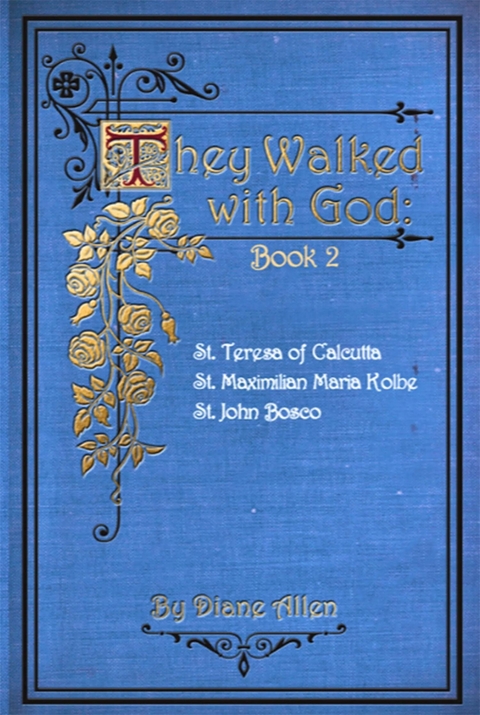
They Walked with God Book 2: (eBook)
310 Seiten
Bookbaby (Verlag)
979-8-3178-0004-8 (ISBN)
b044>
St. Teresa of Calcutta :was born in 1910 in Skopje, in present-day Macedonia, Mother Teresa joined the Sisters of Loreto religious congregation in Dublin, Ireland in 1928. As a Sister of Loreto, she taught geography at St. Mary's High School in Calcutta, India for twenty years. In 1950, she started her own religious congregation, the Missionaries of Charity, in order to minister to the poorest of the poor. To people throughout the world, Mother Teresa is an icon of goodness and compassion. Pope Paul VI said, "e;The work of Mother Teresa shows this - her inexhaustible energy, her potential for good, the resources of her human heart, are poured out. The leaven of her personal sacrifice as well as her courage enabled her to do unbelievable things with God's help."e;St. John Bosco who was born in Becchi, Italy in 1815, was the founder of a religious congregation known as the Salesians. He was also the co-founder of the Daughters of Mary, Help of Christians, an order of religious Sisters whose purpose was to help orphaned and destitute girls in Italy. He organized an association for the laity called the Salesian Cooperators. The Cooperators were to be activists, fully committed to helping the displaced and the destitute. Pope Pius IX was among the first to enroll as a Cooperator. St. John Bosco developed a teaching method called the "e;Preventive System"e; which was based on reason, religion and kindness. He became known as one of Europe's finest educators. By the end of his life, he and his religious congregation were helping 131,000 disadvantaged and orphaned children. When praised for his works of charity he said, "e;I have done nothing by myself. Our Lady has done everything."e; Pope Pius XI said of him: "e;John Bosco's life was a succession of wonders. It was one continuous miracle."e;St. Maximilian Maria Kolbe who was born in 1894, was a Catholic priest and Conventual Franciscan Friar. In 1917 he founded the Militia Immaculatae, a worldwide movement that promotes total consecration to the Blessed Virgin Mary as a means of spiritual renewal. He established a friary which he named "e;The City of the Immaculate"e; near Warsaw, Poland. By 1939, the City of the Immaculate had become the largest Franciscan friary in the world. He published a monthly magazine which he called Knight of the Immaculata. He lived in Japan for a period of six years where he established a friary - the Garden of the Immaculate. When he returned to Poland, he continued to write and print his publications. With very little money, he built one of the most advanced religious printing plants in Europe. For years, he had wanted to use the media of radio to broadcast spiritual programs. With a short-wave radio borrowed from the army, he was finally able to do so. He once said, "e;If St. Francis of Assisi was alive, he would be using all of the modern means of technology and mass communication."e; Father Maximilian was known and loved throughout Poland and considered a national hero. The fact that he was a person of such great influence caused the Nazis in Occupied Poland to consider him dangerous. In 1941, he was arrested and taken to the German death camp of Auschwitz. When the Nazi guards selected 10 prisoners to die in punishment for one escapee, Kolbe offered his life in exchange for one of the prisoners. His death was mourned by thousands.
Let us imagine that we are a brush in the hand of an infinitely perfect artist. What must a brush do to make the painting turn out most beautiful? It must allow itself to be guided as perfectly as possible … When Eternal Wisdom, God, uses us as an instrument, then we shall act most fruitfully … when we permit ourselves to be directed most perfectly and entirely.
– St. Maximilian Maria Kolbe
Chapter 2 St. Maximilian Maria Kolbe
Raymond Kolbe (Maximilian Kolbe) was born on January 8, 1894 in Zdunska Wola, Kingdom of Poland. He was baptized on the same day in the parish church of the Assumption of Our Lady. At the time of Raymond’s birth, Zdunska Wola was part of the Russian Empire.
Like many others in Zdunska Wola, Raymond’s parents, Julius and Maria Kolbe earned their living as domestic weavers, spending many hours a day at their looms. At the end of the week, Julius would take the cloth to the town of Lodz where he was paid a small sum for it.
Although the Kolbe family was poor in material goods, they were rich in faith and in the love of God. Julius and Maria were devout Catholics and were wonderful spiritual role models for their children. Raymond had an older brother, Francis and a younger brother, Joseph.
Maria taught her sons to recite daily prayers including the Angelus, the Rosary, and the Litany to Our Lady. She set up a small shrine in their house where they could come together to pray. Raymond had a deep love and reverence for his mother and father. On many occasions, Julius took his family on pilgrimage to the famous shrine in Czestochowa which was dedicated to the Virgin Mary, lovingly called the “Queen of Poland.”
Because it was hard to eke out a living in Zdunska Wola, Julius and Maria decided to move to Pabianice where there would be more opportunities for work. In Pabianice, Maria had a very small store which she operated in her home, selling household goods. She also worked as a midwife. Julius found work in a large factory that made cloth by machine. He also rented a plot of land where he grew and sold vegetables for additional income.
In Pabianice, the Kolbes economic situation improved a little and Julius felt he could finally afford to send one child to school. Francis, the oldest boy, was soon enrolled at the local trade school in Pabianice. Raymond was to stay home and assist his mother with household tasks as well as help care for his younger brother Joseph. When Raymond finished elementary school, it would not be possible for him to go any farther in his education. Few Polish families could afford to send their children to high school as the tuition was very expensive. It was assumed that Raymond would follow in his father’s footsteps regarding his occupation.
One day, Raymond’s mother sent him to the pharmacist, Mr. Kotowska, to pick up medicine. In making the request, Raymond used the Latin name for the medicine with perfect pronunciation. Mr. Kotowska was both surprised and impressed and asked him where he had learned Latin. “From our parish priest,” Raymond replied. As they conversed together, Mr. Kotowska observed Raymond’s maturity and intelligence. He learned that Raymond did not attend school because his parents could not afford to send him. He offered to give Raymond private tutoring lessons so that by the end of the year he would be able to catch up with his older brother in his studies. He set up a schedule for Raymond to come for lessons. Raymond was overjoyed and his parents were very grateful for the opportunity that was given to him.
In 1906, when Raymond was 12 years old, he had a vision of the Virgin Mary which strongly influenced the rest of his life. One day, his mother became annoyed with him and exclaimed, “Raymond, what will become of you?” Not long after, he was in church when he thought of his mother’s recent words. He prayed to the Virgin Mary and asked her, “Blessed Mother, what will become of me?” He then saw the Virgin Mary standing in front of him, holding two crowns. One was white and the other was red. She asked him which one he wanted. The white crown meant that he would live a pure and holy life while the red one was a martyr’s crown. Raymond said that he would like both of them. The Virgin then smiled at him and disappeared. He told his mother in detail what had occurred. Raymond’s mother noticed a great change in her son after his extraordinary experience. He became more prayerful and more serious.
At age thirteen, Raymond along with his brother Francis attended a parish mission in Pabianice given by two Conventual Franciscans. Raymond was deeply inspired by the talks that were given at the mission and was especially moved by a sermon preached by one of the priests, Father Peregrine Haczela. Raymond was familiar with Franciscan spirituality as his father had given him a book on the life of St. Francis of Assisi which he read with deep interest.
At the mission, it was announced that the Conventual Franciscans were opening a school and minor seminary in Lwow, in the Austrian zone of Occupied Poland. They were looking for young men who might be interested in attending. Those who attended the minor seminary had the opportunity to enter the Franciscan Order and become friars but there was no obligation to do so. It was a chance for young men to look at the life of the Conventual Franciscans and see if they might be interested in a vocation to religious life. Meanwhile, for three years they would have the opportunity to receive a free education as well as free room and board.
Julius and Maria Kolbe were thrilled that their sons were offered the opportunity to attend the minor seminary in Lwow. They considered it a great blessing. Feeling the same enthusiasm as their parents, Francis and Raymond were elated at the prospect of living and studying with the Conventual Franciscans.
Francis and Raymond set out on their journey to the Lwow minor seminary with their father Julius. He was able to accompany them as far as Krakow. They came upon a farmer in a hay wagon who was traveling in the same direction and Julius explained that his sons were on their way to the Franciscan minor seminary in Lwow but did not have passports. It would be risky for them to try to cross at the border into Austrian territory without proper documentation. Julius asked the farmer if the boys could travel with him and hide beneath the hay and the farmer readily agreed. With the farmer’s help, they made it safely to their destination. Three years later, their brother Joseph entered the minor seminary as well.
Raymond had a brilliant mind and did very well in his studies at the minor seminary. He had a great interest in mathematics and science and excelled in both. Students and teachers alike marveled at his deep and unusual grasp of mathematics. While the other students labored over difficult mathematical formulas, Raymond was able to solve the problems quickly and with ease. Academically, he was in the top of his class.
Raymond was fascinated by scientific inventions and conducted some of his own experiments in his free time. He loved to look up into the night sky at the amazing treasure chest of astronomical wonders and often spoke to his fellow classmates about interplanetary spaceflight between stars and planets. In 1910, such ideas were considered pure fantasy.
After he completed three years in the minor seminary, Raymond, who by now was sixteen years old, had to make a major decision regarding his future with the Conventual Franciscans. If he wanted to become a priest, he would then enter the novitiate. If not, his education and formation with the Conventual Franciscans was completed and he would return home to his family. Feeling a call to the priesthood, Raymond asked for admittance to the novitiate. He was then invested with the black Franciscan habit and given a new name – Maximilian, after an early Christian saint who had been martyred for the faith. Later, he would choose Maria for his middle name.
Maximilian had many good friends in the Franciscan novitiate and his fellow students described him as a friar that “everyone could trust.” He had a lifelong love for the game of chess and enjoyed playing it in his leisure time with his friends. He had a joyful temperament as well as great confidence in God. He did not get upset when confronted with difficulties but maintained an optimistic attitude.
After completion of one year in the novitiate, Maximilian made his simple profession, vowing to practice poverty, chastity. and obedience according to the rule of St. Francis of Assisi. The following year, he was sent to Krakow to continue his studies.
In 1912, Maximilian’s superior informed him that he was one of seven friars that had been chosen to pursue academic studies in philosophy and theology at the International Seraphic College and the Pontifical Gregorian University in Rome. Studying in Rome was a privilege that was given only to the brightest and most promising students in the Conventual Franciscan seminary. Maximilian traveled to Rome where he would live for the next seven years. At the Pontifical Gregorian University, he earned a Ph.D in philosophy. He continued his academic studies at the International Seraphic College where he earned a second Ph.D, this time in theology. His professors described him as being “intellectually gifted.” One of his professors said of him, “He had a rare, natural genius.”
In Rome, Maximilian was drawn more and more to revere and honor his heavenly Mother, the Blessed Virgin Mary. He lovingly referred to her as Mama Mia. Deeply devoted to the Rosary,...
| Erscheint lt. Verlag | 2.4.2025 |
|---|---|
| Sprache | englisch |
| Themenwelt | Geisteswissenschaften ► Religion / Theologie ► Christentum |
| ISBN-13 | 979-8-3178-0004-8 / 9798317800048 |
| Informationen gemäß Produktsicherheitsverordnung (GPSR) | |
| Haben Sie eine Frage zum Produkt? |
 EPUB (Ohne DRM)
Größe: 1,1 MB
Digital Rights Management: ohne DRM
Dieses eBook enthält kein DRM oder Kopierschutz. Eine Weitergabe an Dritte ist jedoch rechtlich nicht zulässig, weil Sie beim Kauf nur die Rechte an der persönlichen Nutzung erwerben.
Dateiformat: EPUB (Electronic Publication)
EPUB ist ein offener Standard für eBooks und eignet sich besonders zur Darstellung von Belletristik und Sachbüchern. Der Fließtext wird dynamisch an die Display- und Schriftgröße angepasst. Auch für mobile Lesegeräte ist EPUB daher gut geeignet.
Systemvoraussetzungen:
PC/Mac: Mit einem PC oder Mac können Sie dieses eBook lesen. Sie benötigen dafür die kostenlose Software Adobe Digital Editions.
eReader: Dieses eBook kann mit (fast) allen eBook-Readern gelesen werden. Mit dem amazon-Kindle ist es aber nicht kompatibel.
Smartphone/Tablet: Egal ob Apple oder Android, dieses eBook können Sie lesen. Sie benötigen dafür eine kostenlose App.
Geräteliste und zusätzliche Hinweise
Buying eBooks from abroad
For tax law reasons we can sell eBooks just within Germany and Switzerland. Regrettably we cannot fulfill eBook-orders from other countries.
aus dem Bereich