


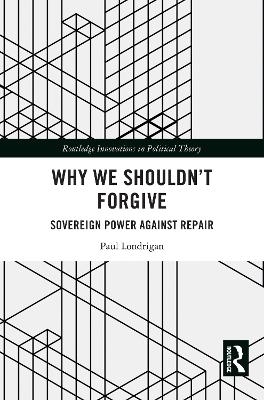
Why We Shouldn’t Forgive
Sovereign Power Against Repair
Seiten
2025
Routledge (Verlag)
978-1-032-85173-0 (ISBN)
Routledge (Verlag)
978-1-032-85173-0 (ISBN)
This book invites the reader to understand how the practice of political forgiveness and sovereignty have changed, evolved, and developed over time. Londrigan offers original insights into forgiveness as part of an analysis of prerogative power, and thus how it has been understood in the history of political thought becomes intelligible.
Why We Shouldn’t Forgive invites you to understand how the practice of political forgiveness and sovereignty has changed, evolved, and developed over time.
Political forgiveness is an awesome power that bears the promise of great benevolence, but this does not mean, as Paul Londrigan argues, that we should forgive. By engaging with the subject of political forgiveness in relation to sovereignty, Londrigan offers original insights into forgiveness as part of an analysis of prerogative power. As a result, what forgiveness does, and how it has been understood in the history of political thought, becomes intelligible. Six substantive chapters that investigate and substantiate the argument that we should not forgive follow the introduction. Each chapter adopts a seminal figure in the history of political thought beginning with Niccolò Machiavelli, and charts a course through Jean Bodin, Thomas Hobbes, John Locke, and Alexis de Tocqueville. As the chapters unfold across thinkers and through time, they build on one another. The resulting narrative illustrates how political forgiveness and sovereign power have evolved, and crucially, how the anxieties and preoccupations of his interlocutors change in accordance with who exercises sovereignty and who benefits or suffers from the dispensation of forgiveness.
Why We Shouldn’t Forgive fills an important gap in advancing this fascinating field of research. This book is required reading for students and academics interested in contemporary approaches to reparative politics, studies of post-conflict reconciliation, and those who seek a deeper understanding of the politics of pardon and amnesty, as well as scholars who engage with critiques of sovereign power.
Why We Shouldn’t Forgive invites you to understand how the practice of political forgiveness and sovereignty has changed, evolved, and developed over time.
Political forgiveness is an awesome power that bears the promise of great benevolence, but this does not mean, as Paul Londrigan argues, that we should forgive. By engaging with the subject of political forgiveness in relation to sovereignty, Londrigan offers original insights into forgiveness as part of an analysis of prerogative power. As a result, what forgiveness does, and how it has been understood in the history of political thought, becomes intelligible. Six substantive chapters that investigate and substantiate the argument that we should not forgive follow the introduction. Each chapter adopts a seminal figure in the history of political thought beginning with Niccolò Machiavelli, and charts a course through Jean Bodin, Thomas Hobbes, John Locke, and Alexis de Tocqueville. As the chapters unfold across thinkers and through time, they build on one another. The resulting narrative illustrates how political forgiveness and sovereign power have evolved, and crucially, how the anxieties and preoccupations of his interlocutors change in accordance with who exercises sovereignty and who benefits or suffers from the dispensation of forgiveness.
Why We Shouldn’t Forgive fills an important gap in advancing this fascinating field of research. This book is required reading for students and academics interested in contemporary approaches to reparative politics, studies of post-conflict reconciliation, and those who seek a deeper understanding of the politics of pardon and amnesty, as well as scholars who engage with critiques of sovereign power.
Paul Londrigan is Clinical Assistant Professor of Political Science at Pace University, USA. His research interests include the politics of forgiveness, mercy and repair, democratic theory, theories of sovereignty, and the history of political thought.
Introduction: Forgiveness Withheld. Chapter I: Modernity’s first critique of political forgiveness Chapter II: Forgiveness and the power of life and death Chapter III: Preservation, peace, and power; peculiar roles for forgiveness Chapter IV: The changing shape of sovereignty Chapter V: The quarantining of the omnipotent. Conclusion: A space for repair
| Erscheinungsdatum | 19.07.2025 |
|---|---|
| Reihe/Serie | Routledge Innovations in Political Theory |
| Verlagsort | London |
| Sprache | englisch |
| Maße | 152 x 229 mm |
| Gewicht | 430 g |
| Themenwelt | Geisteswissenschaften ► Philosophie ► Geschichte der Philosophie |
| Geisteswissenschaften ► Philosophie ► Philosophie der Neuzeit | |
| Sozialwissenschaften ► Pädagogik ► Sozialpädagogik | |
| Sozialwissenschaften ► Politik / Verwaltung ► Europäische / Internationale Politik | |
| Sozialwissenschaften ► Politik / Verwaltung ► Politische Theorie | |
| Sozialwissenschaften ► Soziologie | |
| ISBN-10 | 1-032-85173-2 / 1032851732 |
| ISBN-13 | 978-1-032-85173-0 / 9781032851730 |
| Zustand | Neuware |
| Informationen gemäß Produktsicherheitsverordnung (GPSR) | |
| Haben Sie eine Frage zum Produkt? |
Mehr entdecken
aus dem Bereich


aus dem Bereich
eine Geschichte der Zuversicht von Homer bis zum Klimawandel
Buch | Hardcover (2024)
C.H.Beck (Verlag)
CHF 39,20
Philosophie in Zeiten des Krieges : eine Biographie
Buch | Softcover (2024)
C.H.Beck (Verlag)
CHF 24,90


