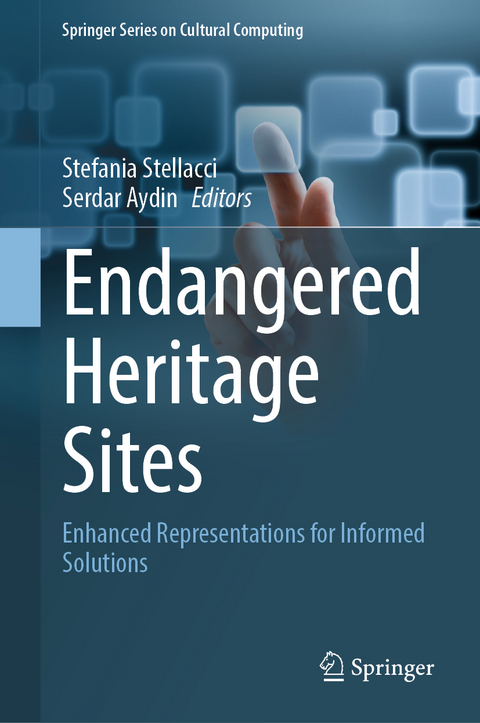
Endangered Heritage Sites
Springer International Publishing (Verlag)
978-3-031-91948-0 (ISBN)
This book provides a thorough exploration of how heritage representation has evolved in the digital age, highlighting connections between diverse informed solutions for preserving and interpreting heritage knowledge. It provides a holistic overview of advanced surveying and visualization tools essential for decoding and analyzing cultural heritage data.
Techniques such as remote sensing, heritage building information modeling (HBIM), knowledge graphs, and game-based learning can unveil the complex layers inherent in endangered heritage sites. Beyond these tools, the book examines policy perspectives that require critical review and collective efforts.
A key focus of the contributions is the revolutionary role of the smart heritage information base as a new form of knowledge and practice. Enriched representations and integrated analyses have revolutionized heritage practices, moving beyond the traditional eidotypes that were prevalent until the first decade of the 21st century. The diverse array of the collected contributions in this book highlights a cultural and technical shift that represents a significant methodological and epistemological progress in the fields of digital humanities and heritage management.
With insightful analyses of heritage sites, especially archaeological remains, through real-world case studies in Spain, Portugal, Turkey, Pakistan, and Israel, this book delves into the challenges posed by human-made induced disasters and natural hazards, offering valuable insights into safeguarding our cultural heritage. These case studies not only show the challenges local sites and communities face now and, in the future, but also enrich the discourse on how to protect our shared cultural heritage together. The advanced mapping and analysis of these case studies reveal the importance to unveil hidden narratives, protect collective values, and reshape perspectives on cultural heritage in the digital age.
The target audience includes heritage practitioners, architects, archaeologists, urban planners, data scientists, researchers, academics, teaching institutions, and architecture students. Its international scope is reflected in contributions and editors from diverse locations. The thematic breadth appeals to a global readership interested in different theoretical and methodological approaches, complemented by a range of case studies across different cultural, economic, and environmental contexts and future scenarios.
Stefania Stellacci is an Integrated researcher at ISTAR (Information Sciences, Technologies and Architecture Research Center) at Iscte (University Institute of Lisbon), Coordinator of ISTAR research group Digital Living Spaces, Member of Scientific Committee (ISTAR), Deputy coordinator of Mixed Reality Lab (2023-), and Invited Professor at Iscte. She is an architect with a MSc in Architecture (University of Ferrara, 2006), holds a postgraduate degree in Built Conservation (Roma3 University, 2007) and a PhD in Architecture (Iscte, 2018). From 2008 to 2014 and 2018 to 2020, she worked as a project architect and team leader at international architecture companies in Lisbon, Pamplona, and Bari.
Her research spans across critical heritage studies, multiple-criteria decision analysis, sustainable heritage management, inclusive design, and digital transformation. Stefania organized a multi-session international symposium Unforeseen path (2022) and co-organized public expositions on the plantation heritage of São Tomé and Príncipe, in Lisbon and São Tomé and Príncipe (2021-2023). She has co-edited a book titled Advanced Research and Design Tools for Architectural Heritage Unforeseen Paths (Routledge, 2024). She has also published in reputable journals in architectural heritage and urban design. She is the Co-Principal Investigator of RETIME Urban Adaptation and Alert Solutions for a TIMEly (re)Action, a 5 million EU-funded project (2024-2028), under HORIZON-CL5-2023-D4-02-02.
Serdar Aydin is an Associate Professor at the Faculty of Engineering and Architecture at Mardin Artuklu University. His research focuses on the digitization of cultural heritage including historical urban landscape, UNESCO-listed (Tentative List) late antique and medieval churches, monasteries, and medieval mosques and madrasahs. His work includes developing process models that illustrate the transition of traditional stone craftsmanship in Mardin to full automation and robotic fabrication; designing interactive virtual reality experiences for historical buildings and environments in Mardin and its rural areas; employing innovative methods such as the transect planning approach, typomorphological analysis, and form-based codes to study the historical urban landscape; and structural analysis of architectural elements in Mardin using finite element methods. As part of these efforts, his project Stone Town won second place in the Natural Stone Design Competition organized by the Ministry of Trade (Republic of Türkiye) in 2021. Serdar s earlier research in digital heritage includes the gamified interactive environments he designed during his PhD, allowing visitors at the Te Papa Museum (Wellington, New Zealand) to experience the historical city of Kashgar, China, and its architectural features through computer games, virtual reality, and hybrid digital platforms.
He was awarded the ROA Award by the Hong Kong Government in 2014, the Design Research Society Student Scholarship in the same year, and the YoungCAADRIA Award in 2015. Beyond digital heritage, his research interests span design-research, building information modeling, game design, parametric and algorithmic design, urban morphology, and smart cities. His academic career has earlier taken him beyond Mardin, with experience in Liverpool (2010-12), Hong Kong (2013-15), Beijing (2014), and Wellington (2015-18). In addition to his academic work, he has engaged in architectural practice. In 2015, he worked at Zaha Hadid Architects in Hong Kong on the Changsha Meixihu International Culture & Arts Centre. He is the founding director of MIMFAB, the architectural research center at Mardin Artuklu University, where he leads architectural projects and R&D initiatives.
Preface: From traditional eidotypes to enriched representations in cultural heritage.- Part 1: Smart heritage information.- Smart policies for heritage at risk.- Anastylosis of the Frigidarium in Patara ancient city using HBIM methodology.- Representing spatial and contextual information about megalithic monuments and the landscape: A knowledge-graph approach.- Part 2: Digital heritage forensics.- Endangered cultural heritage sites in the era of changing climate: Lessons learnt from Pakistan s 2022 floods using satellite data and field observations.- Data-driven documentation: Techniques for historic buildings after anthropogenic and natural hazards.- Digitally aided analysis of medieval vaulted ceilings.- Part 3: Interactive participation in virtual heritage.- Amplifying the future of industrial heritage through digital representation and communication.- Enhanced knowledge transfer in historical site interpretation: A gamified approach for Yedikule Fortress/Türkiye.- Documenting and visualizing heritage in conflict zones: The underground water channel in Tel Gezer.- Digital engagement with remote architecture furthest from the sea : A virtual heritage approach.- Afterword.
| Erscheinungsdatum | 06.10.2025 |
|---|---|
| Reihe/Serie | Springer Series on Cultural Computing |
| Zusatzinfo | XIV, 228 p. 85 illus., 78 illus. in color. |
| Verlagsort | Cham |
| Sprache | englisch |
| Maße | 155 x 235 mm |
| Themenwelt | Geisteswissenschaften ► Geschichte ► Hilfswissenschaften |
| Mathematik / Informatik ► Informatik ► Betriebssysteme / Server | |
| Informatik ► Software Entwicklung ► User Interfaces (HCI) | |
| Sozialwissenschaften | |
| Schlagworte | 3D Heritage Documentation • AI-based Tools • Computational Design Techniques • cultural heritage • Endangered Heritage Sites • Gamification and Narration Learning • knowledge graphs • virtual heritage • visual storytelling |
| ISBN-10 | 3-031-91948-3 / 3031919483 |
| ISBN-13 | 978-3-031-91948-0 / 9783031919480 |
| Zustand | Neuware |
| Informationen gemäß Produktsicherheitsverordnung (GPSR) | |
| Haben Sie eine Frage zum Produkt? |
aus dem Bereich