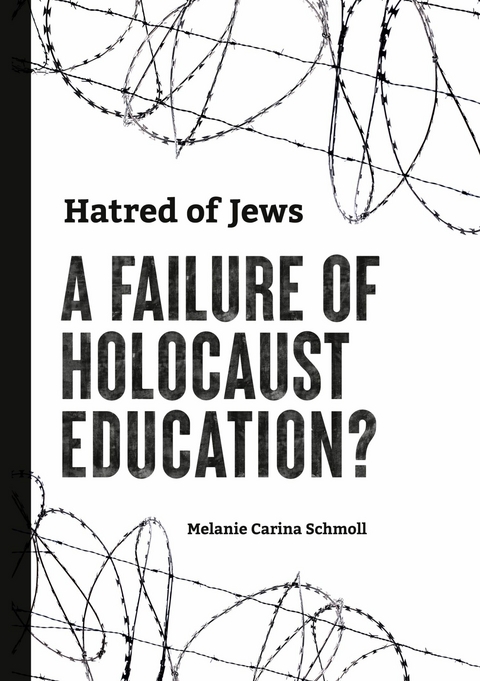
Hatred of Jews-A Failure of Holocaust Education? (eBook)
280 Seiten
Books on Demand (Verlag)
978-3-7693-9705-5 (ISBN)
Melanie Carina Schmoll, PhD, is a historian and research fellow specializing in Holocaust Education. She is an independent author, editor, consultant, speaker, and lecturer. Dr. Schmoll received her doctorate from the University of Hamburg, Germany. She holds a MA and BA degree in the fields of Political Science, History and Philosophy. Dr. Schmoll speaks frequently in the US, Canada, and Israel. Over the course of her career, she held the position as lecturer at the University of Hamburg and the University of the Federal Armed Forces in Hamburg, Germany and Adjunct Associate Professor at the University of Calgary, Canada. She recently finished studies on Holocaust Education in Israel, Canada and Germany. Her current research project deals with Holocaust Education in Canada and Germany. Her talks cover topics like Holocaust Education, education policy and tools and aspects of remembrance and memory. Dr. Schmoll works as an author for school textbooks in the German-speaking countries. She also develops educational material for teachers and educators on various topics. Dr. Schmoll works as a consultant, expert, and reviewer on school textbooks, online learning platforms, and encyclopedias.
2. HOLOCAUST EDUCATION – A CONFUSING TERM AND CONCEPT?
“The dying memory also increases the distance:
The experience-saturated, present survivors become a pure past
that the withdrawn from experience.”1
School is often defined as a micro-level socialization agent, where political, religious, and social positions are further established. Teaching the Holocaust is one of the most demanding topics in schools and is highly difficult to teach. Besides the obvious challenge of teaching kids at the age of 14–16 about the rupture of civilization (Dan Diner) challenges teachers and educators are confronted with are numerous. As Totten stressed in 1999: The Holocaust is one of the most tortuously complex, not to mention horrific subjects an educator can tackle.2 The Holocaust is viewed as a topic for experts with little bearing upon the lives of young people, or so it might seem–but not all teachers and educators are experts. Nevertheless, the Holocaust has to be taught.3
Certainly, the absolute negativity of the Holocaust is unsettling and discouraging. But a discussion on how the Holocaust is taught and whether moral impetus is allowed or even necessary must be held.
The word Holocaust comes from ancient Greek. The word Holocaust is derived from the Greek holokauston, a translation of the Hebrew word ‘olah, meaning a burnt sacrifice offered whole to God. This word was chosen, and gained wide usage, because, in the ultimate manifestation of the National Socialists killing program, the bodies of the victims were consumed whole in crematoria or open fires.4 Since 1945, it has been synonymous with the murder of European Jews during the Second World War (1939–1945). Jews speak of the Shoah, which is the Hebrew word for catastrophe.
The Holocaust
The Holocaust was an unprecedented genocide, total and systematic, perpetrated by National Socialist Germany and its collaborators, with the aim of annihilating the Jewish people. The primary motivation was the national socialist anti-Semitic racist ideology. Between 1933 and 1941 Germany pursued a policy that dispossessed the Jews of their rights and their property, followed by the branding and the concentration of the Jewish population. This policy gained broad support in Germany and much of occupied Europe. In 1941, following the invasion of the Soviet Union, the National Socialists and their collaborators launched the systematic mass murder of the Jews. By 1945 nearly six million Jews had been murdered.5
Following this definition the term Holocaust is used exclusively for the mass murder of Jews and unlike the usage in other studies it is not applicable to other genocides or massacres in human history.6 The Holocaust was a German initiative that took place throughout German- and Axis-controlled Europe. It affected nearly all of Europe’s Jewish population, which in 1933 numbered 9 million people. By the end of the war, 6 million Jews and millions of other victims were dead.7
The time period of the Holocaust differs, here the years of the Holocaust are defined as 1933–1945. In 1933 the Nationalsozialistische Deutsche Arbeiterpartei (NSDAP) (National Socialist German Workers’ Party) came to power in Germany. The Holocaust ended in May 1945, when the Allied Powers defeated Germany in the Second World War (1939–1945).
In order to better understand the background, it is necessary to take a closer look at the period of the Holocaust between 1933 and 1945. When the National Socialists came to power in Germany, they did not immediately start to carry out the mass murder of Jews. But they started quickly to exclude Jews from German society.
Adolf Hitler (1889–1945) was appointed Reichskanzler by President Paul von Hindenburg (1847–1934) on 30 January 1933. He and his party started immediately to rebuild the democratic system of the Weimar Republic by laying the foundations of the National Socialist state. One approach to Hitler’s racist view of the world was the idea of the so-called Volksgemeinschaft (Volk Community). His idea was guided by racist and authoritarian principles. The National Socialists promoted a particularly virulent form of racial hatred of Jews. They believed that the world was divided into distinct races and that some of these races were superior to others. They considered Germans to be members of the supposedly superior race. They asserted that these so-called Aryans were locked in a struggle for existence with other, inferior races.
The National Socialists eliminated individual freedoms and a society which would, in theory, transcend class and religious differences. To reach this goal, Hitler and the National Socialists wanted to unite the German people politically and culturally. Thus, they said that Germans, German blood, and German culture were better than that of the rest of the world. Blood was especially important to the National Socialists for being part of the Volk, the nation. Hitler and other National Socialist thinkers were associating nationality with race. The connection between blood, race and nationality set up the qualifications for who was in and out of the Volksgemeinschaft. To them, the Germans were the perfect race and all others were inferior. They targeted Jews as the worst of all races. According to the National Socialists, Jews were a threat that needed to be removed from German society. Otherwise, Jews would permanently corrupt and destroy the German people–such was the thinking of the National Socialists.
The National Socialists used these ideas to promote an even bigger idea: that to improve the survival of the country, German blood should be preserved, or kept pure. The blood of so-called weaker races should have been eliminated.
Milestones on the way to mass murder were discriminatory laws and organized violence targeting Germany’s Jews. The first anti-Jewish decrees were established in 1933. The persecution also started immediately for example by the public burning of books written by Jewish authors, random attacks on Jews and Jewish property and the police and the courts did no longer protect Jews. In 1934, Jewish students were excluded from exams in medicine, pharmacy, and law. 1935 another major step towards the Holocaust was taken, when the Nürnberger Gesetze (Nuremberg Laws) were established. These laws denied Jews many basic civil rights. One of them, the so-called Law for ‘The Protection of German Blood and German Honour’ forbade mixed marriages. In the fall of 1935, German Jews lost their citizenship according to the definitions posed in these new regulations. Only so-called full Germans were entitled to the full protection of the law.
This radicalization culminated in a plan that National Socialist leaders referred to as the so-called Endlösung, the Final Solution of the Jewish Question. By implementing these measures, the systematic mass murder of all Jews in Europe became a National Socialist policy. The Final Solution was the organized and systematic mass murder of European Jews and implemented by the National Socialists, their allies, and collaborators between 1941 and 1945. The policies varied from place to place. Thus, not all Jews experienced the Holocaust in the same way. But in all instances, millions of people were persecuted simply because they were identified as Jewish. The Final Solution was the last stage of the Holocaust and took place from 1941 to 1945. Though many Jews were killed before the vast majority of Jewish victims were murdered during this period.
As part of the Final Solution, Germany committed mass murder on an unprecedented scale. There were two main methods of killing. One method was mass shooting. German units carried out mass shootings on the outskirts of villages, towns, and cities throughout Eastern Europe. The other method was asphyxiation with poison gas. Gassing operations were conducted at killing centers and with mobile gas vans.8
The mass murder of Jews was very well planned and organized. Since the Germans did not see Jews as humans, they treated the mass murder as an issue that needed to be solved. In late 1941, the National Socialist regime began building specially designed, stationary killing centers in German-occupied Poland. In English, killing centers are sometimes called extermination camps or death camps. They built these killing centers for the sole purpose of efficiently murdering Jews on a mass scale. The primary means of murder at the killing centers was poisonous gas released into sealed gas chambers or vans. German authorities, with the help of their allies and collaborators, transported Jews from across Europe to these killing centers. They disguised their intentions by calling the transports to the killing centers resettlement actions or evacuation transports. In English, they are often referred to as deportations. Most of these deportations took place by train. The vast majority of Jews deported to killing centers were gassed almost immediately after their arrival. Some Jews whom German officials believed to be healthy and strong enough were selected for forced labor. At all five killing centers, German officials forced some Jewish prisoners to assist in the killing process. Among other tasks, these prisoners had to sort through victims’...
| Erscheint lt. Verlag | 24.3.2025 |
|---|---|
| Sprache | englisch |
| Themenwelt | Geschichte ► Allgemeine Geschichte ► 1918 bis 1945 |
| ISBN-10 | 3-7693-9705-3 / 3769397053 |
| ISBN-13 | 978-3-7693-9705-5 / 9783769397055 |
| Informationen gemäß Produktsicherheitsverordnung (GPSR) | |
| Haben Sie eine Frage zum Produkt? |
 EPUB (Wasserzeichen)
Größe: 329 KB
DRM: Digitales Wasserzeichen
Dieses eBook enthält ein digitales Wasserzeichen und ist damit für Sie personalisiert. Bei einer missbräuchlichen Weitergabe des eBooks an Dritte ist eine Rückverfolgung an die Quelle möglich.
Dateiformat: EPUB (Electronic Publication)
EPUB ist ein offener Standard für eBooks und eignet sich besonders zur Darstellung von Belletristik und Sachbüchern. Der Fließtext wird dynamisch an die Display- und Schriftgröße angepasst. Auch für mobile Lesegeräte ist EPUB daher gut geeignet.
Systemvoraussetzungen:
PC/Mac: Mit einem PC oder Mac können Sie dieses eBook lesen. Sie benötigen dafür die kostenlose Software Adobe Digital Editions.
eReader: Dieses eBook kann mit (fast) allen eBook-Readern gelesen werden. Mit dem amazon-Kindle ist es aber nicht kompatibel.
Smartphone/Tablet: Egal ob Apple oder Android, dieses eBook können Sie lesen. Sie benötigen dafür eine kostenlose App.
Geräteliste und zusätzliche Hinweise
Buying eBooks from abroad
For tax law reasons we can sell eBooks just within Germany and Switzerland. Regrettably we cannot fulfill eBook-orders from other countries.
aus dem Bereich