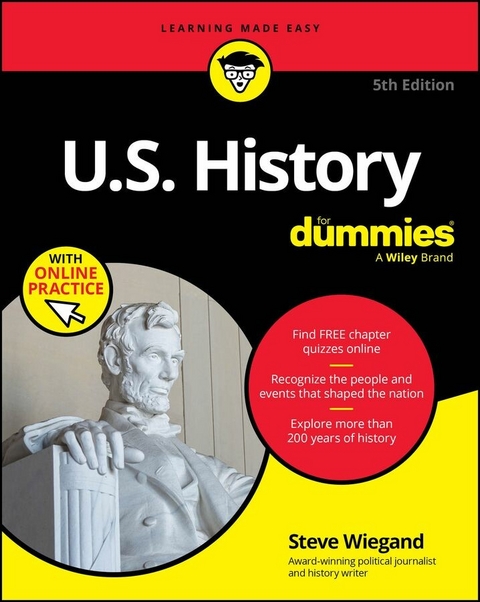
U.S. History For Dummies, 5th Edition (+ Chapter Quizzes Online) (eBook)
566 Seiten
For Dummies (Verlag)
978-1-394-32474-3 (ISBN)
Explore the good, the bad, and the ugly of the United States history
Looking for the essentials of more than 200 years of United States history? Starting at the early civilizations, U.S. History For Dummies covers the growing pains of a new nation. Brush up on the major wars, from fighting against each other to fighting the world. And discover the major people and events that shaped the country. Stay in the know, with coverage of timely topics like climate change, Covid, and the January 6th Capitol riot. Then, when you're ready, challenge yourself with free online chapter quizzes. With history covering the start of the U.S. to the 2024 election, learn how this nation came to be what it is today.
- Read engaging accounts of the major events in the history of the United States
- Learn about important historical figures who shaped the nation
- Discover the background of the big issues that Americans face
- Explore important wars and iconic cultural moments
- FREE 1-year access to chapter quizzes online!
Whether you're a history buff eager to delve into the history of the United States or a student searching for a guide to help them with their studies, U.S. History For Dummies has you covered with clear, easy-to-understand information.
Steve Wiegand is an award-winning political journalist and history writer. Over a 35-year career, he worked as a reporter and columnist at the San Diego Evening Tribune, San Francisco Chronicle, and Sacramento Bee. He is the author or coauthor of 10 books dealing with various aspects of U.S. and world history.
Explore the good, the bad, and the ugly of the United States history Looking for the essentials of more than 200 years of United States history? Starting at the early civilizations, U.S. History For Dummies covers the growing pains of a new nation. Brush up on the major wars, from fighting against each other to fighting the world. And discover the major people and events that shaped the country. Stay in the know, with coverage of timely topics like climate change, Covid, and the January 6th Capitol riot. Then, when you're ready, challenge yourself with free online chapter quizzes. With history covering the start of the U.S. to the 2024 election, learn how this nation came to be what it is today. Read engaging accounts of the major events in the history of the United States Learn about important historical figures who shaped the nation Discover the background of the big issues that Americans face Explore important wars and iconic cultural moments FREE 1-year access to chapter quizzes online! Whether you're a history buff eager to delve into the history of the United States or a student searching for a guide to help them with their studies, U.S. History For Dummies has you covered with clear, easy-to-understand information.
Chapter 1
America: A Short Biography
IN THIS CHAPTER
Tracing America’s roots
Establishing a national identity
Dealing with growing pains
Fighting wars of a different kind
Facing the new millennium
Long before it was a nation, America was an idea, a dream. It didn’t exist as anything but a blank slate waiting to be filled. Eventually, it was filled with people who came for all sorts of reasons and with all sorts of ideas on how to assemble a country. Sometimes, the ideas and the people clashed. But out of the clashes and struggles grew a country founded on a system of government that made it unique in the world.
America was lucky to have great leaders in bad times when it most needed them. It had abundant natural resources, generally peaceable neighbors, and plenty of room to grow. And boy, did it grow. But before all this could happen, someone had to transform it from a fantasy to a very real place. This chapter gives you the lowdown on how that came about and directs you to the places in the book that give you the nitty-gritty in more detail.
They Came, They Saw, They Stayed
The first Americans probably wandered over from Asia about 14,000 years ago, maybe a lot longer. Either way, it was, in geologic terms, an eye-blink ago. Over the succeeding four or five millennia, they spread out over the North and South American continents.
There weren’t a lot of these first Americans, at least not in what became known as the United States of America, but they were wildly diverse in their customs and culture. Many of the differences had to do with the environment in which they settled. Around AD 985, Northern Europeans, popularly known as Vikings, showed up on the North American continent, sticking around only long enough to irritate the Native Americans.
But two things — imagination and greed (not necessarily in that order) — prodded other Europeans into taking their place. Looking for a new route to the riches of the East (particularly spices), explorers such as an Italian weaver’s son named Christopher Columbus thought they might sail west around the globe until they hit Asia. Of course, the Americas got in the way. Rather than reverse course, Columbus and his counterparts refocused their priorities on exploring and exploiting the New World.
The exploiting part included enslaving or killing off the native population. Sometimes, the killing was deliberate; sometimes, it was inadvertent by introducing diseases for which the Native Americans had no defenses. See Chapter 2 for more details on Native Americans and explorers.
Catching up to the Spanish
Spain got a head start in the Americas, mainly because it was the first to get enthusiastic about exploring this New World. But other European countries eventually sought to catch up. France split its efforts between colonizing and just carting off resources like fish and furs. However, the English took steps to make their presence more permanent.
English settlements were founded for both economic and ecclesiastical reasons. In the South, colonists hoped to make money by growing tobacco and, later, cotton. To make their enterprises more profitable, they imported slaves from Africa. It was a practice that would prove far costlier in terms of human misery than the crops were ever worth monetarily.
In the North, settlers who had fled religious persecution established colonies based more on religious principles than making a buck (although they weren’t averse to the latter). Like the Spanish, English settlers often found the easiest way to deal with the Native Americans was to shove them aside or kill them. The English colonies grew rapidly. Chapter 3 has the stories of Pilgrims, Puritans, and entrepreneurs.
It’s revolutionary!
It was probably of small comfort to the Native Americans, but the French and British also spent an inordinate amount of time killing each other. Throughout much of the 18th century, the two nations squared off in a series of wars that were fought in both Europe and the New World. When the dust settled, Britain had cemented its position as the top dog among the European powers in North America. But a new power — whose members increasingly called themselves Americans — was beginning to assert itself. See Chapter 4 for the details.
Stung by slights — both real and imagined — from the mother country, American colonists grew restless under British control. In 1776, after a series of provocations and misunderstandings, the colonies declared themselves independent. The American Revolution took seven years for the colonists to win. To do so took a brilliant leader in George Washington, a timely ally in France, and healthy helpings of tenacity and luck. Chapter 5 has the lowdown on what’s basically the birth of the USA.
Making a country out of the victorious colonies also took tenacity, luck, and genius. Over the summer of 1787, a remarkable group of men gathered in Philadelphia to draw up the rules for the new nation. The United States of America elected Washington as its first president, set up a reasonable financial system, and avoided war with European countries long enough to get itself established. All these events are in Chapter 6.
Putting America on the Map
Thomas Jefferson was a great example of America finding the right man at the right time. He helped the country make a smooth transition from one political party being in charge to another. Plus, he had the imagination to pull off a pretty big land deal — the Louisiana Purchase. That not only doubled the size of the country, it gave Lewis and Clark a good reason for an expedition. Meanwhile, the U.S. Supreme Court asserted itself as a co-equal branch of government. That’s all in Chapter 7, along with fighting pirates and getting into another war with Great Britain.
Nationalizing a nation
The end of the War of 1812 also marked the fading of the Revolution generation. People increasingly began to identify themselves as Americans rather than New Yorkers or Virginians. But it wasn’t the end of tensions among sections of the country when their interests diverged. Those divergent issues included fights over banking, tariffs — and especially slavery.
With the invention of the cotton gin, growing the fiber became quite profitable in the South. Along with a surge in growing sugar, the region became intensely dependent on slave labor. Many people in Northern states opposed slavery for a variety of moral, political, and economic reasons. A fight over the question of allowing slavery to spread was avoided, at least temporarily, with a fragile compromise in 1820.
Beyond its borders, the United States was increasingly alarmed by European nations who were thinking about grabbing former Spanish colonies in Latin America that had recently gained their independence. In 1823, Pres. James Monroe formally warned Europe to keep its hands off the Americas.
Not all the political squabbling was international. In 1824, a crusty military-man-turned-politician, Andrew Jackson, lost a hotly contested and controversial election to John Quincy Adams. In 1828, Jackson avenged the loss after one of the sleaziest campaigns (by both sides) in U.S. history. As president, Jackson found himself confronted by a theory called nullification, which held that states could decide for themselves which federal laws they did and did not have to obey. The theory served to deepen the divide between North and South.
Despite a national recession brought on by speculation and shady financial dealings, Americans were busy coming up with ways to make life better. Improvements in equipment triggered a boom in railroad building. The development of steel plows and rolling harvesters greatly enhanced grain production, and the invention of the telegraph signaled the start of a national communications medium.
Meanwhile, American expatriates in Texas led a successful revolt against Mexico and then waited for nine years to become part of the United States. The annexation of Texas, in turn, helped start another war. Chapter 8 covers this and much more.
Fighting with a neighbor
In 1844, America elected its first dark horse, or surprise, presidential candidate — James K. Polk, a hard worker with a yen to expand the country to the Pacific Ocean by acquiring territory from Mexico. Polk saw it as the nation’s Manifest Destiny.
Mexico saw it as intolerable bullying. After the Mexican government refused to sell, Polk sent U.S. troops to the border. A fight was provoked and quickly escalated into war. The Americans’ rapid and decisive victory resulted in the grabbing of about 500,000 square miles of Mexican territory, comprising much of what became the western United States.
These actions not only fulfilled Polk’s vision of Manifest Destiny but also gave California to America. That addition proved to be particularly fortuitous when gold was discovered there in early 1848. By the end of 1849, the California gold rush had sparked a human stampede and given America all the elbowroom it would need for decades. That was a good thing because immigration was again booming, particularly from Ireland and the European states that would become Germany. However, the acquisition of Mexican territory also renewed the struggle to balance the interests of...
| Erscheint lt. Verlag | 20.3.2025 |
|---|---|
| Sprache | englisch |
| Themenwelt | Sachbuch/Ratgeber ► Geschichte / Politik ► Regional- / Landesgeschichte |
| Geisteswissenschaften ► Geschichte ► Regional- / Ländergeschichte | |
| Schlagworte | 8th grade history • 8th grade us history • American history book dummies • American history books • middle school social studies • us history • us history 101 • us history study guide • us history supplement • us history textbook • us history workbook |
| ISBN-10 | 1-394-32474-X / 139432474X |
| ISBN-13 | 978-1-394-32474-3 / 9781394324743 |
| Informationen gemäß Produktsicherheitsverordnung (GPSR) | |
| Haben Sie eine Frage zum Produkt? |
 EPUB (Adobe DRM)
Kopierschutz: Adobe-DRM
Adobe-DRM ist ein Kopierschutz, der das eBook vor Mißbrauch schützen soll. Dabei wird das eBook bereits beim Download auf Ihre persönliche Adobe-ID autorisiert. Lesen können Sie das eBook dann nur auf den Geräten, welche ebenfalls auf Ihre Adobe-ID registriert sind.
Details zum Adobe-DRM
Dateiformat: EPUB (Electronic Publication)
EPUB ist ein offener Standard für eBooks und eignet sich besonders zur Darstellung von Belletristik und Sachbüchern. Der Fließtext wird dynamisch an die Display- und Schriftgröße angepasst. Auch für mobile Lesegeräte ist EPUB daher gut geeignet.
Systemvoraussetzungen:
PC/Mac: Mit einem PC oder Mac können Sie dieses eBook lesen. Sie benötigen eine
eReader: Dieses eBook kann mit (fast) allen eBook-Readern gelesen werden. Mit dem amazon-Kindle ist es aber nicht kompatibel.
Smartphone/Tablet: Egal ob Apple oder Android, dieses eBook können Sie lesen. Sie benötigen eine
Geräteliste und zusätzliche Hinweise
Buying eBooks from abroad
For tax law reasons we can sell eBooks just within Germany and Switzerland. Regrettably we cannot fulfill eBook-orders from other countries.
aus dem Bereich